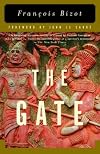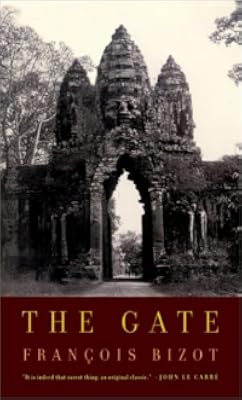
The Gate
by François Bizot
On This Page
Description
"A literary and historical tour de force: what one man saw and did in a land of pristine beauty on the eve of one of the twentieth century's most barbaric spectacles." "In 1971, Francois Bizot was a young French scholar of Khmer pottery and Buddhist ritual working in rural Cambodia. Now, more than thirty years later, he has summoned up the unbearable memory of that moment, letting us see as never before those years leading inexorably to genocide. Perfectly recalled, indelibly written, The show more Gate recounts the nightmare of Bizot's arrest and captivity on suspicion of being an American spy, and his nearly miraculous survival as the only Westerner ever to escape a Khmer Rouge prison. It is the story, as well, of Bizot's unlikely friendship with his captor, Douch - a figure today better remembered as a ruthless perpetrator of the then-looming terror, about which Bizot tried, without success, to warn his government." "Bizot's experience to that point would itself have merited report. But upon his return to Cambodia four years later, chance ordained a second remarkable act in this drama. As the sole individual fluent in both French and Khmer, Bizot found himself playing the intermediary in a surreal standoff when the Communist-backed guerillas now ascendant, laid siege to the French Embassy compound in Phnom Penh. Finally it would fall to Bizot to lead the desperate retreat of the colonial population: here he recounts how he helped the remaining Westerners - and any Cambodians he could - to escape the doomed capital."--BOOK JACKET. show lessTags
Recommendations



















Member Reviews
This is François Bizot's account of his final months in Cambodia in the mid-seventies, first as a prisoner of the Khmer Rouge and then of the days in the French Embassy in Phnom Penh as foreigners and Cambodians took shelter there and how they managed to leave.
Bizot was in Cambodia researching Khmer Buddhist traditions and was traveling around the areas being taken over by the Khmer Rouge with two Cambodian assistants when he was taken by the Khmer military and sent to a prison in the countryside, really just a makeshift camp in the jungle where the prisoners were kept locked in ankle stocks and lying in rows. Because Bizot was too large for the shackles and to keep him isolated, he was chained up near the entrance to the camp. His show more main interactions were with the camp leader, a man who would later be infamous for being in charge of torture, but with whom Bizot formed a sort of relationship, one that led to him finally being released a few months later. Back in Phnom Penh, he takes shelter in the French embassy and given his fluency in Khmer, he soon took on a leadership position. He's also one of the few willing to venture out of the embassy in search of the foreigners who chose not to come to the embassy earlier or to search for supplies. Eventually, a risky exit is planned, a logistical nightmare involving moving over a thousand people through Khmer-held territory into Thailand.
Bizot is not a likeable man and it's to his credit that he makes no attempt to make himself so. He's arrogant and he holds attitudes and ideas about the Cambodians, and especially a fetishization of the women, that he might be encouraged to examine and rethink today, but that doesn't change the value of this document of an important and terrifying time in history. show less
Bizot was in Cambodia researching Khmer Buddhist traditions and was traveling around the areas being taken over by the Khmer Rouge with two Cambodian assistants when he was taken by the Khmer military and sent to a prison in the countryside, really just a makeshift camp in the jungle where the prisoners were kept locked in ankle stocks and lying in rows. Because Bizot was too large for the shackles and to keep him isolated, he was chained up near the entrance to the camp. His show more main interactions were with the camp leader, a man who would later be infamous for being in charge of torture, but with whom Bizot formed a sort of relationship, one that led to him finally being released a few months later. Back in Phnom Penh, he takes shelter in the French embassy and given his fluency in Khmer, he soon took on a leadership position. He's also one of the few willing to venture out of the embassy in search of the foreigners who chose not to come to the embassy earlier or to search for supplies. Eventually, a risky exit is planned, a logistical nightmare involving moving over a thousand people through Khmer-held territory into Thailand.
Bizot is not a likeable man and it's to his credit that he makes no attempt to make himself so. He's arrogant and he holds attitudes and ideas about the Cambodians, and especially a fetishization of the women, that he might be encouraged to examine and rethink today, but that doesn't change the value of this document of an important and terrifying time in history. show less
Intriguing memoir of a French academic caught up in the Khmer Rouge uprising. Bizot found himself taken as a prisoner by the Communist forces and, following his release, central to events at the French Embassy. Bizot has an alternative world view and his straight faced disbelieve is at times comical. He is honest to the point of being painful. Unfortunately the pacing is uneven at times and the jumble of events and names can become confusing. This does not lessen the emotional impacts which come thick and fast. Bizot is capable of beautiful prose and his idiosynchratic telling of this tale fits the oddness within it very well.
Francois Bizot is one of the only westerners to survice the Khmer Rouge camps in Cambodia. His account of his time in captivity is terrifying and completely enthralling. This is one of those stories that would be unbelievable if it weren't true.
This book is dated and a little too self-absorbed to be truly illuminating about pre-Khmer Rouge Cambodia and Duch, the cadre who became the director of S-21 (Tuol Sleng) and one of the architects of the Cambodian genocide. Much better is journalist [a:Thierry Cruvellier|3427766|Thierry Cruvellier|https://s.gr-assets.com/assets/nophoto/user/u_50x66-632230dc9882b4352d753eedf9396530.png]'s [b:The Master of Confessions: The Making of a Khmer Rouge Torturer|18513484|The Master of Confessions The Making of a Khmer Rouge Torturer|Thierry Cruvellier|https://s.gr-assets.com/assets/nophoto/book/50x75-a91bf249278a81aabab721ef782c4a74.png|26311026]. Yet it is a glimpse of Duch as well as life inside the prison. There are some beautifully rendered show more moments, like this description:
The man who spoke had the black skin of the Khmers, very dark and coppery. He had a hard look, square jaw, short teeth, like small, worn blocks, and the three furrows in his neck, stacked horizontally, so characteristic and so elegant in young women that they used to represent one of the hieratic attributes of beauty in wall paintings. Beneath his open shirt you could see the ritual tattoos. He wore a mass of necklaces, adorned with Buddhas, tigers' teeth, and amulets, which we were to hear clinking together protectively throughout the night. show less
The man who spoke had the black skin of the Khmers, very dark and coppery. He had a hard look, square jaw, short teeth, like small, worn blocks, and the three furrows in his neck, stacked horizontally, so characteristic and so elegant in young women that they used to represent one of the hieratic attributes of beauty in wall paintings. Beneath his open shirt you could see the ritual tattoos. He wore a mass of necklaces, adorned with Buddhas, tigers' teeth, and amulets, which we were to hear clinking together protectively throughout the night. show less
Unlike many memoirists of the Cambodian civil war, Bizot was an adult and not Cambodian. In fact, he was the only foreigner actually detained by the Khmer Rouge who survived the experience. This was in the early years of their insurgency and is detailed in first part of the book; the second half has elements that are more familiar to the reader of histories and memoirs of this era and describes his experiences inside the French compound after the fall of Phnom, Penh.
Bizot's child figures prominently, though always as an absent figure; her mother, a Cambodian, is even further removed from the narrative. The time jump between sections is disconcerting and lends a fragmented air to the book. Since Bizot worked with ancient Buddhist texts show more and objects, perhaps this is deliberate parallelism. Read with one of the Cambodian narratives of the Khmer Rouge period, with Swain's [b:The River of Time|228665|The Eye of the World (The Wheel of Time, Book 1)|Robert Jordan|http://photo.goodreads.com/books/1172889531s/228665.jpg|2008238] and the film The Killing Fields for a rounded description of the foreign experience prior to evacuation. show less
Bizot's child figures prominently, though always as an absent figure; her mother, a Cambodian, is even further removed from the narrative. The time jump between sections is disconcerting and lends a fragmented air to the book. Since Bizot worked with ancient Buddhist texts show more and objects, perhaps this is deliberate parallelism. Read with one of the Cambodian narratives of the Khmer Rouge period, with Swain's [b:The River of Time|228665|The Eye of the World (The Wheel of Time, Book 1)|Robert Jordan|http://photo.goodreads.com/books/1172889531s/228665.jpg|2008238] and the film The Killing Fields for a rounded description of the foreign experience prior to evacuation. show less
I enjoyed reading this one at the time - Cambodia and the Khmer Rouge are topics I know little about - but the more I thought about it afterwards, the more Bizot's attitudes towards some of the characters (and his Cambodian wife specifically) all seemed a bit odd. Regardless, it's an amazing portrait of a dark period of history.
Had to bail. Gave it 100 pages. Could not get into it at all...
Members
- Recently Added By
Author Information

Francois Bizot is the Director of Studies at the Ecole Pratique des Hautes-etudes and holds the chair in Southeast Asian Buddhism at the Sorbonne.
Some Editions
Awards and Honors
Series
Belongs to Publisher Series
Gallimard, Folio (3606)
Common Knowledge
- Canonical title*
- Le portail
- Original title
- Le portail
- Original publication date
- 2001
- Important places
- Cambodia
- Original language*
- Français
*Some information comes from Common Knowledge in other languages. Click "Edit" for more information.
Classifications
- Genres
- Nonfiction, Biography & Memoir, History, General Nonfiction
- DDC/MDS
- 959.604 — History & geography History of Asia Southeast Asia: Myanmar, Thailand, Laos, Cambodia, Vietnam Cambodia 1949-
- LCC
- DS554.8 .B6513 — History of Europe, Asia, Africa and Oceania Asia History of Asia Southeast Asia French Indochina Cambodia
- BISAC
Statistics
- Members
- 440
- Popularity
- 70,088
- Reviews
- 9
- Rating
- (3.92)
- Languages
- 7 — Danish, Dutch, English, French, Italian, Spanish, Swedish
- Media
- Paper, Ebook
- ISBNs
- 19
- ASINs
- 4