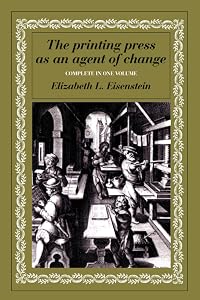
The printing press as an agent of change
by Elizabeth L. Eisenstein
On This Page
Description
Originally published in two volumes in 1980, The Printing Press as an Agent of Change is now issued in a paperback edition containing both volumes. The work is a full-scale historical treatment of the advent of printing and its importance as an agent of change. Professor Eisenstein begins by examining the general implications of the shift from script to print, and goes on to examine its part in three of the major movements of early modern times - the Renaissance, the Reformation, and the show more rise of modern science. show lessTags
Recommendations












































Member Reviews
This is a magisterial study, and the first major one, of the impact the printing press made on its introduction to Europe. Essential reading for anyone who wants to learn about the differences between print and manuscript culture.
Cited in "the information" by James Gleick
Ratings
Members
- Recently Added By
Lists

Books in the Bibliography of Contested Continent by Peter Mancall
495 works; 1 member
Author Information

14+ Works 1,267 Members
Elizabeth L. Eisenstein was born Elizabeth Ann Lewisohn on October 11, 1923 in Manhattan, New York. She received a bachelor's degree from Vassar College in 1944 and master's and doctoral degrees in history from Harvard University. She taught at American University in Washington before joining the faculty at the University of Michigan, where she show more taught until her retirement in 1988. She wrote several books during her lifetime including The Printing Press as an Agent of Change: Communications and Cultural Transformations in Early Modern Europe, The First Professional Revolutionist, Grub Street Abroad: Aspects of the French Cosmopolitan Press From the Age of Louis XIV to the French Revolution, and Divine Art, Infernal Machine: The Reception of Printing in the West from First Impressions to the Sense of an Ending. She died on January 31, 2016 at the age of 92. (Bowker Author Biography) show less
Awards and Honors
Awards
Work Relationships
Is abridged in
Common Knowledge
- Canonical title
- The printing press as an agent of change
- Original title
- The printing press as an agent of change: communications and cultural transformations in early-modern Europe
- Original publication date
- 1979 (1st original US publishing, Cambridge university press) (1st original US publishing, Cambridge university press)
- People/Characters
- Johannes Gutenberg (1394/99-c.1468); Robert Estienne; Badius; Johann Fust; Elsevier; Aldus Pius Manutius (1449/52-1515) (show all 9); Christoffel Plantijn (as Christopher Plantin); William Caxton (c.1422-1491); Albrecht Pfister
- Important places
- Mainz, Rhineland-Palatinate, Germany; Basel, Basel-Stadt, Switzerland; Leiden, South Holland, Netherlands; Strassbourg, Grand-Est, France; Paris, France; Venice, Veneto, Italy (show all 7); Amsterdam, North Holland, Netherlands
- Dedication
- To the memory of
John Eisenstein 1953-1974 - First words
- This book has been composed over the course of some fifteen years.
- Last words
- (Click to show. Warning: May contain spoilers.)Of them all none seems more important than seeing how many of the facts of life that are presently being kept apart actually belong together.
Classifications
- Genres
- Nonfiction, History, General Nonfiction, Religion & Spirituality, Technology
- DDC/MDS
- 686.2 — Applied science & technology Manufacture for specific uses Printing and related activities Printing
- LCC
- Z124 .E37 — Bibliography, Library Science and Information Resources Book industries and trade History
- BISAC
Statistics
- Members
- 422
- Popularity
- 73,823
- Reviews
- 3
- Rating
- (4.45)
- Languages
- English, French, German, Italian
- Media
- Paper, Ebook
- ISBNs
- 10
- ASINs
- 2