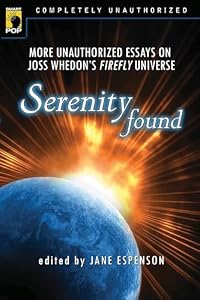
Serenity Found: More Unauthorized Essays on Joss Whedon's Firefly Universe
by Jane Espenson (Editor)
On This Page
Description
A lot has happened since Finding Serenity. We learned River's secret; Mal took on the Alliance. Our favorite crew became Big Damn Heroes. And the Browncoats proved that hard work, passion and a little fan coordination can do the impossible. Serenity Found takes the contents of Finding Serenity even further, exploring not just the show but the events of the film as well, to create an anthology that's even more thought-provoking, fascinating and far-thinking than its predecessor. * Acclaimed show more science fiction author Orson Scott Card lauds "Serenity" as film sci-fi finally done right * Writer and comedian Natalie Haynes reveals the real feminist savvy of the "Firefly" universe: the girls get the guns and the gags * Pop culture critic Michael Marano connects damaged, ass-kicking River to the other weaponized women of the Whedonverse * Multiverse executive producer Corey Bridges explains why the world of "Firefly" is the perfect setting for an MMORPG * Mutant Enemy's visual effects wizard Loni Peristere relates what he's learned from Joss about telling stories, and tells a story of his own about Serenity's design * Television Without Pity recapper Jacob Clifton frames "Serenity" as a parable about media: how it controls us, how we can control it and how to separate the signal from the noise * And Nathan Fillion, "Firefly" and "Serenity's" Captain Malcolm Reynolds, shares his affinity for Mal and his love of Mal's ship and crew. show lessTags
Recommendations

Member Recommendations
Member Reviews
The Book Report: Eighteen more essays about the moral, political, and ethical underpinnings, implications, and effects of the late, lamented "Firefly" TV series.
My Review: Last collection had yummy-yummy Jewel Staite, aka Kaylee, writing about her favorite things in each episode; this collection has the slurpsome Nathan Fillion reflecting on being the Captain! For that alone, it's worth the price of admission!
But wait! There's more! Loni Peristere (also a beauteous hunk of man-flesh, maybe Joss is a switch-hitter? All the men in the 'verse are so toothsome!), the f/x wizard behind the whole Whedonesque world, talks about the amazing and exacting Creator in terms of inspiring the best work from Loni and his minions, an essay that made show more me even angrier at the business-sound-but-aesthetically-idiotic cancellation of "Firefly". Then one Geoff Klock pulls apart and analyzes the brilliant, brilliant episode "Out of Gas", in search of storytelling genius and its telltale markers; there are many, and they are important for anyone interested in storytelling craft to study in depth. This essay makes that process almost easy, which is in itself a feat of storytelling.
Bruce Bethke's essay, "Cut 'Em Off At The Horsehead Nebula!", goes into the whys and wherefores of the SFnal aversion to Western tropes invading "its" territory, rooted in the pulp origins of SF, and its early competition with Western pulps for writers and readers. One can still hear nasty, condescending echoes of the war, which SF **won** and could and should drop, in the covert critical reception of "Firefly" as a damned Bat Durston story. Read the essay, I ain't explainin' that one. Too long, and also it pisses me the hell off.
My personal favorite essay is "The Bonnie Brown Flag", relating the "Firefly" underpinnings to the American Civil War's myth of the Noble Losers, the Gentleman Planters following the Bonnie Blue Flag. It's poignant, it's well crafted, and it's quite nicely argued.
The only essay that's a real flop is "The Virtual 'Verse", which was a waaay premature ad for the dead-in-the-water MMORPG of "Firefly" that was, at that time, being touted as forthcoming. Well, it never forthcame, and the essay looks like what it was: Blatant product placement. Ptui.
But then comes what I think is the most important essay: "The Alliance's War on Science" by Ken Wharton. Ten pages of keen observation on the nature of political propaganda masquerading as science. Again, if all you read is this one essay, your purchase price will be fully amortized. The subject is ever-more important, and this essay will sensitize you to the issue like never before.
Just like "Firefly" would have, had it survived intact to this good day. Next best thing is buying BenBella Books's essay collections. And, of course, reading them with the starved passion of a jilted lover. Or is it just me...? show less
My Review: Last collection had yummy-yummy Jewel Staite, aka Kaylee, writing about her favorite things in each episode; this collection has the slurpsome Nathan Fillion reflecting on being the Captain! For that alone, it's worth the price of admission!
But wait! There's more! Loni Peristere (also a beauteous hunk of man-flesh, maybe Joss is a switch-hitter? All the men in the 'verse are so toothsome!), the f/x wizard behind the whole Whedonesque world, talks about the amazing and exacting Creator in terms of inspiring the best work from Loni and his minions, an essay that made show more me even angrier at the business-sound-but-aesthetically-idiotic cancellation of "Firefly". Then one Geoff Klock pulls apart and analyzes the brilliant, brilliant episode "Out of Gas", in search of storytelling genius and its telltale markers; there are many, and they are important for anyone interested in storytelling craft to study in depth. This essay makes that process almost easy, which is in itself a feat of storytelling.
Bruce Bethke's essay, "Cut 'Em Off At The Horsehead Nebula!", goes into the whys and wherefores of the SFnal aversion to Western tropes invading "its" territory, rooted in the pulp origins of SF, and its early competition with Western pulps for writers and readers. One can still hear nasty, condescending echoes of the war, which SF **won** and could and should drop, in the covert critical reception of "Firefly" as a damned Bat Durston story. Read the essay, I ain't explainin' that one. Too long, and also it pisses me the hell off.
My personal favorite essay is "The Bonnie Brown Flag", relating the "Firefly" underpinnings to the American Civil War's myth of the Noble Losers, the Gentleman Planters following the Bonnie Blue Flag. It's poignant, it's well crafted, and it's quite nicely argued.
The only essay that's a real flop is "The Virtual 'Verse", which was a waaay premature ad for the dead-in-the-water MMORPG of "Firefly" that was, at that time, being touted as forthcoming. Well, it never forthcame, and the essay looks like what it was: Blatant product placement. Ptui.
But then comes what I think is the most important essay: "The Alliance's War on Science" by Ken Wharton. Ten pages of keen observation on the nature of political propaganda masquerading as science. Again, if all you read is this one essay, your purchase price will be fully amortized. The subject is ever-more important, and this essay will sensitize you to the issue like never before.
Just like "Firefly" would have, had it survived intact to this good day. Next best thing is buying BenBella Books's essay collections. And, of course, reading them with the starved passion of a jilted lover. Or is it just me...? show less
As I said in my review for the book, I thought Finding Serenity was hit-and-miss at best. There were several good essays, but those were almost all on feminism, and many of the others simply complained about the show being cancelled.
This book is what I wanted Finding Serenity to be. This collection of essays is first rate, almost without exception. There was only one essay I did not like (it was actually unreadable it was so bad), but the rest were interesting and informative.
Instead of all focusing on feminism, this collection addresses a very wide range of topics, touching on many of the complexities of the Firefly universe. Browncoats should be sure to grab this one!
This book is what I wanted Finding Serenity to be. This collection of essays is first rate, almost without exception. There was only one essay I did not like (it was actually unreadable it was so bad), but the rest were interesting and informative.
Instead of all focusing on feminism, this collection addresses a very wide range of topics, touching on many of the complexities of the Firefly universe. Browncoats should be sure to grab this one!
We all know that Firefly and Serenity has a cult following. There shouldn’t be any surprise then that people have studied what can be found in the series and movie, have taken it apart piece by piece to evaluate what made it so good and so loved. And some of these essays can be found in Serenity Found.
This is actually the second book of essays on Firefly that this publisher released. I decided to pick up the second book of essays before the first (Finding Serenity) because I knew more of the authors who contributed to it.
Included in this book are the following essays:
Catching Up with the Future (Orson Scott Card)
Mars Needs Women (Maggie Burns)
Girls, Guns, Gags (Natalie Haynes)
River Tam and the Weaponized Women of the Whedonverse show more (Michael Marano)
I, Malcolm (Nathan Fillion)
Freedom in an Unfree World (P. Gardner Goldsmith)
A Tale of Two Heroes (Shanna Swendson)
The Good Book (Eric Greene)
Mal Contents (Alex Bledsoe)
Curse Your Sudden But Inevitable Betrayal (Lani Diane Rich)
Mutant Enemy U (Loni Peristere)
Geeks of the World, Unite! (Natasha Giardina)
The Alliance’s War on Science (Ken Wharton)
The Virtual ‘Verse (Corey Bridges)
Firefly and Story Structure, Advanced (Geoff Klock)
Cut ‘Em Off at the Horsehead Nebula! (Bruce Bethke)
The Bonnie Brown Flag (Evelyn Vaughn)
Signal to Noise (Jacob Clifton)
The Response
As with any collection of essays (or even collections of short stories, for that matter), there are some wonderful ones, some mediocre ones, and some that weren’t (for one reason or another) very interesting at all. I’m going to focus mainly on the wonderful ones, as the ones I didn’t enjoy weren’t because they weren’t GOOD, it’s because they were about stuff that didn’t interest me (such as gaming) – and I really am not qualified to say anything on subjects such as those as I don’t know anything about them.
“I, Malcolm” is the inclusion from out wonderful Captain Tightpants himself, Nathan Fillion. His essay, while short, is as humorous as you would come to expect from Fillion. (If you don’t know what his sense of humour is like, I highly recommend that you check out his Twitter account.) And he tells us what it was like to be Malcolm Reynolds.
One of my fave chicklit authors, Shanna Swendson, wrote “A Tale of Two Heroes.” In this, she takes a look at the hero myth (a favourite story type of mine), and explores how both Mal and Simon are the heroes of the show. As someone who was never particularly fond of Simon, this idea has really made me curious about watching the show again to see if I can pick up on what Swendson mentioned.
“Firefly and Story Structure, Advanced” was my favourite essay in the collection. In this essay, the best episode in the series, “Out of Gas” is taken apart scene by scene and we are taken through the transitions, and how the show is, in essence, a love story between a man and his ship.
In “The Bonnie Brown Flag” Evelyn Vaughn compared Firefly and Serenity to the American Civil War, the old south, issues with slavery, etc. In fact, it even brought in Margaret Mitchell’s Gone with the Wind (and anything that quotes Rhett Butler is bound to be good, in my opinion). In some aspects, the war between the Alliance and the Independents is quite similar – especially in how the losing side reacts to the winning side. But one of the largest differences between the two is the slavery issue: one of the causes of the American Civil War was due to slavery in the south, and the abolishment of it, but in Firefly and Serenity, slavery had no cause in the war. In fact, after the war, the Alliance still uses what amounts to slavery in some worlds.
These were, in my opinion, the best inclusions in the collection. That’s not to say they others weren’t that great, but these are the ones that stood out the most to me. Other essays take a look at the special effects of the show and movie, various characters, how the movie is an allusion to the media, etc. There’s definitely something here for all browncoats.
The Bottom Line
Will be following this up at some point in time with the first book of essays. Definitely recommended to any browncoat. show less
This is actually the second book of essays on Firefly that this publisher released. I decided to pick up the second book of essays before the first (Finding Serenity) because I knew more of the authors who contributed to it.
Included in this book are the following essays:
Catching Up with the Future (Orson Scott Card)
Mars Needs Women (Maggie Burns)
Girls, Guns, Gags (Natalie Haynes)
River Tam and the Weaponized Women of the Whedonverse show more (Michael Marano)
I, Malcolm (Nathan Fillion)
Freedom in an Unfree World (P. Gardner Goldsmith)
A Tale of Two Heroes (Shanna Swendson)
The Good Book (Eric Greene)
Mal Contents (Alex Bledsoe)
Curse Your Sudden But Inevitable Betrayal (Lani Diane Rich)
Mutant Enemy U (Loni Peristere)
Geeks of the World, Unite! (Natasha Giardina)
The Alliance’s War on Science (Ken Wharton)
The Virtual ‘Verse (Corey Bridges)
Firefly and Story Structure, Advanced (Geoff Klock)
Cut ‘Em Off at the Horsehead Nebula! (Bruce Bethke)
The Bonnie Brown Flag (Evelyn Vaughn)
Signal to Noise (Jacob Clifton)
The Response
As with any collection of essays (or even collections of short stories, for that matter), there are some wonderful ones, some mediocre ones, and some that weren’t (for one reason or another) very interesting at all. I’m going to focus mainly on the wonderful ones, as the ones I didn’t enjoy weren’t because they weren’t GOOD, it’s because they were about stuff that didn’t interest me (such as gaming) – and I really am not qualified to say anything on subjects such as those as I don’t know anything about them.
“I, Malcolm” is the inclusion from out wonderful Captain Tightpants himself, Nathan Fillion. His essay, while short, is as humorous as you would come to expect from Fillion. (If you don’t know what his sense of humour is like, I highly recommend that you check out his Twitter account.) And he tells us what it was like to be Malcolm Reynolds.
One of my fave chicklit authors, Shanna Swendson, wrote “A Tale of Two Heroes.” In this, she takes a look at the hero myth (a favourite story type of mine), and explores how both Mal and Simon are the heroes of the show. As someone who was never particularly fond of Simon, this idea has really made me curious about watching the show again to see if I can pick up on what Swendson mentioned.
“Firefly and Story Structure, Advanced” was my favourite essay in the collection. In this essay, the best episode in the series, “Out of Gas” is taken apart scene by scene and we are taken through the transitions, and how the show is, in essence, a love story between a man and his ship.
In “The Bonnie Brown Flag” Evelyn Vaughn compared Firefly and Serenity to the American Civil War, the old south, issues with slavery, etc. In fact, it even brought in Margaret Mitchell’s Gone with the Wind (and anything that quotes Rhett Butler is bound to be good, in my opinion). In some aspects, the war between the Alliance and the Independents is quite similar – especially in how the losing side reacts to the winning side. But one of the largest differences between the two is the slavery issue: one of the causes of the American Civil War was due to slavery in the south, and the abolishment of it, but in Firefly and Serenity, slavery had no cause in the war. In fact, after the war, the Alliance still uses what amounts to slavery in some worlds.
These were, in my opinion, the best inclusions in the collection. That’s not to say they others weren’t that great, but these are the ones that stood out the most to me. Other essays take a look at the special effects of the show and movie, various characters, how the movie is an allusion to the media, etc. There’s definitely something here for all browncoats.
The Bottom Line
Will be following this up at some point in time with the first book of essays. Definitely recommended to any browncoat. show less
It's amazing that a quickly canceled TV show and a single movie could spawn not one, but two essay collections. And even more amazing that the second batch is actually pretty good. Whether you are looking for a feminist take, or you are interested in the parallels between the Alliance and the Union in the Civil War, you will find something to interest you in this book. Plus, for all you fans out there, there's a short piece by Malcolm Reynolds himself, Nathan Fillion. Not all essays are winners, but there's more than enough to make the book worth it.
I give a full review over at The Mongrel Dogs Who Teach [http://www.adfinemfidelis.net/mongrel/2008/07/16/review-serenity-found/]
paperback
Members
- Recently Added By
Lists

Noriu perskaityti
33 works; 1 member
Author Information

Jane Espenson has written for Buffy the Vampire Slayer, Angel, Firefly, The O.C., Gilmore Girls, Dollhouse, Battlestar Galactica, Caprica, and A Game of Thrones, among other series. She also co-wrote and executive produced the Emmy-nominated Battlestar webisodes and co-created Syfy's Warehouse 13. She is currently delighted and proud to be a new show more member of the Torchwood writing staff. show less
All Editions
Series
Belongs to Publisher Series
Common Knowledge
Classifications
- Genres
- Nonfiction, Literature Studies and Criticism
- DDC/MDS
- 791.4572 — Arts & recreation Recreation, sports, and performing arts Movies, TV, Video Motion pictures, radio, television, podcasting Television Programs; television plays Single programs
- LCC
- PN1992.77 .F54 .S47 — Language and Literature Literature (General) Literature (General) Drama Broadcasting Television broadcasts
- BISAC
Statistics
- Members
- 321
- Popularity
- 98,838
- Reviews
- 7
- Rating
- (3.90)
- Languages
- English
- Media
- Paper, Audiobook, Ebook
- ISBNs
- 2
- ASINs
- 2