On This Page
Description
When the quiet and responsible Leonard Trader and the wild and reckless Johnny Delvin wake up in each other's bodies, Trader is left to try to patch together Devlin's shattered and hopeless life.Tags
Recommendations




























Member Reviews
There is no better author writing Urban Fantasy than [[Charles de Lint]]. In this entry in the Newford cannon, Max Trader wakes up in a different body, his life stolen by an interloper inhabiting his body. The questions and ramifications of identity go much deeper than any teenie Disney treatment. Max must learn who he is, in his heart, in order to successfully maneuver the world in another person's meat suit, and without that knowledge he has little hope of navigating back to his former life and body. In fact, the point for Max is that his former life was so vacant as to be vulnerable to theft by another. For de Lint fans, there's plenty of Newford's mysticism and spirituality.
Highly recommended.
5 bones!!!!!
Highly recommended.
5 bones!!!!!
When Max Trader wakes up in the body of Johnny Devlin, a man he has never met, he can not believe that his comfortable life has been usurped by a loser who is just about to get evicted for non-payment of rent. But Max lives in Newford where the threshold of the world of spirits that most people only visit in their dreams is easily breached, and the street people are closer to the liminal zone than most, so when he finds himself living in a park with a stray dog, his new friends and the real Johnny's not so friendly acquaintances help him come to terms with what has happened and decide what to do about it.
One thing that has sometimes irritated me about Charles de Lint is the idea that apart from street people it is only creative types show more like artists and musicians who are going to have otherworldly experiences. In this book however, although Max Trader is a master craftsman, a successful and well-respected luthier, it is not the creative side of his life that left him vulnerable to the body swap, but his social isolation and lack of connection with other people. The charming but feckless Johnny Devlin just went to bed wishing that his problems would all go away, and once he had Max's comfortable apartment and his bank accounts, he didn't want to let them go.
I thought that this book was a bit too long and could have done with having a few less characters; if the author had thought up a different way for Nia to meet up with the real Max, he could have dispensed with Nia's mother Lisa and her relationship with Julie altogether. I found them the least convincing characters, and leaving out their story would probably have knocked 50 or so pages off the length. show less
One thing that has sometimes irritated me about Charles de Lint is the idea that apart from street people it is only creative types show more like artists and musicians who are going to have otherworldly experiences. In this book however, although Max Trader is a master craftsman, a successful and well-respected luthier, it is not the creative side of his life that left him vulnerable to the body swap, but his social isolation and lack of connection with other people. The charming but feckless Johnny Devlin just went to bed wishing that his problems would all go away, and once he had Max's comfortable apartment and his bank accounts, he didn't want to let them go.
I thought that this book was a bit too long and could have done with having a few less characters; if the author had thought up a different way for Nia to meet up with the real Max, he could have dispensed with Nia's mother Lisa and her relationship with Julie altogether. I found them the least convincing characters, and leaving out their story would probably have knocked 50 or so pages off the length. show less
Max Trader is a luthier who wakes up one morning in a body not his own. After the initial panic and a little further investigation, Trader finds out that charming, womanizing rake, Johnny Devlin, has wished for a different life and somehow they have traded bodies. Devlin has no intention of trying to switch back. He gets a fresh start while Trader tries to navigate his way through the wreckage of Johnny's life. While learning about Johnny, though, Devlin learns a few things about his own life and how he needs to start living as large as trees, to paraphrase.
Characters, characters, characters. What draws me to Charles de Lint are his characters, and he did not disappoint with this one. Trader is a mild-mannered kind of guy, mostly show more forgettable except for his talent, but he's willing to learn from this unbelievable experience he has. He learns to live his life to the fullest and not take a single day for granted.
So that one's obvious. What makes this a de Lint book is that even the secondary characters grow and learn and change. Trader and Devlin's switch is like a stone thrown into a still pond: the effects ripple out in ways that you don't see coming. Even minor characters learn self-acceptance, the value of having your own life outside of a relationship, acceptance of others, forgiveness, open-mindedness and all kinds of Important Life Lessons. I've loaned out my copy already or I would throw out a couple of quotes that sum all of this up much better than I can. Expect to see a revised version of this review when I get my copy back.
Finally got it back!
"The thing to do is to be happy with yourself, with what's in your own life; then if a relationship comes along it's a bonus, something to enjoy instead of the thing your life revolves around."
"Look inside yourself for the answers--you're the only one who knows what's best for you. Everybody else is only guessing."
What kept this from being five stars are two of the characters who actually grow the most. They were the whiniest women I have read about in a long time. Oh, they felt real alright. I know plenty of women who moan on and on and on about their boyfriends, the lack of, or the fact that they need a life apart from. They are not women I want to spend time with, either in books or in real life. I have very little tolerance for that kind of thing. It's an important lesson to get out there, but spare me. Please.
What's a little unusual about this novel is that there isn't really a bad guy. Devlin's not anyone's idea of a nice guy, but the real antagonists are apathy, inertia, missed opportunities, wasted talent, and a lack of self-awareness. Devlin's actually sort of the poster child for the "wherever you go, there you are" theme running through the book. He gets a new life, but he's unwilling to change and makes the same old mistakes all over again.
This falls pretty early in the Newford books, which I will still maintain that you don't have to read in order, but it was pretty cool to go back and read an early book and see how the regulars were doing back then. I finally know who Tanya is and how she and Geordie meet, and I finally realize that there are hints of Jilly's [b:The Onion Girl (Newford, Book 11)|543343|The Onion Girl (Newford, Book 11) |Charles de Lint|http://photo.goodreads.com/books/1175655444s/543343.jpg|2570632] trials this early.
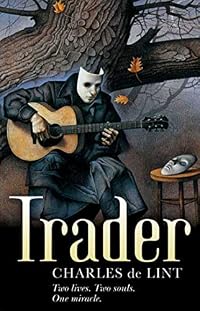
On a side note, I adore the cover art that John Jude Palancar creates for de Lint's books.
Anyway, this is a great example of why Charles de Lint is my favorite author. He tells a great story with an important message without being preachy, all while creating characters who honestly feel like old friends to me at this point. Reading this one has given me the urge to go on a Newford re-reading binge. Highly recommended. show less
Characters, characters, characters. What draws me to Charles de Lint are his characters, and he did not disappoint with this one. Trader is a mild-mannered kind of guy, mostly show more forgettable except for his talent, but he's willing to learn from this unbelievable experience he has. He learns to live his life to the fullest and not take a single day for granted.
So that one's obvious. What makes this a de Lint book is that even the secondary characters grow and learn and change. Trader and Devlin's switch is like a stone thrown into a still pond: the effects ripple out in ways that you don't see coming. Even minor characters learn self-acceptance, the value of having your own life outside of a relationship, acceptance of others, forgiveness, open-mindedness and all kinds of Important Life Lessons. I've loaned out my copy already or I would throw out a couple of quotes that sum all of this up much better than I can. Expect to see a revised version of this review when I get my copy back.
Finally got it back!
"The thing to do is to be happy with yourself, with what's in your own life; then if a relationship comes along it's a bonus, something to enjoy instead of the thing your life revolves around."
"Look inside yourself for the answers--you're the only one who knows what's best for you. Everybody else is only guessing."
What kept this from being five stars are two of the characters who actually grow the most. They were the whiniest women I have read about in a long time. Oh, they felt real alright. I know plenty of women who moan on and on and on about their boyfriends, the lack of, or the fact that they need a life apart from. They are not women I want to spend time with, either in books or in real life. I have very little tolerance for that kind of thing. It's an important lesson to get out there, but spare me. Please.
What's a little unusual about this novel is that there isn't really a bad guy. Devlin's not anyone's idea of a nice guy, but the real antagonists are apathy, inertia, missed opportunities, wasted talent, and a lack of self-awareness. Devlin's actually sort of the poster child for the "wherever you go, there you are" theme running through the book. He gets a new life, but he's unwilling to change and makes the same old mistakes all over again.
This falls pretty early in the Newford books, which I will still maintain that you don't have to read in order, but it was pretty cool to go back and read an early book and see how the regulars were doing back then. I finally know who Tanya is and how she and Geordie meet, and I finally realize that there are hints of Jilly's [b:The Onion Girl (Newford, Book 11)|543343|The Onion Girl (Newford, Book 11) |Charles de Lint|http://photo.goodreads.com/books/1175655444s/543343.jpg|2570632] trials this early.
On a side note, I adore the cover art that John Jude Palancar creates for de Lint's books.
Anyway, this is a great example of why Charles de Lint is my favorite author. He tells a great story with an important message without being preachy, all while creating characters who honestly feel like old friends to me at this point. Reading this one has given me the urge to go on a Newford re-reading binge. Highly recommended. show less
This review and others posted over at my blog.
I’m a big fan of de Lint. He’s one of the authors whose work I hoard (and sadly am very behind in reading) so it’s not surprising to me that I really enjoyed this book. He’s excellent at writing urban fantasy with a Native American twist. Trader, like many of his novels, is set in the fictional town of Newford, where the barrier between “our world” and the spirit world seems to be pretty thin. Many of his characters pop in and out of each other’s stories, so there were a few I recognized.
Max isn’t a character I recognized (though my memory is shit, so it’s possible I’ve come across him in other Newford novels and simply forgot), but he’s one I quickly came to enjoy. show more This book is told from multiple points of view, but Max is the only one with a first-person perspective. Sometimes the change in perspectives screws with me, but in this case, I think it gave a lot of depth to Max’s character. His voice was stronger than the others and, given that he wakes up in another man’s body and is stuck in his life, it makes sense.
The rest of the story is primarily told through the eyes of the female characters in both men’s lives. There’s Nia and her mother Lisa, Max’s neighbors; Zeffy and her roommate Tanya, Johnny’s enemy and ex-girlfriend respectively; and Jilly Coppercorn (one of my favorite Newford characters – please go read The Onion Girl immediately) who works with Zeffy and Tanya and is no stranger to the…spiritual…side of the city. These ladies are all well-developed with clear voices.
De Lint is one of those authors who gives a description of his characters when they come on the scene. As you might be aware, I’m really growing out of this. I don’t mind a little description, but it gets tiring to get the run-down of every character – it pulls me out of the story. Fortunately, once he lets you know what they look like, he really doesn’t mention it again. Except, in this case, for Zeffy. I got tired of hearing about how beautiful she was with her curly red hair, freckles and darker skin. An interesting mix, to be sure, but not one I needed to hear about throughout the whole story.
That’s really my only complaint though, and I realize it’s a pretty minor one. Despite a somewhat slow-moving plot, I was never bored. The story is told partly through the relationships these characters have with each other.
I’d say this is a contemporary urban fantasy (set maybe in the 90s – at least before cell phones were a thing – but yeah I’m still calling that contemporary), but it’s light on the fantasy. Yes, two men switch bodies and there’s a journey into the spirit world. But it feels almost normal (which is what I’ve come to love about the Newford books in general) because the real focus is on relationships. How strained things are with Nia and her mother; the almost father-like relationship Max has with Nia; the way Tanya can’t seem to get over Jonny; Max’s lack of meaningful friendships in his life.
This is a book centered around the theme of relationships and friendships and sharing your life and your happiness with those you love and value. That sounds hella sappy, but it’s true! Max’s journey is about making meaningful connections and having more than just a comfortable life, a hobby, and going through the motions.
If you’re interested in fantasy lite, Native American folklore, the “trading places” trope and lots of female characters, I think you’ll like this book. There’s probably an order to the books in the Newford series, but from what I can tell, they really don’t need to be read chronologically. Really, just pick up any of de Lint’s books – he’s great! show less
I’m a big fan of de Lint. He’s one of the authors whose work I hoard (and sadly am very behind in reading) so it’s not surprising to me that I really enjoyed this book. He’s excellent at writing urban fantasy with a Native American twist. Trader, like many of his novels, is set in the fictional town of Newford, where the barrier between “our world” and the spirit world seems to be pretty thin. Many of his characters pop in and out of each other’s stories, so there were a few I recognized.
Max isn’t a character I recognized (though my memory is shit, so it’s possible I’ve come across him in other Newford novels and simply forgot), but he’s one I quickly came to enjoy. show more This book is told from multiple points of view, but Max is the only one with a first-person perspective. Sometimes the change in perspectives screws with me, but in this case, I think it gave a lot of depth to Max’s character. His voice was stronger than the others and, given that he wakes up in another man’s body and is stuck in his life, it makes sense.
The rest of the story is primarily told through the eyes of the female characters in both men’s lives. There’s Nia and her mother Lisa, Max’s neighbors; Zeffy and her roommate Tanya, Johnny’s enemy and ex-girlfriend respectively; and Jilly Coppercorn (one of my favorite Newford characters – please go read The Onion Girl immediately) who works with Zeffy and Tanya and is no stranger to the…spiritual…side of the city. These ladies are all well-developed with clear voices.
De Lint is one of those authors who gives a description of his characters when they come on the scene. As you might be aware, I’m really growing out of this. I don’t mind a little description, but it gets tiring to get the run-down of every character – it pulls me out of the story. Fortunately, once he lets you know what they look like, he really doesn’t mention it again. Except, in this case, for Zeffy. I got tired of hearing about how beautiful she was with her curly red hair, freckles and darker skin. An interesting mix, to be sure, but not one I needed to hear about throughout the whole story.
That’s really my only complaint though, and I realize it’s a pretty minor one. Despite a somewhat slow-moving plot, I was never bored. The story is told partly through the relationships these characters have with each other.
I’d say this is a contemporary urban fantasy (set maybe in the 90s – at least before cell phones were a thing – but yeah I’m still calling that contemporary), but it’s light on the fantasy. Yes, two men switch bodies and there’s a journey into the spirit world. But it feels almost normal (which is what I’ve come to love about the Newford books in general) because the real focus is on relationships. How strained things are with Nia and her mother; the almost father-like relationship Max has with Nia; the way Tanya can’t seem to get over Jonny; Max’s lack of meaningful friendships in his life.
This is a book centered around the theme of relationships and friendships and sharing your life and your happiness with those you love and value. That sounds hella sappy, but it’s true! Max’s journey is about making meaningful connections and having more than just a comfortable life, a hobby, and going through the motions.
If you’re interested in fantasy lite, Native American folklore, the “trading places” trope and lots of female characters, I think you’ll like this book. There’s probably an order to the books in the Newford series, but from what I can tell, they really don’t need to be read chronologically. Really, just pick up any of de Lint’s books – he’s great! show less
Max Trader is a successful luthier - a master guitar maker - with a quiet, relatively contented life. Johnny Devlin is selfish, mean spirited and chronically unemployed. One morning the two of them wake up in each other's bodies. Devlin quickly and gleefully sets up in Trader's life, while Trader - friendless, penniless and about to be homeless, attempts to reclaim some semblence of his former life...
Bodyswopping - a tired, worn out science fiction cliche you might say. But this book is actually rather good. It's the first Charles De Lint book I've read, and first and foremost I was very impressed with the quality of his writing. The language is quite evocative, he doesn't just describe things, he lets you see them, feel them, smell show more them. The characters are very well drawn, you quickly find yourself liking them, understanding them, and feeling for them when things go badly. The plot is probably the weakest point of the book, slow at times with not a lot happening, but then this story is very character orientated, and it's what happens to them that matters most to the reader, not a grand over-arching plot.
I've given this book 4 our of 5. It probably deserves more, but for two reasons. One is that I'm very keen on plot-driven novels, and the second is that there are books that I've enjoyed a lot more, and I need some way to differentiate between them. show less
Bodyswopping - a tired, worn out science fiction cliche you might say. But this book is actually rather good. It's the first Charles De Lint book I've read, and first and foremost I was very impressed with the quality of his writing. The language is quite evocative, he doesn't just describe things, he lets you see them, feel them, smell show more them. The characters are very well drawn, you quickly find yourself liking them, understanding them, and feeling for them when things go badly. The plot is probably the weakest point of the book, slow at times with not a lot happening, but then this story is very character orientated, and it's what happens to them that matters most to the reader, not a grand over-arching plot.
I've given this book 4 our of 5. It probably deserves more, but for two reasons. One is that I'm very keen on plot-driven novels, and the second is that there are books that I've enjoyed a lot more, and I need some way to differentiate between them. show less
Trader was my first De Lint after glowing praise for "The Onion Girl" from a friend a few years back. Stumbled upon this book at the local used bookstore and decided to see if the praise carried over to his other work.
It didn't.
Now, don't get me wrong, this is a decent read. De Lint manages to instill a sense of life in his characters that appeals to the reader's empathy and seems to do so effortlessly. In the end though, the people in Trader are forgettable, like friends you make at summer camp. Also, De Lint chooses to - I suppose - emphasize the youthfulness of one of his protagonists (Nya) by having her react strongly to her mother kissing another woman. Which is fine, but what feels jarring is that while Nya is portrayed to be show more more intelligent, open-minded and mature than her peers, she immediately thinks her mother's switched brains when she sees her kissing her date. Having Nya not agree with her mother's behaviour is one thing, teenagers have kneejerk reactions to that, but turning her into a scared little girl is strange to say the least. The story is a fairly basic "what if" mindswapping scenario married to Native American mythology and imagery. It's nothing special, but it won't keep you bored either. show less
It didn't.
Now, don't get me wrong, this is a decent read. De Lint manages to instill a sense of life in his characters that appeals to the reader's empathy and seems to do so effortlessly. In the end though, the people in Trader are forgettable, like friends you make at summer camp. Also, De Lint chooses to - I suppose - emphasize the youthfulness of one of his protagonists (Nya) by having her react strongly to her mother kissing another woman. Which is fine, but what feels jarring is that while Nya is portrayed to be show more more intelligent, open-minded and mature than her peers, she immediately thinks her mother's switched brains when she sees her kissing her date. Having Nya not agree with her mother's behaviour is one thing, teenagers have kneejerk reactions to that, but turning her into a scared little girl is strange to say the least. The story is a fairly basic "what if" mindswapping scenario married to Native American mythology and imagery. It's nothing special, but it won't keep you bored either. show less
Overall, very good. I would especially recommend it to fans of Neil Gaiman's "Anansi Boys" and "American Gods." I was not overly fond of the technique of switching point of view from chapter to chapter (not just from character to character but from first to third person), and it does tend to drag a little in the middle. But it picks up wonderfully in the final third, and it's a very enlightening and inspirational book. Even thought I've gotten very stingy with my remaining shelf space, this one's a keeper.
Members
- Recently Added By
Author Information

196+ Works 43,387 Members
Charles de Lint, an extraordinarily prolific writer of fantasy works, was born in the Netherlands in 1951. Due to his father's work as a surveyor, the family lived in many different places, including Canada, Turkey, and Lebanon. De Lint was influenced by many writers in the areas of mythology, folklore, and science fiction. De Lint originally show more wanted to play Celtic music. He only began to write seriously to provide an artist friend with stories to illustrate. The combination of the success of his work, The Fane of the Grey Rose (which he later developed into the novel The Harp of the Grey Rose), the loss of his job in a record store, and the support of his wife, Mary Ann, helped encourage de Lint to pursue writing fulltime. After selling three novels in one year, his career soared and he has become a most successful fantasy writer. De Lint's works include novels, novellas, short stories, chapbooks, and verse. He also publishes under the pseudonyms Wendelessen, Henri Cuiscard, and Jan Penalurick. He has received many awards, including the 2000 World Fantasy Award for Best Collection for Moonlight and Vines, the Ontario Library Association's White Pine Award, as well as the Great Lakes Great Books Award for his young adult novel The Blue Girl. His novel Widdershins won first place, Amazon.com Editors' Picks: Top 10 Science Fiction & Fantasy Books of 2006. In 1988 he won Canadian SF/Fantasy Award, the Casper, now known as the Aurora for his novel Jack, the Giant Killer. Also, de Lint has been a judge for the Nebula Award, the World Fantasy Award, the Theodore Sturgeon Award and the Bram Stoker Award. (Bowker Author Biography) show less
Some Editions
Awards and Honors
Awards
Distinctions
Notable Lists
Series

Common Knowledge
- Original publication date
- 1997-02
- People/Characters
- Max Trader; Johnny Devlin; Jilly Coppercorn; Geordie Riddell; Joseph Crazy Dog
- Important places
- Newford (fictitious city)
- Epigraph
- Denied our names, our faces,
we lie in the graves of our identity
with a stranger's pennies on our eyes,
seeking to reclaim ourselves
from the spaces between
what we remember doing
and what we yet might d... (show all)o.
--Wendelessen, from "The Graves of Strangers"
Your treasure house is within;
it contains all you will ever need.
--Hui Neng - Dedication
- for Grit
luthier, musician, author;
good guy extraordinaire - First words
- If dreams can be portents of what is to come, then I had my fair share of forewarning before my life was stolen away.
- Last words
- (Click to show. Warning: May contain spoilers.)Lord knows he'd been missing that bighearted, patient woman of his.
- Original language
- English
- Canonical DDC/MDS
- 813.54
- Canonical LCC
- PR9199.3.D357
Classifications
Statistics
- Members
- 1,114
- Popularity
- 22,581
- Reviews
- 17
- Rating
- (3.92)
- Languages
- English
- Media
- Paper, Audiobook, Ebook
- ISBNs
- 11
- ASINs
- 6