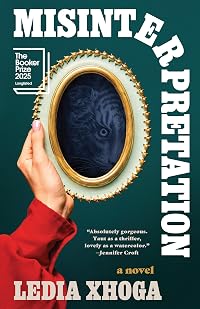
Misinterpretation
by Ledia Xhoga
On This Page
Description
"In present-day New York City, an Albanian interpreter reluctantly agrees to work with Alfred, a Kosovar torture survivor, during his therapy sessions. Despite her husband's cautions, she soon becomes entangled in her clients' struggles: Alfred's nightmares stir up her own buried memories, and an impulsive attempt to help a Kurdish poet leads to a risky encounter and a reckless plan. As ill-fated decisions stack up, jeopardizing the nameless narrator's marriage and mental health, she takes a show more spontaneous trip to reunite with her mother in Albania, where her life in the United States is put into stark relief. When she returns to face the consequences of her actions, she must question what is real and what is not. Ruminative and propulsive, Ledia Xhoga's debut novel, Misinterpretation, interrogates the darker legacies of family and country, and the boundary between compassion and self-preservation"-- show lessTags
Recommendations
























Member Reviews
An aching novel of traumas spoken and unspoken, simple and compounded. A nameless female interpreter jeopardizes her marriage, her life, and her sanity when she gets too involved with the lives of her clients. At its best, Misinterpretation is a squirm inducing psychological thriller.
It's both a shockingly empathetic and relatable slippery slope, and also hard to believe. How could she have so few support systems, work supervisors, colleagues? But her isolation is at the novel's heart. She is desperate for a genuine connection and also self-destructively unable to have that. She spends so much time worrying about the people she cannot (should not?) help, that she does real harm to the people she should be caring for.
It's both a shockingly empathetic and relatable slippery slope, and also hard to believe. How could she have so few support systems, work supervisors, colleagues? But her isolation is at the novel's heart. She is desperate for a genuine connection and also self-destructively unable to have that. She spends so much time worrying about the people she cannot (should not?) help, that she does real harm to the people she should be caring for.
This novel had an interesting premise, but the author didn’t know how to build on it.
The focus is on a young unnamed interpreter, New York City-based but originally from Albania. She is experiencing tension in her marriage to her film-professor husband, Billy, and finds herself attracted to a traumatized Kosovar-Albanian, Alfred, who has recently come to the US and trusts few people. The interpreter is evidently flattered that one of them happens to be herself.
First, the interpreter accompanies Alfred to an emergency dental appointment. Then, even when she recognizes that she may be unable to maintain professional distance, she agrees to interpret for him as he undergoes psychotherapy. In making this commitment, she defies the show more protocols of the agency that employs her. Interpreters are not to work with clients with whom they identify too closely or whose histories resemble their own: “If the client’s trauma mirrors in any way the interpreter’s experience, the interpreter should let the therapist know and have them find a replacement.” To add to the trouble, Alfred is also married, his wife is expecting a baby, and he is ambivalent about both of these facts. At their initial meeting, he holds the interpreter’s hand, and she does not discourage the contact.
Given this setup, I was expecting the author to gradually reveal more about the protagonist’s possibly troubled early life in Albania. But that isn’t what she does. Instead, Xhoga more or less abandons the narrative about Alfred. At his first psychotherapy session, the psychiatrist observes that the interpreter’s attention drifts; she is delayed in translating Alfred’s words or completely misses what he says because she’s too preoccupied with her own memories (which bear little resemblance to his experiences). Demonstrably lacking the requisite inner balance and obviously troubled by issues of her own, she is red flagged by the physician. Supposedly suffering from compassion fatigue, the interpreter is subsequently put on administrative leave. She may do translation work, but for a time she is barred from direct interaction with immigrants.
It turns out that this naive do-gooder has her fingers in other pies. The narrative concerning Alfred takes a back seat to another story—one concerning a young Kurdish poet seeking asylum on the basis of domestic abuse. After meeting Leyla at a literary event, the interpreter involves herself in this woman’s life, attempting to solve her problems in ways that even more dramatically reflect her poor judgement and lack of boundaries. Her failure to consider the potential repercussions of her actions ends up endangering Leyla, Billy, and the interpreter herself. I found the plot developments related to this story implausible, even ridiculous.Sexual attraction to the stalker who is harassing a woman she claims to be concerned about? Come on!
Like Claire Adam’s Love Forms, another Booker nominee which focuses on an immigrant who’s made a “mistake”, Misinterpretation is studded with cultural, geographical, and political details about the protagonist’s home country. The author has her character travel back to Albania—ostensibly to fill the reader in on the aspects of the character’s history that explain her “empathy” and the reasons she can’t be appropriately impartial in her work. However, one gets the sense that Xhoga includes the trip to Albania mainly to give the interpreter something to do. Certainly no trauma on par with Alfred’s is exposed. The journey to the Balkans also provides an opportunity for the author to deliver travelogue-style information about Tirana, Albania’s capital, and Berat, its famed museum town—about which Xhoga clearly knows a lot. Close to the end of the book, a conversation between the interpreter and her cousin Lina does shed some light on the main character’s psychology, but ultimately her problematic relationship with her agoraphobic mother (who remains in Albania) is never adequately explored.
Misinterpretation is an accessible read and one that had ”potential”, but neither of these qualify it for inclusion on a longlist for a major award. For one thing, I believe the author simply lacks the skill and insight that would allow her to produce a work of quality literary fiction. What Xhoga does here is take serious subject matter—immigration, asylum seeking, domestic abuse—and trivialize it with soap-opera-ish treatment. Even the sections focusing on the main character’s marital issues have a melodramatic edge to them. The book concludes simplistically and unsatisfactorilywith the main character reneging on a promise to read and edit Alfred’s witness account of his experience in Kosovo, rediscovering her love for her husband, and recommitting to her marriage . I think we’re supposed to view this as evidence of growth.
When it comes to literary awards, I understand the value in shining a light on promising, lesser-known authors who tell stories about places infrequently represented in literature in English, but in selecting a novel, literary merit shouldn’t fall by the wayside. I feel that’s exactly what has happened here.
I was never engaged by this novel. I was never convinced or transported by it. Even putting literary quality aside, there was nothing to hold my interest. A hard pass. show less
The focus is on a young unnamed interpreter, New York City-based but originally from Albania. She is experiencing tension in her marriage to her film-professor husband, Billy, and finds herself attracted to a traumatized Kosovar-Albanian, Alfred, who has recently come to the US and trusts few people. The interpreter is evidently flattered that one of them happens to be herself.
First, the interpreter accompanies Alfred to an emergency dental appointment. Then, even when she recognizes that she may be unable to maintain professional distance, she agrees to interpret for him as he undergoes psychotherapy. In making this commitment, she defies the show more protocols of the agency that employs her. Interpreters are not to work with clients with whom they identify too closely or whose histories resemble their own: “If the client’s trauma mirrors in any way the interpreter’s experience, the interpreter should let the therapist know and have them find a replacement.” To add to the trouble, Alfred is also married, his wife is expecting a baby, and he is ambivalent about both of these facts. At their initial meeting, he holds the interpreter’s hand, and she does not discourage the contact.
Given this setup, I was expecting the author to gradually reveal more about the protagonist’s possibly troubled early life in Albania. But that isn’t what she does. Instead, Xhoga more or less abandons the narrative about Alfred. At his first psychotherapy session, the psychiatrist observes that the interpreter’s attention drifts; she is delayed in translating Alfred’s words or completely misses what he says because she’s too preoccupied with her own memories (which bear little resemblance to his experiences). Demonstrably lacking the requisite inner balance and obviously troubled by issues of her own, she is red flagged by the physician. Supposedly suffering from compassion fatigue, the interpreter is subsequently put on administrative leave. She may do translation work, but for a time she is barred from direct interaction with immigrants.
It turns out that this naive do-gooder has her fingers in other pies. The narrative concerning Alfred takes a back seat to another story—one concerning a young Kurdish poet seeking asylum on the basis of domestic abuse. After meeting Leyla at a literary event, the interpreter involves herself in this woman’s life, attempting to solve her problems in ways that even more dramatically reflect her poor judgement and lack of boundaries. Her failure to consider the potential repercussions of her actions ends up endangering Leyla, Billy, and the interpreter herself. I found the plot developments related to this story implausible, even ridiculous.
Like Claire Adam’s Love Forms, another Booker nominee which focuses on an immigrant who’s made a “mistake”, Misinterpretation is studded with cultural, geographical, and political details about the protagonist’s home country. The author has her character travel back to Albania—ostensibly to fill the reader in on the aspects of the character’s history that explain her “empathy” and the reasons she can’t be appropriately impartial in her work. However, one gets the sense that Xhoga includes the trip to Albania mainly to give the interpreter something to do. Certainly no trauma on par with Alfred’s is exposed. The journey to the Balkans also provides an opportunity for the author to deliver travelogue-style information about Tirana, Albania’s capital, and Berat, its famed museum town—about which Xhoga clearly knows a lot. Close to the end of the book, a conversation between the interpreter and her cousin Lina does shed some light on the main character’s psychology, but ultimately her problematic relationship with her agoraphobic mother (who remains in Albania) is never adequately explored.
Misinterpretation is an accessible read and one that had ”potential”, but neither of these qualify it for inclusion on a longlist for a major award. For one thing, I believe the author simply lacks the skill and insight that would allow her to produce a work of quality literary fiction. What Xhoga does here is take serious subject matter—immigration, asylum seeking, domestic abuse—and trivialize it with soap-opera-ish treatment. Even the sections focusing on the main character’s marital issues have a melodramatic edge to them. The book concludes simplistically and unsatisfactorily
When it comes to literary awards, I understand the value in shining a light on promising, lesser-known authors who tell stories about places infrequently represented in literature in English, but in selecting a novel, literary merit shouldn’t fall by the wayside. I feel that’s exactly what has happened here.
I was never engaged by this novel. I was never convinced or transported by it. Even putting literary quality aside, there was nothing to hold my interest. A hard pass. show less
Interpretation involves all a person’s faculties. The unspoken cues are as important as the spoken words. This gives it a much more immediate feel than translation, where there is time for consideration, and possibly some research and discussion.
An unnamed young woman in NYC , originally from Albania, was employed as a translator for an immigration agency. She spoke multiple languages, but on the day the reader first meets her, she was taking a refugee from Kosovar to the dentist, translating from the Albanian.
How to translate the American world of cosmetic dentistry to someone who has lost his teeth in a manner he does not want to disclose? How to translate his world back to the dentist? The initial questionnaire instantly reveals show more the divide: “What would you change about your smile?”
It is the interpreter herself who is the unnamed narrator. There are rules about interpreter /client interaction. She is not allowed to ask questions about the past, She is not to interact with clients outside of her work. She is not to do more for them than is assigned. Furthermore, If the interpreter’s circumstances resemble the client’s, do not accept the assignment.
In this case, she is allowed to interpret for him as he visits a therapist, a kind of interpretation which requires extra certification and awareness. It is here that it becomes evident she has crossed the impersonal line required for interpretation. The agency then restricted her to translation work: manuals, guides, reports.
The narrator herself believes she lives happily in her New York world with her American husband; that she has adapted to this new world and culture as easily as she thinks her husband Billy has adapted to hers.
However, typical Albanian hospitality is not New York hospitality. When Albanians start coming to their apartment, it becomes obvious to the reader that a domestic line has been crossed. Whether or not the narrator realises it is open to interpretation. Her ability to read the unspoken cues in her somewhat taciturn husband’s communication is random at best.
The visits also reveal to Billy a side of his wife he did not really know. People who speak multiple languages often reveal different aspects of their personality in different languages, and in this case his wife was displaying whole aspects of herself he had not seen before..
Throw in a stalking and possible “disappearance” on the Albanian side, and you have a novel that reads easily, while giving the reader lots to ponder. show less
An unnamed young woman in NYC , originally from Albania, was employed as a translator for an immigration agency. She spoke multiple languages, but on the day the reader first meets her, she was taking a refugee from Kosovar to the dentist, translating from the Albanian.
How to translate the American world of cosmetic dentistry to someone who has lost his teeth in a manner he does not want to disclose? How to translate his world back to the dentist? The initial questionnaire instantly reveals show more the divide: “What would you change about your smile?”
It is the interpreter herself who is the unnamed narrator. There are rules about interpreter /client interaction. She is not allowed to ask questions about the past, She is not to interact with clients outside of her work. She is not to do more for them than is assigned. Furthermore, If the interpreter’s circumstances resemble the client’s, do not accept the assignment.
In this case, she is allowed to interpret for him as he visits a therapist, a kind of interpretation which requires extra certification and awareness. It is here that it becomes evident she has crossed the impersonal line required for interpretation. The agency then restricted her to translation work: manuals, guides, reports.
The narrator herself believes she lives happily in her New York world with her American husband; that she has adapted to this new world and culture as easily as she thinks her husband Billy has adapted to hers.
However, typical Albanian hospitality is not New York hospitality. When Albanians start coming to their apartment, it becomes obvious to the reader that a domestic line has been crossed. Whether or not the narrator realises it is open to interpretation. Her ability to read the unspoken cues in her somewhat taciturn husband’s communication is random at best.
The visits also reveal to Billy a side of his wife he did not really know. People who speak multiple languages often reveal different aspects of their personality in different languages, and in this case his wife was displaying whole aspects of herself he had not seen before..
Throw in a stalking and possible “disappearance” on the Albanian side, and you have a novel that reads easily, while giving the reader lots to ponder. show less
This is my 3rd from the Booker longlist (although i have some catching up to do)
A wonderful quirky novel centered, at least in my memory, around a giant mushroom cookie. You know, the psychedelic kind.
This is careful, surreal-moving prose, along the lines of Deborah Levy, but with a New York-is-international feel. Our narrator is an Albanian-born translator with desire to help every immigrant she meets in Manhattan, including a Kurdish poet trying to find refuge from her abusive husband, and married Kosovo Albanian torture-survivor, who, as his wife is pregnant, hits on to our narrator. Her response, despite her green-eyed American husband, is curiously not be offended.
Balls get juggled, and as I reader I felt a lovely mysterious show more intensity. I couldn't decide if I liked her husband, or the Kurdish refugee, or the Kosovo refugee, or other Albanian and Kurdish characters. Our narrator has a cousin in NY with a green card who professes a selfish attitude that if she makes herself happy, the whole world will be better. I struggled with how I felt about all these people, and all their inner demons, strains, and O struggled with how I felt about our narrator. In judgement sense. In a literary sense, I adored the narrator. Also, that was one fantastic mushroom cookie leading a wonderfully surreal segment.
As all this above is swirling, our author makes an odd plot choice that I think accidentally takes some energy out of the book. The wonderment, sexual tension, sustained mystery and discomfort all evaporate, or the surface shine of them do, and we are left with our unnamed narrator. And she doesn't have another cookie. At this point I adored our narrator, and I adored her New York City. I was forgiving, and I loved this book overall. But it's a point worth bringing up.
I think this book gets recommended for those who are searching for some magic in the international mélange within New York City and its surrounds, or whatever that idea might mean. So, in general, recommended.
2025
https://www.librarything.com/topic/372264#8930955 show less
A wonderful quirky novel centered, at least in my memory, around a giant mushroom cookie. You know, the psychedelic kind.
This is careful, surreal-moving prose, along the lines of Deborah Levy, but with a New York-is-international feel. Our narrator is an Albanian-born translator with desire to help every immigrant she meets in Manhattan, including a Kurdish poet trying to find refuge from her abusive husband, and married Kosovo Albanian torture-survivor, who, as his wife is pregnant, hits on to our narrator. Her response, despite her green-eyed American husband, is curiously not be offended.
Balls get juggled, and as I reader I felt a lovely mysterious show more intensity. I couldn't decide if I liked her husband, or the Kurdish refugee, or the Kosovo refugee, or other Albanian and Kurdish characters. Our narrator has a cousin in NY with a green card who professes a selfish attitude that if she makes herself happy, the whole world will be better. I struggled with how I felt about all these people, and all their inner demons, strains, and O struggled with how I felt about our narrator. In judgement sense. In a literary sense, I adored the narrator. Also, that was one fantastic mushroom cookie leading a wonderfully surreal segment.
As all this above is swirling, our author makes an odd plot choice that I think accidentally takes some energy out of the book. The wonderment, sexual tension, sustained mystery and discomfort all evaporate, or the surface shine of them do, and we are left with our unnamed narrator. And she doesn't have another cookie. At this point I adored our narrator, and I adored her New York City. I was forgiving, and I loved this book overall. But it's a point worth bringing up.
I think this book gets recommended for those who are searching for some magic in the international mélange within New York City and its surrounds, or whatever that idea might mean. So, in general, recommended.
2025
https://www.librarything.com/topic/372264#8930955 show less
This book was longlisted for the Booker this year. It concerns an Albanian main character living in NYC who translates for a living.
Like this year's Booker winner, [book:Flesh|214152261], I think the main character keeps a lot of trauma repressed inside. Both main characters are Eastern European & both are "making it", living in America/UK, being "successful" (of a sort) in their respective lives. In Flesh, the male MC seems to glide along, not feeling or experiencing a lot of inner anything (at least as far as the readers are concerned), letting life wash over him for good or for bad. In Misinterpretation, the female MC is constantly parsing, processing, analyzing, & replaying things to the point it's hard to know what she is doing irl show more vs. imagining; she becomes an unreliable narrator.Her trauma response seems to emerge in a bizarre type of people-pleasing &/or a savior role of rushing in to save the day (or person). Ironically, she most endangers herself & those closest to her in the process so there's a warring there, an opposition, acts that seem rash or ill-considered (at best). Flesh ends (imo) with a sad, dispiriting, & apathetic acceptance of life's woes. Whereas, Misinterpretation's ending sees the MC seemingly decide to create boundaries, stop shouldering the trauma of others & instead focus on healing herself to move forward.
I'm not quite sure what to think of this book but I do think it's interesting to consider in conversation with Flesh. Similarly to Flesh, opinions seem to be sharply divided among readers. Overall, I very much preferred Misinterpretation. show less
Like this year's Booker winner, [book:Flesh|214152261], I think the main character keeps a lot of trauma repressed inside. Both main characters are Eastern European & both are "making it", living in America/UK, being "successful" (of a sort) in their respective lives. In Flesh, the male MC seems to glide along, not feeling or experiencing a lot of inner anything (at least as far as the readers are concerned), letting life wash over him for good or for bad. In Misinterpretation, the female MC is constantly parsing, processing, analyzing, & replaying things to the point it's hard to know what she is doing irl show more vs. imagining; she becomes an unreliable narrator.
I'm not quite sure what to think of this book but I do think it's interesting to consider in conversation with Flesh. Similarly to Flesh, opinions seem to be sharply divided among readers. Overall, I very much preferred Misinterpretation. show less
Longlisted for the 2025 Booker Prize
On the road again, with insufficient time to write a proper review of Ledia Xhoga's complex debut novel. Misinterpretation is the story of an unnamed narrator, an Albanian woman who works as a translator and interpreter in New York City. Her past trauma impacts her relationships with her clients and her husband, Billy, a film professor at NYU. She has difficulty setting boundaries, and her desire to help others can be impractical, putting herself and those closest to her in danger.
Xhoga's writing is terse, and she does a good job depicting the narrator's impulsivity and inability to understand her own motivations and actions. However, the story often moves too slowly, and the narrator's lack of show more awareness makes the plot feel impenetrable at times. I wanted to understand the reasons behind her actions, rather than just witnessing behaviors I didn't fully comprehend. Yet, that may be the point.
Despite these concerns, Misinterpretation is an intriguing first novel that is well worth reading. Highly recommend. show less
On the road again, with insufficient time to write a proper review of Ledia Xhoga's complex debut novel. Misinterpretation is the story of an unnamed narrator, an Albanian woman who works as a translator and interpreter in New York City. Her past trauma impacts her relationships with her clients and her husband, Billy, a film professor at NYU. She has difficulty setting boundaries, and her desire to help others can be impractical, putting herself and those closest to her in danger.
Xhoga's writing is terse, and she does a good job depicting the narrator's impulsivity and inability to understand her own motivations and actions. However, the story often moves too slowly, and the narrator's lack of show more awareness makes the plot feel impenetrable at times. I wanted to understand the reasons behind her actions, rather than just witnessing behaviors I didn't fully comprehend. Yet, that may be the point.
Despite these concerns, Misinterpretation is an intriguing first novel that is well worth reading. Highly recommend. show less
Ratings
Members
- Recently Added By
Lists

2025 Booker Prize Longlist
13 works; 6 members

Books Read in 2026
1,952 works; 66 members

WBS - Book Club
71 works; 1 member
Author Information
1 Work 123 Members
Some Editions
Awards and Honors
Common Knowledge
- Canonical title
- Misinterpretation
- Original publication date
- 2024
- Important places
- New York
- Epigraph
- Not for ourselves alone are we born. Cicero
- First words
- I was fifteen minutes late and his phone number was out of service.
- Blurbers
- Elisa Shua Dusapin; Rita Bullwinkel; Jennifer Croft; Idra Novey
- Original language
- English
Classifications
Statistics
- Members
- 123
- Popularity
- 265,276
- Reviews
- 6
- Rating
- (3.55)
- Languages
- English
- Media
- Paper, Audiobook, Ebook
- ISBNs
- 7
- ASINs
- 3