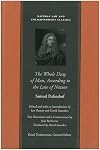
The Whole Duty of Man, According to the Law of Nature
by Samuel Pufendorf, Jean Barbeyrac, Ian Hunter, David Saunders, Freiherr von
On This Page
Description
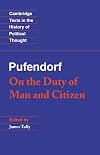
On the Duty of Man and Citizen (1673) is Pufendorf's succinct and condensed presentation of the natural law political theory he developed in his monumental classic On the Law of Nature and Nations (1672). His theory was the most influential natural law philosophy of the seventeenth- and eighteenth-centuries. He advanced a compelling reply to Grotius and Hobbes, and in doing so, set the intellectual problems for theorists such as Locke, Hutcheson, Hume, Rousseau, and Smith. In the aftermath show more of the Thirty Years' War, Pufendorf sets forth a classic justification of the early modern enlightened state and of the proper relations of moral and political subjection to it. This lucid and historically sensitive translation by Michael Silverthorne, (a classicist and a specialist in Roman Law and early modern political thought) is the first since the early twentieth century. James Tully's introduction sets the text in its seventeenth-century context, summarises the main arguments, surveys recent literature on Pufendorf, and shows how Pufendorf transformed natural law theory into an independent discipline of juristic political philosophy which dominated reflection on politics until Kant. show lessTags
Recommendations











Member Reviews
Members
- Recently Added By
Author Information

50 Works 413 Members
Born in Dorfchemnitz, Saxony, the son of a Lutheran pastor, Samuel Pufendorf was educated at Leipzig and Jena. At Jena he first read Grotius and Hobbes, and studied under Erhard Weigel. In 1658 he became a tutor in the household of the Swedish ambassador to Denmark; when war erupted between these two countries, he was imprisoned for eight months. show more It was during this time that Pufendorf wrote his first work in philosophy of law, the brief Universal Elements of Jurisprudence (1660). Subsequently he taught jurisprudence at the University of Heidelberg and the University of Lund (in Sweden); from 1688 onward he lived in Berlin as court historian to the Duke of Brandenburg. Pufendorf produced historical writings, such as his 1667 account of the Holy Roman Empire, as well as treatises on moral and legal philosophy. His greatest work was the On the Law of Nature and Nations (1672). Although Pufendorf is often described (accurately enough) as a natural rights theorist and also as the thinker who first introduced the ideas of Grotius and Hobbes into Germany, his true originality consisted in his view that a society's law and morality are a function of its culture considered as a determinate and living whole. He may thus be regarded as the inventor of the sociological approach to law. As a historian, he anticipated many of the views of nineteenth-century historicism. (Bowker Author Biography) show less

11+ Works 173 Members
4 Works 171 Members
3 Works 164 Members
2 Works 161 Members
Some Editions
Series
Belongs to Publisher Series
Common Knowledge
- Canonical title
- On the Duty of Man and Citizen according to Natural Law; The Whole Duty of Man, According to the Law of Nature
Classifications
Statistics
- Members
- 158
- Popularity
- 205,179
- Reviews
- 1
- Rating
- (3.00)
- Languages
- English, Latin
- Media
- Paper, Ebook
- ISBNs
- 8
- ASINs
- 1