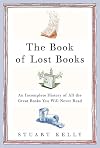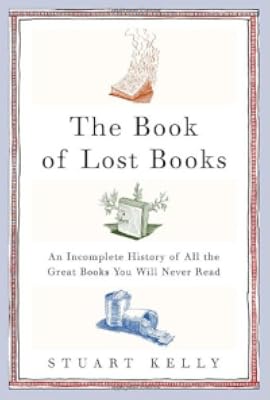
The Book of Lost Books: An Incomplete History of All the Great Books You'll Never Read
by Stuart Kelly
On This Page
Description
"In an age when deleted scenes from Adam Sandler movies are saved, it's sobering to realize that some of the world's greatest prose and poetry has gone missing. This witty, wry, and unique new book rectifies that wrong. Part detective story, part history lesson, part expose, The Book of Lost Books is the first guide to literature's what-ifs and never-weres. In compulsively readable fashion, Stuart Kelly reveals details about tantalizing vanished works by the famous, the acclaimed, and the show more influential, from the time of cave drawings to the late twentieth century. Here are the true stories behind stories, poems, and plays that now exist only in imagination: Aristophanes' Heracles, the Stage Manager was one of the playwright's several spoofs that disappeared. Love's Labours Won may have been a sequel to Shakespeare's Love's Labours Lost--or was it just an alternative title for The Taming of the Shrew? Jane Austen's incomplete novel Sanditon, was a critique of hypochondriacs and cures started when the author was fatally ill. Nikolai Gogol burned the second half of Dead Souls after a religious conversion convinced him that literature was paganism. Some of the thousand pages of William Burroughs's original Naked Lunch were stolen and sold on the street by Algerian street boys. Sylvia Plath's widower, Ted Hughes, claimed that the 130 pages of her second novel, perhaps based on their marriage, were lost after her death. Whether destroyed (Socrates' versions of Aesop's Fables), misplaced (Malcolm Lowry's Ultramarine was pinched from his publisher's car), interrupted by the author's death (Robert Louis Stevenson's Weir of Hermiston), or simply never begun (Vladimir Nabokov's Speak, America, a second volume of his memoirs), these missing links create a history of literature for a parallel world. Civilized and satirical, erudite yet accessible, The Book of Lost Books is itself a find."--Publisher's website. A history of world literature showcases authors whose books have been missing, destroyed, or left unfinished, describing works that have been lost by such authors as Euripides, Shakespeare, Charles Dickens, and Sylvia Plath. show lessTags
Recommendations


Member Recommendations
Member Reviews
Beginning at the very beginning of the written word, the missing parchments or symbols that first told a story from one human to another, and finishing with missing works from Sylvia Plath and George Perec, this is a book of missing literature. Some of the works were actually completed, then stolen, lost or burned. Other novels or epic poems were begun then left unfinished, while many others were essentially rumors, just talked about by the intended authors (Milton seems to have enjoyed claiming the vocation of poet more than producing the work) but the proposed themes never appeared.
I can't imagine how difficult it would be to research books that haven't existed in hundreds of years, or even thousands, so Stuart has done something most show more people wouldn't attempt. The chapters are short but informative, giving the reader reasons why the author was important (or not), his or her status or situation and why the work is lost. show less
I can't imagine how difficult it would be to research books that haven't existed in hundreds of years, or even thousands, so Stuart has done something most show more people wouldn't attempt. The chapters are short but informative, giving the reader reasons why the author was important (or not), his or her status or situation and why the work is lost. show less
Full marks for research, but at times I felt that his treatment of "lost" wobbled a bit. The core meaning, of course, is that completed manuscripts have gone missing, and vanished from history. But he also includes books never written or started but never finished, which opens the range of possible entries nigh infinite. These latter are usually of less interest than the former, but presumably more accessible as subject matter, and thus forms the bulk of the text. All very interesting, but in truth my attention began to wane as we read of yet another writer's schoolboy scribblings that have not been preserved, or a sketched opus that never got written. Fewer entries, but more in-depth treatment of significant lacunae in the written show more record, would have perhaps been a better approach. show less
British book critic Stuart Kelly took a wonderfully good idea and has turned it into mush. Perhaps it was because my expectations for The Book of Lost Books: An Incomplete History of All the Great Books You'll Never Read were so high that I was so disappointed in this book. Kelly's aim is a good one; he writes in the introduction that the book is "an alternative history of literature, an epitaph and a wake, a hypothetical library and an elergy to what might have been." I was looking forward to a fascinating compendium of works of literature that have been lost to history.
What I got instead was what the book perhaps ought to have been titled: The Book of Authors, Some of Whose Works Have been Lost. Kelly focuses far too much on the show more biographical details of the authors he chooses to highlight, and not nearly enough on their lost works. While his sketches of their lives are well-written and quite interesting, there were several occasions where I had to re-read an essay two or three times before I discovered what exactly had gone missing.
This is a good start, and hopefully Kelly's effort will encourage other literary scholars to examine this area of their field more closely. I hope that future endeavors will be better executed. show less
What I got instead was what the book perhaps ought to have been titled: The Book of Authors, Some of Whose Works Have been Lost. Kelly focuses far too much on the show more biographical details of the authors he chooses to highlight, and not nearly enough on their lost works. While his sketches of their lives are well-written and quite interesting, there were several occasions where I had to re-read an essay two or three times before I discovered what exactly had gone missing.
This is a good start, and hopefully Kelly's effort will encourage other literary scholars to examine this area of their field more closely. I hope that future endeavors will be better executed. show less
This book turned out to be completely different than I expected. It doesn't mean it is bad, not at all. But I am still a bit disappointed.
I have recently read several non-fiction books although I usually stick to fiction. I generally liked those books. And then I came across this book and I liked the idea of it. A book about books that have been lost and which we will never read. Cool.
And that's what this book is about. It consists of short, several-page chapters devoted to different writers in chronological order. Great idea and nice execution. One can see the author's fascination with the whole topic and the very detailed research he conducted.
So why am I disappointed? Because I was expecting to sit down and just read this book show more quickly just as I do with my fiction (and as I did with my non-fiction books recently). The topic definitely interested me, the chapters are short. Nothing should stop me. But it did not happen.
I wonder what exactly is wrong and it seems to me that this book simply lacks some unique charm. That lightness and humor that you find for example in the books of Bill Bryson. I read one short chapter, sometimes no more than four pages, and I didn't feel the need to start another one. What's more, when I tried to read a few chapters one by one, I lost my concentration, I stopped focusing on the text. I wasn't able to sit down and read 40 or 50 pages at once. Is it bad? No. It's just not a book you read all at once. Rather, one that you read for two, three months, several pages a day with breaks for some other readings. That’s all.
And I just wasn't in the mood for something like that. I try hard for it not to affect my overall rating of this book. But the truth is I read better books. This one is not bad, just not for me I think. Still, love the whole idea. show less
I have recently read several non-fiction books although I usually stick to fiction. I generally liked those books. And then I came across this book and I liked the idea of it. A book about books that have been lost and which we will never read. Cool.
And that's what this book is about. It consists of short, several-page chapters devoted to different writers in chronological order. Great idea and nice execution. One can see the author's fascination with the whole topic and the very detailed research he conducted.
So why am I disappointed? Because I was expecting to sit down and just read this book show more quickly just as I do with my fiction (and as I did with my non-fiction books recently). The topic definitely interested me, the chapters are short. Nothing should stop me. But it did not happen.
I wonder what exactly is wrong and it seems to me that this book simply lacks some unique charm. That lightness and humor that you find for example in the books of Bill Bryson. I read one short chapter, sometimes no more than four pages, and I didn't feel the need to start another one. What's more, when I tried to read a few chapters one by one, I lost my concentration, I stopped focusing on the text. I wasn't able to sit down and read 40 or 50 pages at once. Is it bad? No. It's just not a book you read all at once. Rather, one that you read for two, three months, several pages a day with breaks for some other readings. That’s all.
And I just wasn't in the mood for something like that. I try hard for it not to affect my overall rating of this book. But the truth is I read better books. This one is not bad, just not for me I think. Still, love the whole idea. show less
I really liked the premise of this, but Kelly as a companion got very tiresome. The beginning, in which he talks about Greek and Roman writings that we know existed, is quite good; but as the writers get modern he starts randomly theorizing about what so-and-so might have written had they not died. Well, sure, but that's not my definition of "lost". And it all went to hell for me when he posited, in utter seriousness, that it was not a visitor that interrupted Coleridge in his writing of "Kubla Khan", but a need to masturbate. Kelly seems to be quite sure of this, and I'm always a little turned off by too much conviction regarding dead people's onanism.
What's funny is that this would be the perfect blog/twitter feed, but it's almost overwhelming as a book. After a certain point, it's hard to focus on the litany of famous authors who may or may not have even written a book, who lost their juvenilia at a train station (okay, that was Hemingway), who we only know exist because Francis Meres who wrote about Shakespeare wrote about them, et cetera. As a blog where one can pick the people one cares about to read about what works were lost, it would be a lot less overwhelming. Now, if you care about lost works, this is the perfect book and if you're not reading all the way through, it's fun and funny, just hard to read in one sitting.
A great tour-de-force by Kelly as he spans millennia covering writers, famous and obscure, throughout history that have had their writing misplaced or destroyed for whatever reason.
Homer, Aristophanes, Philip K. Dick and Jane Austen are all namechecked and I recommend keeping a dictionary handy while reading this as I have never come across so many words new to me before. Of course, all these new words were promptly forgotten and sadly I am no more intelligent than when I first picked up this book.
I read the second edition which provides us with the bonus information around how "The Book of Lost Books" almost became a lost book itself.
Homer, Aristophanes, Philip K. Dick and Jane Austen are all namechecked and I recommend keeping a dictionary handy while reading this as I have never come across so many words new to me before. Of course, all these new words were promptly forgotten and sadly I am no more intelligent than when I first picked up this book.
I read the second edition which provides us with the bonus information around how "The Book of Lost Books" almost became a lost book itself.
Members
- Recently Added By
Author Information

3 Works 872 Members
Series
Belongs to Publisher Series
Common Knowledge
- Canonical title*
- Il libro dei libri perduti : storia dei capolavori della letteratura che non leggerete mai
- Original title
- The book of lost books : an incomplete history of all the great books you'll never read
- Original publication date
- 2010 (rev. ed.) (rev. ed.); 2005
- People/Characters
- Homer; Hesiod; Sappho; Aeschylus; Sophocles; Euripides (show all 53); Agathon; Aristophanes; Menander; Xenocles; Callimachus; Gallus; Ovid; Longinus; Saint Paul; Origen, ca. 185-ca. 254; Bede, 673-735; Dante Alighieri; Geoffrey Chaucer; Edmund Spenser; William Shakespeare; John Donne; Ben Jonson; John Milton; Molière; Gottfried Wilhelm von Leibniz; Alexander Pope; Samuel Johnson; Laurence Sterne; Edward Gibbon; Johann Wolfgang von Goethe; Walter Scott; Samuel Taylor Coleridge; Jane Austen; Lord Byron; Thomas Carlyle; Joseph Smith, Jr.; Nikolai Gogol; Charles Dickens; Herman Melville; Gustave Flaubert; Fyodor Dostoevsky; Sir Richard Francis Burton; Algernon Charles Swinburne; Émile Zola; Frank Norris; Franz Kafka; Ezra Pound; T. S. Eliot; T. E. Lawrence; Ernest Hemingway; Dylan Thomas; Robert Lowell
- Epigraph
- Hence, perpetually and essentially, texts run the risk of becoming definitively lost. Who will ever know of such disappearances?
—Jacques Derrida - Dedication
- This book is for Sam, who found me
- First words
- My mother claims it started with the Mr. Men series of children's books.
- Last words
- (Click to show. Warning: May contain spoilers.)We struggle unsuccessfully against oblivion, and the struggling itself is our success.
- Blurbers
- Mieville, China; Faulks, Sebastian; Truss, Lynne; Spark, Muriel
*Some information comes from Common Knowledge in other languages. Click "Edit" for more information.
Classifications
- Genres
- Nonfiction, Literature Studies and Criticism, General Nonfiction, History
- DDC/MDS
- 002.09 — Computer science, information & general works Computer science, knowledge & systems Books (Science and history of the book) Standard subdivisions Biography and History
- LCC
- Z1024 .K45 — Bibliography, Library Science and Information Resources General bibliography Special classes of books
- BISAC
Statistics
- Members
- 807
- Popularity
- 34,466
- Reviews
- 16
- Rating
- (3.34)
- Languages
- 8 — English, French, Greek, Italian, Polish, Portuguese (Portugal), Spanish, Turkish
- Media
- Paper, Ebook
- ISBNs
- 15
- ASINs
- 4