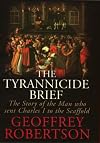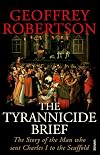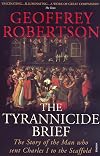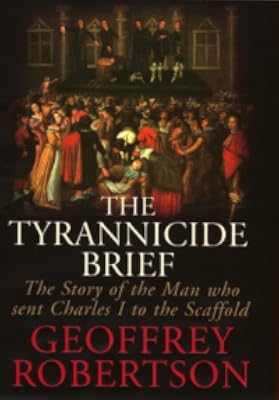
The Tyrannicide Brief: The Story of the Man Who Sent Charles I to the Scaffold
by Geoffrey Robertson
On This Page
Description
Charles I waged civil wars that cost one in ten Englishmen their lives.But in 1649 parliament was hard put to find a lawyer with the skill and daring to prosecute a King who was above the law - in the end the man they briefed was theradical barrister, John Cooke. Cooke was a plebeian, son of a poor Leicestershire farmer.His puritan conscience, political vision and love of civil liberty gave him the courage to bring the King's trial to its dramatic conclusion: the English republic.Cromwell show more appointed him as a reforming Chief Justice in Ireland, but in 1660 he was dragged back to the Old Bailey, tried and brutally executed. Geoffrey Robertson QC, the internationally renowned human rights lawyer, provides a vivid new reading of the tumultuous Civil War years, exposing long-hidden truths: that the King was guilty as charged; that his execution was necessary to establish the sovereignty of Parliament; that the regicide trials were rigged and their victims should be seen as national heroes. John Cooke was the bravest of barristers, who risked his own life to make tyranny a crime.He originated the right to silence, the'cab rank' rule of advocacy and the duty to act free-of-charge for the poor.He conducted the first trial of a Head of State for waging war on his own people - a forerunner of the prosecutions of Pinochet, Milosevic and Saddam Hussein, and a lasting inspiration to the modern world. show lessTags
Recommendations
















Member Reviews
This is a book that succeeds very well in giving us a lawyer's-eye-view of both the trial of Charles I and the "regicide trials" after the Restoration. This is something that most books on the period tend to skirt around rather: with his expert knowledge and his forensic way of presenting a case, Robertson makes the intricacies of 17th century court procedure very clear. Moreover, he does a pretty good job of demonstrating to the reader what an interesting figure John Cooke must have been.
Anyone who was previously unfamiliar with the details of "hanging, drawing and quartering" will be happy to know that Robertson explains this gruesome punishment in detail at least four times in the course of the book: the rest of us might wish to show more skip those passages...
Where it doesn't quite achieve its goal is in its attempt to convince us that Cooke and the prosecution of Charles I laid the foundations for the modern concept of "crimes against humanity". Robertson does show that arguments, e.g. of head-of-state immunity and refusal to acknowledge the jurisdiction of the court, that were discussed in 1649 were also relevant to (say) the prosecutions of Milosevic and Saddam Hussein, but he doesn't really explain how we got from 1649 to 1945. Whilst the lawyers preparing the Nuremberg trials must have been glad to find precedents in the trial of Charles I, that doesn't mean that the one was a prerequisite for the other.
I thought Robertson rather oversold Cooke, as well. He's clearly very interesting in many ways: his unsuccessful schemes for law reform, for example, and his equally unsuccessful attempt to defend himself in the regicide trial with the classic (but then new) argument that a barrister has a duty to accept any client, no matter how distasteful. However, his role as prosecutor in the 1649 trial clearly wasn't as pivotal as Robertson would have liked it to be: since Charles's refusal to enter a plea had to be considered, according to the practice of the time, as a confession, there was no case for the prosecutor to prove, and the trial was a bit of a damp squib, completely eclipsed by Charles's virtuoso performance as "royal martyr" at his execution. show less
Anyone who was previously unfamiliar with the details of "hanging, drawing and quartering" will be happy to know that Robertson explains this gruesome punishment in detail at least four times in the course of the book: the rest of us might wish to show more skip those passages...
Where it doesn't quite achieve its goal is in its attempt to convince us that Cooke and the prosecution of Charles I laid the foundations for the modern concept of "crimes against humanity". Robertson does show that arguments, e.g. of head-of-state immunity and refusal to acknowledge the jurisdiction of the court, that were discussed in 1649 were also relevant to (say) the prosecutions of Milosevic and Saddam Hussein, but he doesn't really explain how we got from 1649 to 1945. Whilst the lawyers preparing the Nuremberg trials must have been glad to find precedents in the trial of Charles I, that doesn't mean that the one was a prerequisite for the other.
I thought Robertson rather oversold Cooke, as well. He's clearly very interesting in many ways: his unsuccessful schemes for law reform, for example, and his equally unsuccessful attempt to defend himself in the regicide trial with the classic (but then new) argument that a barrister has a duty to accept any client, no matter how distasteful. However, his role as prosecutor in the 1649 trial clearly wasn't as pivotal as Robertson would have liked it to be: since Charles's refusal to enter a plea had to be considered, according to the practice of the time, as a confession, there was no case for the prosecutor to prove, and the trial was a bit of a damp squib, completely eclipsed by Charles's virtuoso performance as "royal martyr" at his execution. show less
Geoffrey Robertson very ably recounts the trial of Charles I and the subsequent trials of the regicides, using as his centerpiece John Cooke, the lawyer assigned to prosecute the king (who later paid for his efforts with his own life). While Cooke certainly seems like a fascinating character, it seems like his actual role as a regicide was a bit overblown, given that he never actually got to make his case in open court given that Charles refused to plead.
The bits of this book where Robertson is delving into the details of the legal intricacies of the case against the king, and then the differences in procedure between that trial and the proceedings against the regicide are riveting. The parts where he attempts to link these events to show more the late-twentieth-century trials for crimes against humanity felt less successful, and Robertson's very strong inclination to the republican side makes his criticisms of previous historical and legal treatments of the events he covers lose a bit of their punch. show less
The bits of this book where Robertson is delving into the details of the legal intricacies of the case against the king, and then the differences in procedure between that trial and the proceedings against the regicide are riveting. The parts where he attempts to link these events to show more the late-twentieth-century trials for crimes against humanity felt less successful, and Robertson's very strong inclination to the republican side makes his criticisms of previous historical and legal treatments of the events he covers lose a bit of their punch. show less
A compelling case for the barrister who prosecuted Charles I, by one of the most compelling of the world's great barristers. John Cooke has languished in history as one of the key players of a deed thought better forgotten. Robertson, on the other hand, portrays Cooke as a man of powerful ethics and advanced legal understanding who had risen from poor circumstances. Cooke's vision of legal practice has largely come about - but centuries after he proposed the improvements. As an outsider, his attempts to overturn the closed shop of insider privilege was always doomed in his own life time. A great book. Read August 2011.
What a fascinating book. It covers the life of John Cooke, with two parts being utterly spell-binding: him being the lead prosecutor in the trial of Charles I for treason (a case few others dared take), and then his own trial for treason as Charles II exacted revenge almost a generation later. The book raises serious questions about how a governmental leader can be punished for his crimes. But there are spots where the book drags, and the author's use of obscure (and sometimes incorrect) words does detract some from the main storyline.
A new take on an old story. Robertson holds up John Cooke, the prosecutor in the case against Charles I, as a liberal hero who was 350 years before his time. Robertson puts the best face possible on the Interregnum, but he succeeds in making a case that Cooke - not the Stuarts - are the ones to celebrate in a republican world.
Very detailed history of a pivotal period in English legal history, which according to Robertson is much underestimated. Billed as the story of John Cooke, Solicitor-General at the trial of King Charles I, this is really much more. Beginning with the seeds of the English Revolution and ending with the rigged trials of those who participated in the trial of the King, Robertson's witty style and apparently careful research result in a gripping, readable account of the period. Written very much through the lens of a criminal lawyer, which is not such a bad thing...
This book succeeds in many elements, yet fails in its determined goal. As a biography of John Cooke it is very good, though somewhat blind to his faults. As a historical investigation into the events of the regicide and the trials of the regicides it is exemplary. However, Robertson's goal is not so much to be Cooke's biographer, or to recount the history, legal and otherwise of those tumultuous times, but to vindicate the actions of Cooke and the republicans. This he pursues with little regard for balance or context, which erodes the other merits of this book. As an apologia, it is not a particularly meritorious due to its thoroughgoing lack of fairness which does not fail to lead one to question his thesis.
Members
- Recently Added By
Lists

Legal Stories
84 works; 12 members

Books Read in 2018
4,360 works; 110 members
Author Information

30+ Works 1,542 Members
Geoffrey Robertson QC deplore this hypocrisy and, in An Inconvenient Genocides, the renowned human right lawyer proves beyond reasonable doubt that the horrific avents in the Ottoman Empire in 1915 constitute the crime against humanity that is today known as genocide. His justly celebrated powers of advocacy are on full display as he condemns all show more those who try to justify the mass murder of children and civilians in the name of military necessity or religious fervour. show less
Some Editions
Awards and Honors
Awards
Common Knowledge
- Canonical title
- The Tyrannicide Brief: The Story of the Man Who Sent Charles I to the Scaffold
- Original title
- The Tyrannicide Brief: The Story of the Man Who Sent Charles I to the Scaffold
- Alternate titles
- The Tyrannicide Brief
- Original publication date
- 2005
- People/Characters
- John Cooke (Solicitor-General); Oliver Cromwell; Charles I, King of England, Scotland, and Ireland; Charles II, King of England, Scotland, and Ireland
- Important places
- London, England, UK
- Important events
- English Civil War (1642 | 1651); Execution of Charles I
- Original language
- English
Classifications
- Genres
- History, Nonfiction, Politics and Government, General Nonfiction, Biography & Memoir
- DDC/MDS
- 942.06 — History & geography History of Europe England and Wales England 1603–1714, House of Stuart and Commonwealth periods
- LCC
- KD621 .C66 .R62 — Law Law of the United Kingdom and Ireland Law of England and Wales History
- BISAC
Statistics
- Members
- 399
- Popularity
- 78,331
- Reviews
- 12
- Rating
- (4.21)
- Languages
- English
- Media
- Paper, Ebook
- ISBNs
- 7
- ASINs
- 3