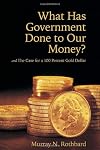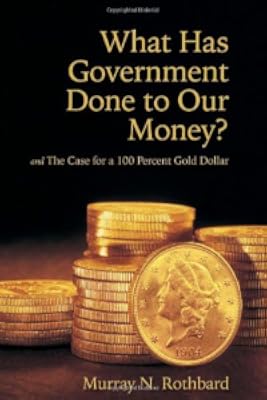
What Has Government Done to Our Money?
by Murray Rothbard
On This Page
Description
In 'What Has Government Done to Our Money?', Murray N. Rothbard explores the origins and evolution of money within a free society, highlighting the natural emergence of money as a medium of exchange. Rothbard delves into the effects of government intervention in monetary and banking systems, arguing that such interference leads to inflation and the erosion of purchasing power. The book discusses the historical progression of Western monetary systems, identifying systemic weaknesses and the show more eventual collapse of various monetary orders. Rothbard's analysis, extended by Fernando Ulrich, covers up to the 2008 financial crisis, critiquing modern economic practices and advocating for free-market principles in money production. This comprehensive examination is aimed at economists and laypersons alike, enhancing their understanding of monetary phenomena and economic policy. show lessTags
Recommendations





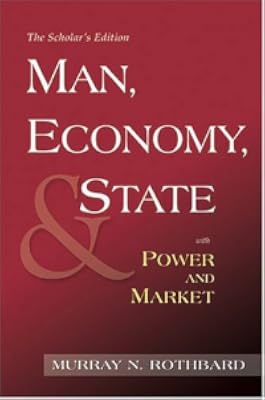
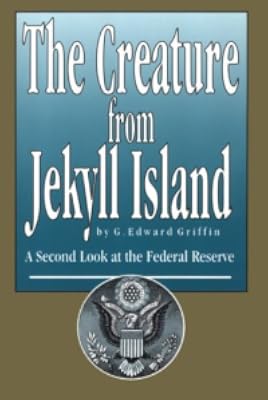
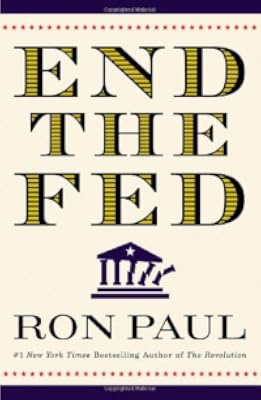
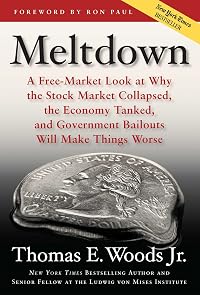









Member Recommendations
MaskedMumbler Schiff's allegorical version of Rothbard's classic.
Member Reviews
Rothbard’s masterwork is an extended essay and tour de force; a detailed description of the origins of money, its nature, and government’s sins against it. He originally published it in 1963, and then extended it in 1991 to include later events. He exposes some of the falsity inherent in our current ‘global economy’ as well as the risks and instability it contains. He points toward the soon to be born Euro, and some of the 2008 ‘crises’. I cannot strongly enough recommend this book for one point of view that helps to understand that crisis.
I cannot improve on Llewellyn Rockwell's hope in his introduction to the fourth edition: "May this book be distributed far and wide, so that when the next monetary crisis arrives, show more Americans will, finally, refuse to put up with what the government is doing to our money." show less
I cannot improve on Llewellyn Rockwell's hope in his introduction to the fourth edition: "May this book be distributed far and wide, so that when the next monetary crisis arrives, show more Americans will, finally, refuse to put up with what the government is doing to our money." show less
Excellent book on basic concepts of money. Covers the history and how money came about and its various form. Rothbard shows strong influence of his economic thinking and come across as strong critic of fiat currency that is controlled by government. Though there is frequent reference to gold, Rothbard does not actually promote gold as money, instead anything can represent money. Main argument is that fiat money is monopolized by government via a central bank which is allowed to create new money causing inflation. It may be possible and debatable that little bit of inflation by keeping new money creation just marginally above real growth can be helpful and much better than gold based money, but in practice it is too difficult for show more government. Given that a government has monopoly over fiat money creation, temptation to create new money and spend it it simply irresistible.
A very good book to understand the basic. It won't make you "argumentative" economist, but understanding the basics will give basic understanding of what governments, and central banks do.
Essential reading especially in view of recent events, asset price increase, economy collapse, quantitative easing (aka US exporting inflation as dollar is world currency that only US can print), potential future high inflation scenario, etc. show less
A very good book to understand the basic. It won't make you "argumentative" economist, but understanding the basics will give basic understanding of what governments, and central banks do.
Essential reading especially in view of recent events, asset price increase, economy collapse, quantitative easing (aka US exporting inflation as dollar is world currency that only US can print), potential future high inflation scenario, etc. show less
Such a timely book, even the 1990 edition now that China is questioning the position of the US dollar in the world economy and as our financial world seems doomed. An especially useful section is the explanation of stages from the fairly smooth 19th century, to the effect of WWI, then depression, Bretton Woods and finally Nixon ending the system in 1971. Short, readable, but hits the important points. This would be a very good supplementary reading for any economics course.
This was the book that changed my views the most, it's an eye-opener for someone who was born in the current banking system and grows beng told it's the way it should be done.
I read the entire book in a day. A great history of money, and how it's been manipulated. It's free to download, but it's one you'll want a hard copy of.
The case against modern monetary policy of inflation-targeting central banking to a free-market money such as gold.
Ratings
Members
- Recently Added By
Lists

Ancap Part 1 - Novice
11 works; 1 member
Author Information

126+ Works 4,790 Members
Common Knowledge
- Original publication date
- 1963
- Disambiguation notice
- Editions after 1991 are importantly expanded from the original.
Classifications
- Genres
- Economics, Nonfiction, General Nonfiction, Business, Politics and Government, History
- DDC/MDS
- 332.4973 — Society, government, & culture Economics Banking & Money Money Biography And History North America United States
- LCC
- HG501 .R67 — Social sciences Finance Finance Money By region or country
- BISAC
Statistics
- Members
- 464
- Popularity
- 65,697
- Reviews
- 6
- Rating
- (4.15)
- Languages
- 8 — Chinese, Czech, Dutch, English, Finnish, German, Polish, Portuguese
- Media
- Paper, Audiobook, Ebook
- ISBNs
- 24
- ASINs
- 8