On This Page
Description
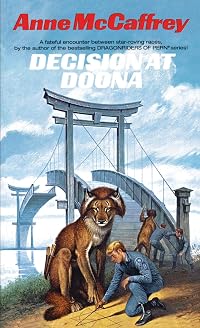
A fateful encounter between star-roving races by the author of the bestselling Dragonriders of Pern series! After the first human contact with the Siwannese, that entire race committed mass suicide. So the Terran government made a law--no further contact would be allowed with sentient creatures anywhere in the galaxy. Therefore Doona could be colonized only if an official survey established that the planet was both habitable and uninhabited. But Spaceship had made a mistake--Doona show more was inhabited. Now the colonists' choice was limited. Leave Doona and return to the teeming hell of an overpopulated Terra. Or kill the catlike Hrrubans. Or learn, for the first time in history, how to coexist with an alien race. show lessTags
Recommendations


















Member Reviews
I’ve read many of Anne McCaffrey’s books, but for some reason I never got around to her Doona books. This first one primarily stars Ken Reeve. Earth is enormously overcrowded, so Ken is excited to learn that Doona, a planet uninhabited by intelligent sentient beings, has been discovered and that he and his family have been picked to be some of the first colonists.
The “uninhabited by intelligent sentient beings” part is important. Two hundred years earlier, a botched first contact situation led to an entire alien species, the Siwannese, committing suicide. This led to the Non-Cohabitation Principle, which stated that humans could only colonize a planet if there was no evidence that intelligent beings already lived there. Doona show more seems perfect - until the human colonists come across a settlement of cat-like aliens known as Hrrubans.
Nobody wants to go back to overcrowded Earth, but the Non-Cohabitation Principle is serious business. Still, it isn’t as easy as just packing up and leaving. They need the bigwigs back on Earth to believe what they’ve seen and reported, they need a ship, and they need orders on how to conduct themselves until a ship can come pick them up. Meanwhile, the Hrrubans don’t seem to care about any of that and are just as determined to interact with the humans as the humans are to keep their interactions with the Hrrubans friendly but brief.
I tend to gravitate towards first contact science fiction. And one with stubbornly friendly cat-like aliens? Gimme! Unfortunately, I didn’t like it nearly as much as I expected I would.
The first third of the book was probably the best. I enjoyed the humans’ initial interactions with the Hrrubans, particularly the Hrrubans’ polite determination to work together with the humans. I also liked that this seemed to be a subversion of the usual “colonists with more advanced technology save the poor low-tech natives” story, without going the “mystical natives” route. The Hrrubans were polite and friendly, yes, but even the humans noticed that the Hrrubans seemed more concerned with them learning the Hrruban way of speaking and doing things than the other way around. And although the Hrrubans asked the humans for help building a bridge, in the end it didn’t seem like the humans were particularly necessary at all. The Hrrubans had all the necessary materials, technology, and knowledge, so the bridge-building was really more of a cross-species togetherness activity than anything.
Early on, I suspected that there was more going on with the Hrrubans than they were letting on. How had whole Hrruban villages gone unnoticed during the initial evaluations of Doona as a possible colony planet candidate? Why were the Hrrubans handling first contact with humans so calmly and so well? I had a guess as to what was going on, and I really wanted to find out if I was right or if McCaffrey had something even better up her sleeve. I enjoyed the big reveal, when it came, although I was a little less thrilled with it when I realized that the book included an enormous spoiler at the beginning that I just hadn’t been observant enough to catch. It also bugged me that the big reveal essentially negated some of the things I’d previously enjoyed about the book.
The characters were pretty flat - most of them were little more than names to me. Also, many aspects of the story were dated. There was a reference to a hugely important event in 2010 that, obviously, never happened (and was linguistically suspect). And the colonists anxiously read communications from Earth using microfilm readers.
The thing that really turned me off this book, though, was Todd, Ken’s 6-year-old son. Since Earth was so overcrowded, everyone was taught from an early age to be quiet, move carefully, and not take up too much space. Todd violated societal norms by being loud, energetic, and occasionally aggressive. He was so difficult to deal with during the journey to Doona that he’d had to be locked up and supervised in 4-hour shifts. One of his first actions upon arriving on Doona was to run up to one of the Hrrubans and yank his tail as hard as he could.
While I could sympathize with Todd’s frustration with the requirement to keep his behavior restrained and with the way he was treated (more on that in a bit), the tail-yanking was absolutely not okay and he should have been old enough to know better. The humans were horrified, but surprisingly the Hrrubans treated Todd indulgently. Later on, one of them even said that his behavior indicated he’d one day be a leader.
As much as I disliked Todd, I also didn’t like the way his parents spoke of him. Until a certain point in the book, Todd’s mom (Pat, Ken’s wife) never said anything truly positive about him and Ken’s feelings about him were mixed but leaned heavily towards negative. At one point, Ken almost beat Todd but refrained because he’d have had an audience. When the Hrrubans offered to essentially act as Todd’s daycare, Pat couldn’t have agreed more quickly and Ken’s protests were token at best. (I initially understood the Hrrubans’ offer as a kind of temporary adoption, which made Pat and Ken’s relief and celebratory sex especially difficult to take.)
Todd turned out to be instrumental to the book’s ending, and...ugh. McCaffrey wanted readers to believe that 6-year-old Todd was incapable/unwilling to conform to behavioral norms on Earth, and yetwilling and able to become fluent in both the formal and informal varieties of a new language, learn an alien species’ formal etiquette, and behave according to those rules for hours on end. Um, no. Even an adult would probably have had periods of boredom and mental exhaustion.
McCaffrey was one of my favorite authors when I was a teen, but this definitely isn’t making it onto my list of favorite books by her. Still, I won’t rule out reading the next book in the series, which was published a couple decades later and might potentially work better for me.
Rating Note:
I debated between 1.5 and 2 stars for this. In the end, I decided that the stuff with Todd, plus the many difficult-to-believe aspects of the world-building, pushed this more towards 1.5 stars than 2.
(Original review posted on A Library Girl's Familiar Diversions.) show less
The “uninhabited by intelligent sentient beings” part is important. Two hundred years earlier, a botched first contact situation led to an entire alien species, the Siwannese, committing suicide. This led to the Non-Cohabitation Principle, which stated that humans could only colonize a planet if there was no evidence that intelligent beings already lived there. Doona show more seems perfect - until the human colonists come across a settlement of cat-like aliens known as Hrrubans.
Nobody wants to go back to overcrowded Earth, but the Non-Cohabitation Principle is serious business. Still, it isn’t as easy as just packing up and leaving. They need the bigwigs back on Earth to believe what they’ve seen and reported, they need a ship, and they need orders on how to conduct themselves until a ship can come pick them up. Meanwhile, the Hrrubans don’t seem to care about any of that and are just as determined to interact with the humans as the humans are to keep their interactions with the Hrrubans friendly but brief.
I tend to gravitate towards first contact science fiction. And one with stubbornly friendly cat-like aliens? Gimme! Unfortunately, I didn’t like it nearly as much as I expected I would.
The first third of the book was probably the best. I enjoyed the humans’ initial interactions with the Hrrubans, particularly the Hrrubans’ polite determination to work together with the humans. I also liked that this seemed to be a subversion of the usual “colonists with more advanced technology save the poor low-tech natives” story, without going the “mystical natives” route. The Hrrubans were polite and friendly, yes, but even the humans noticed that the Hrrubans seemed more concerned with them learning the Hrruban way of speaking and doing things than the other way around. And although the Hrrubans asked the humans for help building a bridge, in the end it didn’t seem like the humans were particularly necessary at all. The Hrrubans had all the necessary materials, technology, and knowledge, so the bridge-building was really more of a cross-species togetherness activity than anything.
Early on, I suspected that there was more going on with the Hrrubans than they were letting on. How had whole Hrruban villages gone unnoticed during the initial evaluations of Doona as a possible colony planet candidate? Why were the Hrrubans handling first contact with humans so calmly and so well? I had a guess as to what was going on, and I really wanted to find out if I was right or if McCaffrey had something even better up her sleeve. I enjoyed the big reveal, when it came, although I was a little less thrilled with it when I realized that the book included an enormous spoiler at the beginning that I just hadn’t been observant enough to catch. It also bugged me that the big reveal essentially negated some of the things I’d previously enjoyed about the book.
The characters were pretty flat - most of them were little more than names to me. Also, many aspects of the story were dated. There was a reference to a hugely important event in 2010 that, obviously, never happened (and was linguistically suspect). And the colonists anxiously read communications from Earth using microfilm readers.
The thing that really turned me off this book, though, was Todd, Ken’s 6-year-old son. Since Earth was so overcrowded, everyone was taught from an early age to be quiet, move carefully, and not take up too much space. Todd violated societal norms by being loud, energetic, and occasionally aggressive. He was so difficult to deal with during the journey to Doona that he’d had to be locked up and supervised in 4-hour shifts. One of his first actions upon arriving on Doona was to run up to one of the Hrrubans and yank his tail as hard as he could.
While I could sympathize with Todd’s frustration with the requirement to keep his behavior restrained and with the way he was treated (more on that in a bit), the tail-yanking was absolutely not okay and he should have been old enough to know better. The humans were horrified, but surprisingly the Hrrubans treated Todd indulgently. Later on, one of them even said that his behavior indicated he’d one day be a leader.
As much as I disliked Todd, I also didn’t like the way his parents spoke of him. Until a certain point in the book, Todd’s mom (Pat, Ken’s wife) never said anything truly positive about him and Ken’s feelings about him were mixed but leaned heavily towards negative. At one point, Ken almost beat Todd but refrained because he’d have had an audience. When the Hrrubans offered to essentially act as Todd’s daycare, Pat couldn’t have agreed more quickly and Ken’s protests were token at best. (I initially understood the Hrrubans’ offer as a kind of temporary adoption, which made Pat and Ken’s relief and celebratory sex especially difficult to take.)
Todd turned out to be instrumental to the book’s ending, and...ugh. McCaffrey wanted readers to believe that 6-year-old Todd was incapable/unwilling to conform to behavioral norms on Earth, and yet
McCaffrey was one of my favorite authors when I was a teen, but this definitely isn’t making it onto my list of favorite books by her. Still, I won’t rule out reading the next book in the series, which was published a couple decades later and might potentially work better for me.
Rating Note:
I debated between 1.5 and 2 stars for this. In the end, I decided that the stuff with Todd, plus the many difficult-to-believe aspects of the world-building, pushed this more towards 1.5 stars than 2.
(Original review posted on A Library Girl's Familiar Diversions.) show less
This is a difficult book to rate for me. Anne McCaffrey has always been one of my favourite writers. She has strong characters that usually do not fit into a mold. This book is not that.
It was written in 1969, making it one of her first books published. Writing a book that had to pass the white male publishers to interest a predominately white male audience must have been difficult. Maybe that is why she chose to have wailing women who only saw the inside of a kitchen. The only new types of characters were cat people. Ones that were more intelligent, technologically advanced and able to defend themselves against invasion, that did not want to invade others.
The main focuses of the novel is not outstripping the resources of the place show more you live, that colonialism is bad, and that violence is not the answer. All of those ideas are good ones. If I had read this book closer to the date it was published, or probably in my early teens, I would have really enjoyed the story. I would have learned something too.
Now the story is dated. The lack of women's rights is very glaring. It was a disappointing read. show less
It was written in 1969, making it one of her first books published. Writing a book that had to pass the white male publishers to interest a predominately white male audience must have been difficult. Maybe that is why she chose to have wailing women who only saw the inside of a kitchen. The only new types of characters were cat people. Ones that were more intelligent, technologically advanced and able to defend themselves against invasion, that did not want to invade others.
The main focuses of the novel is not outstripping the resources of the place show more you live, that colonialism is bad, and that violence is not the answer. All of those ideas are good ones. If I had read this book closer to the date it was published, or probably in my early teens, I would have really enjoyed the story. I would have learned something too.
Now the story is dated. The lack of women's rights is very glaring. It was a disappointing read. show less
I love first contact fiction. A good examination of what can go right and what can go wrong when two different cultures (or civilizations, or species) meet makes for a good story.
McCaffrey's "Decision at Doona" fits the bill. An upbeat take on what can go wrong when first contact with an alien civilization is made. The colonists have to make difficult choices when they meet the alien race, difficult choices further hampered by the terran bureaucracy.
If you're a fan of McCaffrey, but haven't read Decision at Doona, you should. It is part of her 'earlier' collection of work; less repetitive than her later novels. A good read in general, especially if you are a fan of first contact fiction.
McCaffrey's "Decision at Doona" fits the bill. An upbeat take on what can go wrong when first contact with an alien civilization is made. The colonists have to make difficult choices when they meet the alien race, difficult choices further hampered by the terran bureaucracy.
If you're a fan of McCaffrey, but haven't read Decision at Doona, you should. It is part of her 'earlier' collection of work; less repetitive than her later novels. A good read in general, especially if you are a fan of first contact fiction.
One of my favorite Anne McCaffrey novels. Coincidentally, its also one of her earlier books. This isn't complicated or epic, just good straightforward science fiction. The 'first contact' theme isn't tremendously original, but it is done well.
This book discusses some important issues, several of which really ought to be brought up again in modern society. So still definitely worth a read..
However, it does suffer a bit from dating, and a bit from this being an early work of hers. There's a clumsiness in how the positions on each side are presented; I'm not sure how much of that is inexperience or restrictions on length that were often seen back then.
However, it does suffer a bit from dating, and a bit from this being an early work of hers. There's a clumsiness in how the positions on each side are presented; I'm not sure how much of that is inexperience or restrictions on length that were often seen back then.
On rereading this book so many years after originally buying it (sometime back in the early eighties) I was rather surprised as to how passive the women are in this book - probably the most passive than in any other of Ms McCaffrey's books. The science and technology largely stands up to the passage of time, what little of there is though the drones used by the colonists use film cameras that may have some younger readers wondering what that is :-).
The story itself is a fairly standard first contact situation, with a Terran colony dumped on a planet that's supposed not to have any intelligent life on it so they are a little... put out when an exploratory party is suddenly confronted by a pair of young felinoid 'natives'. There's much show more tooing and froing as the colonists try to get a sensible answer out of the various colonial bodies.
Although the story does come to a self contained conclusion, there was a second book written in the mid to late nineties as a collaboration. show less
The story itself is a fairly standard first contact situation, with a Terran colony dumped on a planet that's supposed not to have any intelligent life on it so they are a little... put out when an exploratory party is suddenly confronted by a pair of young felinoid 'natives'. There's much show more tooing and froing as the colonists try to get a sensible answer out of the various colonial bodies.
Although the story does come to a self contained conclusion, there was a second book written in the mid to late nineties as a collaboration. show less
"Decision at Doona," written by Anne McCaffrey in 1969, tells the story of two distopian worlds whose citizens accidently colonize the same world. Even after 39 years, this story captivates the reader with the the confusion that can come from two law-abiding groups when neither set of laws allows for the existence of the other. The story of how they get beyond confusion and politics to forge a dynamic new community is satisfying without being sacchrine. This book is still fun to read.
Members
- Recently Added By
Lists

Best reading order of Anne McCaffrey's non-Pern sci-fi
43 works; 2 members
Author Information

Anne McCaffrey was born in Cambridge, Massachusetts on April 1, 1926. She received a degree in Slavonic languages from Radcliffe College. She worked in advertising for Helena Rubenstein from 1947 to 1952. Her first publication was a short story in Science Fiction Magazine, and her first novel, Restoree, was published in 1967. She is a well-known show more author of over 100 books, mostly science fiction, including the Dragonriders of Pern series, the Crystal Singer series, Acorna's Children series, The Twins of Petaybee series, and Barque Cats series. She won numerous awards including the Hugo Award for Best Novella for the short story Weyr Search in 1968 and the Nebula Award for Best Novella for Dragonrider in 1969. In 2006, she was inducted into the Science Fiction Hall of Fame. She has also written books under the pseudonym Jody Lynn. She died of a stroke on November 21, 2011 at the age of 85. (Bowker Author Biography) show less
Some Editions
Series

Belongs to Publisher Series
Work Relationships
Is contained in
Common Knowledge
- Canonical title
- Decision at Doona
- Original title
- Decision at Doona
- Original publication date
- 1969
- People/Characters
- Todd Reeve; Hrrula; Hrruna; Hrrto; Hrrestan; Mrrva (show all 36); Hrriss; Hrran; Mrrim; Ken Reeves; Patricia Reeve; Ilsa Reeve; Hu Shih; Phullis Hu; Sam Gaynor; Aurie Gaynor; Lee Lawrence; Sally Lawrence; Macy McKee; Do McKee; Ezra Moody; Kate Moody; Bill Moody; Martin Ramasan; Fawzia Ramasan; lfred Ramasan; Ben Adjei; Akosua Adjei; Abe Dautrish; Becky Dautrish; Buzz Eckerd; Anneck Eckerd; Ali Kiachif; Al Landreau; E K Chaminade; Afroza Sumitral
- Important places
- Doona (Fictitious planet)
- Epigraph
- [None]
- Dedication
- To Todd Johnson - of course!
- First words
- The planet receded to a small, blue-green sphere, the lesser of its two satellites beginning to pass across the retreating face of its primary, a pearly tear in the northeast hemisphere.
- Last words
- (Click to show. Warning: May contain spoilers.)"I get what you mean," Hrrula purred.
- Original language
- English
Classifications
Statistics
- Members
- 1,903
- Popularity
- 11,296
- Reviews
- 15
- Rating
- (3.55)
- Languages
- English, French, German, Portuguese
- Media
- Paper, Ebook
- ISBNs
- 19
- ASINs
- 30