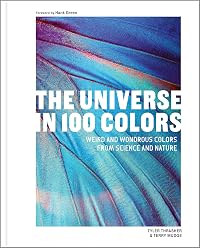
The Universe in 100 Colors: Weird and Wondrous Colors from Science and Nature
by Tyler Thrasher
On This Page
Description
"This book aims to highlight 100 incredibly interesting colors that the average human could live their life unaware of. These colors exist in the strangest of places, and serve the most specific functions in nature, or were human-made with one particular goal in mind"--Tags
Recommendations
















Member Reviews
In a Nutshell: Love STEM-based books? Love admiring the colours of nature? Ever wonder what is ‘colour”? Here’s a fabulous addition to your TBR. Insightful, informative, mind-boggling. Loved the entire spectrum of information and hues in this book.
~~~~~~~~~~~~~~~~~~~~~~~~~~~~
Ours is a world of light, and hence, of colours. It is tough to think of colours as linked to energy, but that’s what they are. In school, we learn of the VIBGYOR spectrum, and we learn of the prism experiment that helps us scatter white light into a visible rainbow. But are sufficient light, an object, and functional eyesight enough to see all colours?
The book begins with an introductory note on the meaning of colour. (I love how it used the analogy of a show more music orchestra to explain how we see colours.) It includes several mind-blowing facts about colours, both visible and invisible to the human eye. (Did you know that red, yellow, and blue are NOT the primary colours of the universe?) The explanation is scientific but not too jargon-dominated.
Once the foundation of colours is set, the content moves on to what the title promises: the universe in a hundred colours. We see a hundred shades (Confession: A few of the shades appeared very similar to this human’s eye!) and learn fascinating details about them. The left-hand side contains a coloured photograph of the colour itself or some object in that precise shade. The right-hand side contains the physical composition of the colour (using a helpful symbol-based key to denote the nature of each colour) and textual insights into the shade.
Now you might wonder, as I did: how much text could be written about individual colours? Turns out, quite a lot! The explanations accompanying the colours cover an astonishing array of subjects such as history, zoology, botany, astronomy, chemistry, and even modern-day technology. Once the visible colour spectrum is exhausted, the content even covers iridescent colours (wow!) and imagined colours (went entirely above my head!)
Most of the explanation is straightforward, making it manageable for even a layperson with limited scientific knowledge to understand the more complex scientific bits. I appreciate how the content even addressed trickier issues such as Anish Kapoor's unethical behaviour in hoarding Vantablack or racism against certain cultures leading to colours named after them.
However, some of the pages did go too technical. I especially zoned out at the bits about chemical composition of various minerals. In a couple of cases, the origin of the colour’s name is from another language such as feuille morte from French (dead leaves). It would have been great if they had mentioned this language reference as well. Reading ‘dead leaves’ as the meaning makes us understand why the colour is called ‘feuille morte’. (That said, I greatly appreciate being told the correct pronunciation of mineralogist Fuchs’ last name. show less
~~~~~~~~~~~~~~~~~~~~~~~~~~~~
Ours is a world of light, and hence, of colours. It is tough to think of colours as linked to energy, but that’s what they are. In school, we learn of the VIBGYOR spectrum, and we learn of the prism experiment that helps us scatter white light into a visible rainbow. But are sufficient light, an object, and functional eyesight enough to see all colours?
The book begins with an introductory note on the meaning of colour. (I love how it used the analogy of a show more music orchestra to explain how we see colours.) It includes several mind-blowing facts about colours, both visible and invisible to the human eye. (Did you know that red, yellow, and blue are NOT the primary colours of the universe?) The explanation is scientific but not too jargon-dominated.
Once the foundation of colours is set, the content moves on to what the title promises: the universe in a hundred colours. We see a hundred shades (Confession: A few of the shades appeared very similar to this human’s eye!) and learn fascinating details about them. The left-hand side contains a coloured photograph of the colour itself or some object in that precise shade. The right-hand side contains the physical composition of the colour (using a helpful symbol-based key to denote the nature of each colour) and textual insights into the shade.
Now you might wonder, as I did: how much text could be written about individual colours? Turns out, quite a lot! The explanations accompanying the colours cover an astonishing array of subjects such as history, zoology, botany, astronomy, chemistry, and even modern-day technology. Once the visible colour spectrum is exhausted, the content even covers iridescent colours (wow!) and imagined colours (went entirely above my head!)
Most of the explanation is straightforward, making it manageable for even a layperson with limited scientific knowledge to understand the more complex scientific bits. I appreciate how the content even addressed trickier issues such as Anish Kapoor's unethical behaviour in hoarding Vantablack or racism against certain cultures leading to colours named after them.
However, some of the pages did go too technical. I especially zoned out at the bits about chemical composition of various minerals. In a couple of cases, the origin of the colour’s name is from another language such as feuille morte from French (dead leaves). It would have been great if they had mentioned this language reference as well. Reading ‘dead leaves’ as the meaning makes us understand why the colour is called ‘feuille morte’. (That said, I greatly appreciate being told the correct pronunciation of mineralogist Fuchs’ last name. show less
Ratings
Members
- Recently Added By
Lists

Science: Earth
109 works; 1 member
Author Information
3 Works 52 Members
Classifications
Statistics
- Members
- 38
- Popularity
- 764,038
- Reviews
- 1
- Rating
- (4.00)
- Languages
- English
- Media
- Paper, Ebook
- ISBNs
- 2