On This Page
Description
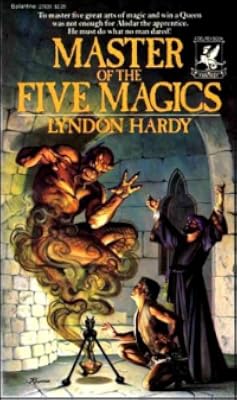
Alodar was a mere journeyman thaumaturge learning the least of the five arts of magic. As such he had no right to aspire to the hand of the fair lady, Queen Vendora, but aspire he did. "One of the most logical detailing of the laws of magic ever to appear in fantasy" - Lester del Rey Out of print for over three decades and now returning to availability. This edition includes new added chapters, a glossary and an author's afterward.Tags
Recommendations


















Member Recommendations
Member Reviews
Maybe 2 1/2 stars, to be fair. Rounded down for disappointment!
The author's preface (or whatever one calls a preface when it shows up at the end of the book) was very illuminating. He admits spending the Vast Majority of his time on working out the details of his magic system, and comparatively little time on plot and characters, and it certainly shows.
The characters have no character whatsoever--the main character especially so. He's a bit of a Mary Sue, except that he's also awful several times throughout without any indication that anyone (other than mean, bad people) might think he's being awful. There's never a dark night of the soul where he comes to realize his horrible mistakes--no, turns out destiny's groomed him for even show more greater greatness. Very annoying.
The magical system is very specifically thought out, and I went along with the subpar book just to see how it would all transpire, but now I rather wish I'd cut and bailed early enough to just read a more enjoyable book.
Oh--and it also reads rather like one of those pre-novel novels, e.g. Sir Philip Sidney's Arcadia, or an Icelandic saga, etc., because it's so very plot-based and, as implied before, the lack of anything resembling psychological realism. Your emotional involvement will be similar to having a not-very-good RPG video game plotline explained to you.
(Note: 5 stars = rare and amazing, 4 = quite good book, 3 = a decent read, 2 = disappointing, 1 = awful, just awful. There are a lot of 4s and 3s in the world!) show less
The author's preface (or whatever one calls a preface when it shows up at the end of the book) was very illuminating. He admits spending the Vast Majority of his time on working out the details of his magic system, and comparatively little time on plot and characters, and it certainly shows.
The characters have no character whatsoever--the main character especially so. He's a bit of a Mary Sue, except that he's also awful several times throughout without any indication that anyone (other than mean, bad people) might think he's being awful. There's never a dark night of the soul where he comes to realize his horrible mistakes--no, turns out destiny's groomed him for even show more greater greatness. Very annoying.
The magical system is very specifically thought out, and I went along with the subpar book just to see how it would all transpire, but now I rather wish I'd cut and bailed early enough to just read a more enjoyable book.
Oh--and it also reads rather like one of those pre-novel novels, e.g. Sir Philip Sidney's Arcadia, or an Icelandic saga, etc., because it's so very plot-based and, as implied before, the lack of anything resembling psychological realism. Your emotional involvement will be similar to having a not-very-good RPG video game plotline explained to you.
(Note: 5 stars = rare and amazing, 4 = quite good book, 3 = a decent read, 2 = disappointing, 1 = awful, just awful. There are a lot of 4s and 3s in the world!) show less
(Original Review, 1980-10-02)
Just out from Del Rey is MASTER OF THE FIVE MAGICS by Lyndon Hardy (who "became interested in fantasy while wandering through the fringes of fandom as an undergraduate at Caltech"). My skepticism was challenged by the cover blurb's claim, "one of the most logical detail of the laws of magic ever to appear in fantasy". But said claim-- mirabile dictu! --turned out to be legitimate. Can't say how much, if any, he regularized or imposed structure, for he went well beyond what was in the folklore and anthro courses I've had. A lotta things make sense, now, that were just sort of a mishmash, before. (I particularly appreciated the little covert jokes, not just the now-not-unusual employment of Maxwell's demon, show more but the use of painted-daisies in a magical preparation to rid a barbarian of lice, and willow bark in one to relieve pain.)
Definitely recommended for a real good overview of traditional Western European magic, wrapped up in a not very well done story.
[2018 EDIT: This review was written at the time as I was running my own personal BBS server. Much of the language of this and other reviews written in 1980 reflect a very particular kind of language: what I call now in retrospect a “BBS language”.] show less
Just out from Del Rey is MASTER OF THE FIVE MAGICS by Lyndon Hardy (who "became interested in fantasy while wandering through the fringes of fandom as an undergraduate at Caltech"). My skepticism was challenged by the cover blurb's claim, "one of the most logical detail of the laws of magic ever to appear in fantasy". But said claim-- mirabile dictu! --turned out to be legitimate. Can't say how much, if any, he regularized or imposed structure, for he went well beyond what was in the folklore and anthro courses I've had. A lotta things make sense, now, that were just sort of a mishmash, before. (I particularly appreciated the little covert jokes, not just the now-not-unusual employment of Maxwell's demon, show more but the use of painted-daisies in a magical preparation to rid a barbarian of lice, and willow bark in one to relieve pain.)
Definitely recommended for a real good overview of traditional Western European magic, wrapped up in a not very well done story.
[2018 EDIT: This review was written at the time as I was running my own personal BBS server. Much of the language of this and other reviews written in 1980 reflect a very particular kind of language: what I call now in retrospect a “BBS language”.] show less
Didn't find the main character compelling and there just isn't much to this except for their viewpoint. Things spiral out of control quickly and resolve quickly. Most of the book is weightless, checking off each of the magics in turn (I liked the alchemy part quite a bit). Make it 'master of the three magics' or something and I might have enjoyed it more. Going to skip the rest of the series.
I stumbled across "Riddle of the Seventh Realm" in a flea market bookseller's trove, already having this one and "Secret of the Sixth Magic" (which I never read). I recalled enjoying reading Hardy's first and before I passed it on to my son, I decided to re-read it. After 30 years, it was still quite fun and an innovative take on the genre. I checked to see if Hardy had written any more than the three and learned he was the mastermind behind the Great Rose Bowl Hoax...stuff of legend when I was a kid. Looking forward to finally reading #2, and then #3.
A story set in a small kingdom in a fantasy world where there are five distinct magical traditions. These traditions are well defined and the principles they rely on, their methods of operation, and the kind of results they deliver are all interestingly different. Since part of the joy of reading this book is to discover each of them in turn, I won't enumerate them here.
I liked the way the traditions were systematic. Unlike in most fantasy books where one achieves results simply by wanting to very badly, or by having the appropriate parentage, in Lyndon Hardy's work one must apply the principles correctly and intelligently and they will work the same way for anyone who has mastered them. The result is a story that lauds the hero's show more mental abilities rather than the physical.
Speaking of which, the story itself is fairly simple, a traditional hero's quest. I won't say more of it because I detest spoilers. The first few chapters are a little awkward, as some of the characters spout two paragraphs of exposition where I would have expected a curt reply, but this smoothes out later. If you can get to page 40 then the rest will be fine.
A persistent annoyance was the poor spelling, particularly of the lose/loose variety. Perhaps a later publication than my 1980 edition will have fixed this.
This is a fantasy that fans of hard science fiction will like. show less
I liked the way the traditions were systematic. Unlike in most fantasy books where one achieves results simply by wanting to very badly, or by having the appropriate parentage, in Lyndon Hardy's work one must apply the principles correctly and intelligently and they will work the same way for anyone who has mastered them. The result is a story that lauds the hero's show more mental abilities rather than the physical.
Speaking of which, the story itself is fairly simple, a traditional hero's quest. I won't say more of it because I detest spoilers. The first few chapters are a little awkward, as some of the characters spout two paragraphs of exposition where I would have expected a curt reply, but this smoothes out later. If you can get to page 40 then the rest will be fine.
A persistent annoyance was the poor spelling, particularly of the lose/loose variety. Perhaps a later publication than my 1980 edition will have fixed this.
This is a fantasy that fans of hard science fiction will like. show less
One of the better 'coming of age' fantasies. Alodar is young, ambitious, and is seeking the hand of a beautiful woman. But his quest takes some very surprising turns, and leads to a satisfying and unexpected denouement.
This book had an interesting approach in dividing up the realms of magic. It was not a bad read, but the latter half was riddled with misspelled words and a few sentences that were half-edited or had missing words. Despite that, it wasn't a bad story.
Alodar is on a quest to restore his family's honor. To do this he decides to pursue nothing less than the hand of the beautiful, single queen. He plies his arts with skill despite not being a master of them, and each success leads him on to study another magical path. The culmination is an epic battle of the remaining queen's forces and a prince of demons.
I do have to say that at the end, I absolutely HATE the queen. What a bitch.
Alodar is on a quest to restore his family's honor. To do this he decides to pursue nothing less than the hand of the beautiful, single queen. He plies his arts with skill despite not being a master of them, and each success leads him on to study another magical path. The culmination is an epic battle of the remaining queen's forces and a prince of demons.
I do have to say that at the end, I absolutely HATE the queen. What a bitch.
Members
- Recently Added By
Lists

Books Read in 2004
212 works; 7 members
Author Information

12 Works 2,711 Members
Some Editions
Awards and Honors
Awards
Series

Common Knowledge
- Canonical title
- Master of the Five Magics
- Original publication date
- 1980-10
- People/Characters
- Alodar; Queen Vendora; Lady Aeriel; Lord Festil; Feston; Periac - Master Thaumaturge (show all 12); Saxton - Master Alchemist; Cedric; Basil the Apothecary; Duncan - Acolyte; Lectonil - Master Magician; Beliac - Master Magician
- Dedication
- To my wife, Joan
- First words
- Alodar closed his mind to the pounding of the huge stones agains the lower walls of the keep.
- Last words
- (Click to show. Warning: May contain spoilers.)Without looking back, they galloped away into the pages of the sagas.
Classifications
Statistics
- Members
- 1,217
- Popularity
- 20,464
- Reviews
- 11
- Rating
- (3.52)
- Languages
- English, German
- Media
- Paper, Ebook
- ISBNs
- 10
- ASINs
- 4