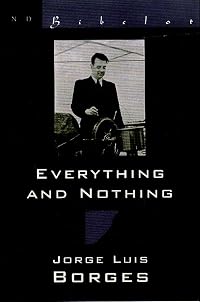
Everything & Nothing
by Jorge Luis Borges
On This Page
Description
Celebrating the centennial of his birth, Everything and Nothing compiles the most anthologized and widely read fictions by Jorge Luis Borges, "a giant of world literature" (John Updike, The New Yorker). Some of the narrative pieces herein contained are: "Pierre Menard" in which a modern writer reconstructs passages from Don Quixote that are verbally identical but read differently; "The Garden of Forking Paths," an intellectual variation on the detective-story genre; and "Nightmares," a show more lecture which, as Alastair Reid puts it, "shifts from personal memories to writers, to an examination of other peoples' metaphors, to language itself." Everything and Nothing serves as a perfect introduction to Borges's genius. show lessTags
Recommendations

















Member Reviews
I bought this little book while in Madrid last year. The shopkeeper of a second-hand bookshop recommended it to me, saying that even if I wouldn't like the stories, they might add to my cultural knowledge (or something along those lines).
Borges is a name I had seen or heard before (a long time ago, though), but never paid attention to it. This compilation is only 108 pages thin and consists of eleven stories and essays, next to an introduction by one of the translators, Donald A. Yates. The blurb and several other readers describe this compilation as "a perfect introduction to Borges's genius." Unfortunately, I can't agree at all, for whatever reason.
Only two of the eleven stories (I'll use that term) managed to be of my liking: show more 'Nightmares', which is about dreams and nightmares and the influence they have on your thinking, writing, behaviour, etc..., and 'Blindness', since Borges became blind at some point in his life. In this little essay he describes this situation and how he dealt with it, in his work, in his renewed interest to study history (about the Celts, the Saxons, literature, and more).
The other stories just couldn't convince me, there was no click, no connection, no emotion. I was reading the texts without understanding what I was reading or what the possible meaning/message was. Several felt like extracts that missed background info of a bigger whole. Also, Borges may have had a way with words, but this also formed an obstacle in trying to find the story, the idea, the message, whatever-you-want-to-call-it in the respective texts.
Maybe Borges's works just aren't for me, regardless of eventual philosophical influences, witty elements (which I have not detected at all), and what not. But you can't know if you don't try. I tried and didn't like it. show less
Borges is a name I had seen or heard before (a long time ago, though), but never paid attention to it. This compilation is only 108 pages thin and consists of eleven stories and essays, next to an introduction by one of the translators, Donald A. Yates. The blurb and several other readers describe this compilation as "a perfect introduction to Borges's genius." Unfortunately, I can't agree at all, for whatever reason.
Only two of the eleven stories (I'll use that term) managed to be of my liking: show more 'Nightmares', which is about dreams and nightmares and the influence they have on your thinking, writing, behaviour, etc..., and 'Blindness', since Borges became blind at some point in his life. In this little essay he describes this situation and how he dealt with it, in his work, in his renewed interest to study history (about the Celts, the Saxons, literature, and more).
The other stories just couldn't convince me, there was no click, no connection, no emotion. I was reading the texts without understanding what I was reading or what the possible meaning/message was. Several felt like extracts that missed background info of a bigger whole. Also, Borges may have had a way with words, but this also formed an obstacle in trying to find the story, the idea, the message, whatever-you-want-to-call-it in the respective texts.
Maybe Borges's works just aren't for me, regardless of eventual philosophical influences, witty elements (which I have not detected at all), and what not. But you can't know if you don't try. I tried and didn't like it. show less
At only 108 pages, this is a short of stories by Borges but what it lacks in length it makes up for in depth. These stories are all full and rich with descriptive prose. Each sentence of Borges feels as if it has been edited many times and we are fortunate enough to read the best possible sentence he could have constructed. Take your time with this one, it will leave you wanting more as well as leaving you floored by the power of the writing.
Everything and Nothing -- After reading the title Borges work in this collection, below are the questions I would ask myself and anybody else reflecting on the subject. I have also included the actual Borges tale beneath the questions. Have fun!
1. If in a dream you heard a voice say that you are everything and nothing, what would you think?
2. “One man is all men” is a familiar Borges theme. In this short piece, an actor is no one man in particular yet all men. If you are a fiction writer, is there anybody on this planet you couldn’t write a story about using first-person narrative?
3. According to Borges, Shakespeare is unable to have a singular identity, a constant and an unchanging Self. What is consistent, if anything, about show more your own sense of identity?
4. Again, according to Borges, Shakespeare created multiple identities to give his life an identity. Is such a creation of multiple identities a viable way to establish identity? Is establishing identity important in the first place?
5. Borges says Shakespeare was never meant to be anyone. Is Borges being ironic? How would an actor or author stake a claim to actually being someone away from the stage or writing desk?
6. Do you feel yourself to be infinitely full of possibilities or completely empty of any way of being in the world other than the way you are?
7. What actions, if any, are unique to you? Is there any pain or joy you have experienced that, in your mind, hasn’t been experienced by someone previously?
8. Borges claims in this piece that Shakespeare’s destiny is no different from the destiny of all other men. Is this another way of stating that there is no individual destiny but only a collective destiny? Do you agree?
9. Is this story really saying that all individual identities are an illusion, that there is only one identity split into so many dreams having no more substance than soap bubbles?
10. Is there any question I've overlooked?
---------------------------
Everything and Nothing
There was no one inside him, nothing but a trace of chill, a dream dreamt by no one else behind the face that looks like no other face (even in the bad paintings of the period) and the abundant, whimsical, impassioned words. He started out assuming that everyone was just like him; the puzzlement of a friend to whom he had confided a little of his emptiness revealed his error and left him with the lasting impression that the individual should not diverge from the species. At one time he thought he could find a cure for his ailment in books and accordingly learned the "small Latin and less Greek" to which a contemporary later referred. He next decided that what he was looking for might be found in the practice of one of humanity's more elemental rituals: he allowed Anne Hathaway to initiate him over the course of a long June afternoon. In his twenties he went to London. He had become instinctively adept at pretending to be somebody, so that no one would suspect he was in fact nobody. In London he discovered the profession for which he was destined, that of the actor who stands on a stage and pretends to be someone else in front of a group of people who pretend to take him for that other person. Theatrical work brought him rare happiness, possibly the first he had ever known–but when the last line had been applauded and the last corpse removed from the stage, the odious shadow of unreality fell over him again: he ceased being Ferrex or Tamburlaine and went back to being nobody. Hard pressed, he took to making up other heroes, other tragic tales. While his body fulfilled its bodily destiny in the taverns and brothels of London, the soul inside it belonged to Caesar who paid no heed to the oracle's warnings and Juliet who hated skylarks and Macbeth in conversation, on the heath, with witches who were also the Fates. No one was as many men as this man: like the Egyptian Proteus, he used up the forms of all creatures. Every now and then he would tuck a confession into some hidden corner of his work, certain that no one would spot it. Richard states that he plays many roles in one, and Iago makes the odd claim: "I am not what I am." The fundamental identity of existing, dreaming, and acting inspired him to write famous lines.
For twenty years he kept up this controlled delirium. Then one morning he was overcome by the tedium and horror of being all those kings who died by the sword and all those thwarted lovers who came together and broke apart and melodiously suffered. That very day he decided to sell his troupe. Before the week was out he had returned to his hometown: there he reclaimed the trees and the river of his youth without tying them to the other selves that his muse had sung, decked out in mythological allusion and latinate words. He had to be somebody, and so he became a retired impresario who dabbled in money-lending, lawsuits, and petty usury. It was as this character that he wrote the rather dry last will and testament with which we are familiar, having purposefully expunged from it every trace of emotion and every literary flourish. When friends visited him from London, he went back to playing the role of poet for their benefit.
The story goes that shortly before or after his death, when he found himself in the presence of God, he said: "I who have been so many men in vain want to be one man only, myself." The voice of God answered him out of a whirlwind: "Neither am I what I am. I dreamed the world the way you dreamt your plays, dear Shakespeare. You are one of the shapes of my dreams: like me, you are everything and nothing." show less
This is a wonderful introduction to Borges for those who have not yet discovered him precisely because it is short and unformidable - at least until you encounter the ideas within.
It is a collection of some short stories and lectures, most of which can also be found in Ficciones... but if you are serious about encountering his works, I suggest picking up Labyrinths, which contains all of the works herein with the exception of his excellent lecture on blindness - both his and the blindness of literary figures, real and fictional.
The book can be described as postmodern since many of Borges short stories are about things that would take an eternity to actually create - a complete faked history of a culture including its own set of show more encyclopedia (see Milorad Pavic); a complete and exact rewriting of Don Quixote not from copying the source document but from attempting to emulate the knowledge, language and culture of Cervantes and then sitting down and writing it; a book that is a neverending labyrinth of forking paths - infinite in an inexplicable but well eluciated way... these are the types of stories at which Borges excels.
This work will be enjoyed by those who like Stanislaw Lem, John Barth and/or the aforementioned Milorad Pavic.
- Pierre Menard, Author of the Quixote
- Tlön, Uqbar, Orbis Tertius
- The Lottery in Babylon
- The Garden of Forking Paths
- Death and the Compass
- The Wall and the Books
- Kafka and His Precursors
- Borges and I
- Everything and Nothing
- Nightmares
- Blindness show less
It is a collection of some short stories and lectures, most of which can also be found in Ficciones... but if you are serious about encountering his works, I suggest picking up Labyrinths, which contains all of the works herein with the exception of his excellent lecture on blindness - both his and the blindness of literary figures, real and fictional.
The book can be described as postmodern since many of Borges short stories are about things that would take an eternity to actually create - a complete faked history of a culture including its own set of show more encyclopedia (see Milorad Pavic); a complete and exact rewriting of Don Quixote not from copying the source document but from attempting to emulate the knowledge, language and culture of Cervantes and then sitting down and writing it; a book that is a neverending labyrinth of forking paths - infinite in an inexplicable but well eluciated way... these are the types of stories at which Borges excels.
This work will be enjoyed by those who like Stanislaw Lem, John Barth and/or the aforementioned Milorad Pavic.
- Pierre Menard, Author of the Quixote
- Tlön, Uqbar, Orbis Tertius
- The Lottery in Babylon
- The Garden of Forking Paths
- Death and the Compass
- The Wall and the Books
- Kafka and His Precursors
- Borges and I
- Everything and Nothing
- Nightmares
- Blindness show less
Everything and Nothing -- After reading the title Borges work in this collection, below are the questions I would ask myself and anybody else reflecting on the subject. I have also included the actual Borges tale beneath the questions. Have fun!
1. If in a dream you heard a voice say that you are everything and nothing, what would you think?
2. “One man is all men” is a familiar Borges theme. In this short piece, an actor is no one man in particular yet all men. If you are a fiction writer, is there anybody on this planet you couldn’t write a story about using first-person narrative?
3. According to Borges, Shakespeare is unable to have a singular identity, a constant and an unchanging Self. What is consistent, if anything, about show more your own sense of identity?
4. Again, according to Borges, Shakespeare created multiple identities to give his life an identity. Is such a creation of multiple identities a viable way to establish identity? Is establishing identity important in the first place?
5. Borges says Shakespeare was never meant to be anyone. Is Borges being ironic? How would an actor or author stake a claim to actually being someone away from the stage or writing desk?
6. Do you feel yourself to be infinitely full of possibilities or completely empty of any way of being in the world other than the way you are?
7. What actions, if any, are unique to you? Is there any pain or joy you have experienced that, in your mind, hasn’t been experienced by someone previously?
8. Borges claims in this piece that Shakespeare’s destiny is no different from the destiny of all other men. Is this another way of stating that there is no individual destiny but only a collective destiny? Do you agree?
9. Is this story really saying that all individual identities are an illusion, that there is only one identity split into so many dreams having no more substance than soap bubbles?
10. Is there any question I've overlooked?
---------------------------
Everything and Nothing
There was no one inside him, nothing but a trace of chill, a dream dreamt by no one else behind the face that looks like no other face (even in the bad paintings of the period) and the abundant, whimsical, impassioned words. He started out assuming that everyone was just like him; the puzzlement of a friend to whom he had confided a little of his emptiness revealed his error and left him with the lasting impression that the individual should not diverge from the species. At one time he thought he could find a cure for his ailment in books and accordingly learned the "small Latin and less Greek" to which a contemporary later referred. He next decided that what he was looking for might be found in the practice of one of humanity's more elemental rituals: he allowed Anne Hathaway to initiate him over the course of a long June afternoon. In his twenties he went to London. He had become instinctively adept at pretending to be somebody, so that no one would suspect he was in fact nobody. In London he discovered the profession for which he was destined, that of the actor who stands on a stage and pretends to be someone else in front of a group of people who pretend to take him for that other person. Theatrical work brought him rare happiness, possibly the first he had ever known–but when the last line had been applauded and the last corpse removed from the stage, the odious shadow of unreality fell over him again: he ceased being Ferrex or Tamburlaine and went back to being nobody. Hard pressed, he took to making up other heroes, other tragic tales. While his body fulfilled its bodily destiny in the taverns and brothels of London, the soul inside it belonged to Caesar who paid no heed to the oracle's warnings and Juliet who hated skylarks and Macbeth in conversation, on the heath, with witches who were also the Fates. No one was as many men as this man: like the Egyptian Proteus, he used up the forms of all creatures. Every now and then he would tuck a confession into some hidden corner of his work, certain that no one would spot it. Richard states that he plays many roles in one, and Iago makes the odd claim: "I am not what I am." The fundamental identity of existing, dreaming, and acting inspired him to write famous lines.
For twenty years he kept up this controlled delirium. Then one morning he was overcome by the tedium and horror of being all those kings who died by the sword and all those thwarted lovers who came together and broke apart and melodiously suffered. That very day he decided to sell his troupe. Before the week was out he had returned to his hometown: there he reclaimed the trees and the river of his youth without tying them to the other selves that his muse had sung, decked out in mythological allusion and latinate words. He had to be somebody, and so he became a retired impresario who dabbled in money-lending, lawsuits, and petty usury. It was as this character that he wrote the rather dry last will and testament with which we are familiar, having purposefully expunged from it every trace of emotion and every literary flourish. When friends visited him from London, he went back to playing the role of poet for their benefit.
The story goes that shortly before or after his death, when he found himself in the presence of God, he said: "I who have been so many men in vain want to be one man only, myself." The voice of God answered him out of a whirlwind: "Neither am I what I am. I dreamed the world the way you dreamt your plays, dear Shakespeare. You are one of the shapes of my dreams: like me, you are everything and nothing." show less
While reading this book I kept getting lost, whether in the subway or in my own room. It was the good kind of lost, mostly.
my copy repeats pages 53-68. misprint or borges invention?
Members
- Recently Added By
Lists

Overdue Podcast
806 works; 9 members
Author Information

864+ Works 58,707 Members
Born in Buenos Aires, Argentina, in 1899, Jorge Borges was educated by an English governess and later studied in Europe. He returned to Buenos Aires in 1921, where he helped to found several avant-garde literary periodicals. In 1955, after the fall of Juan Peron, whom he vigorously opposed, he was appointed director of the Argentine National show more Library. With Samuel Beckett he was awarded the $10,000 International Publishers Prize in 1961, which helped to establish him as one of the most prominent writers in the world. Borges regularly taught and lectured throughout the United States and Europe. His ideas have been a profound influence on writers throughout the Western world and on the most recent developments in literary and critical theory. A prolific writer of essays, short stories, and plays, Borges's concerns are perhaps clearest in his stories. He regarded people's endeavors to understand an incomprehensible world as fiction; hence, his fiction is metaphysical and based on what he called an esthetics of the intellect. Some critics have called him a mystic of the intellect. Dreamtigers (1960) is considered a masterpiece. A central image in Borges's work is the labyrinth, a mental and poetic construct, that he considered a universe in miniature, which human beings build and therefore believe they control but which nevertheless traps them. In spite of Borges's belief that people cannot understand the chaotic world, he continually attempted to do so in his writing. Much of his work deals with people's efforts to find the center of the labyrinth, symbolic of achieving understanding of their place in a mysterious universe. In such later works as The Gold of the Tigers, Borges wrote of his lifelong descent into blindness and how it affected his perceptions of the world and himself as a writer. Borges died in Geneva in 1986. (Bowker Author Biography) show less
Series
Belongs to Publisher Series
Work Relationships
Is contained in
Common Knowledge
- Original publication date
- 1999 (English collection) (English collection)
Classifications
- Genres
- Fiction and Literature, General Fiction
- DDC/MDS
- 868 — Literature & rhetoric Spanish Literature Spanish miscellaneous writings
- LCC
- PQ7797 .B635 .A6 — Language and Literature French, Italian, Spanish and Portuguese literatures Spanish literature Provincial, local, colonial, etc. Spanish America
- BISAC
Statistics
- Members
- 257
- Popularity
- 125,522
- Reviews
- 7
- Rating
- (3.92)
- Languages
- English
- Media
- Paper, Ebook
- ISBNs
- 2
- ASINs
- 2