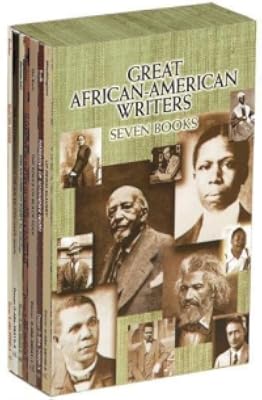
Great African-American Writers: Seven Books
by Dover Publications, Frederick Douglass, W.E.B. DuBois, Paul Laurence Dunbar, James Weldon Johnson, Sojourner Truth, Booker T. Washington
On This Page
Description
This impressive collection contains Frederick Douglass' Narrative of his life; The Souls of Black Folk, by W. E. B. Du Bois; Booker T. Washington's Up from Slavery; The Autobiography of an Ex-Colored Man, by James Weldon Johnson; The Narrative of Sojourner Truth, an autobiography of the dynamic abolitionist; and much more.Tags
Members
- Recently Added By
Author Information

493+ Works 6,031 Members

201+ Works 18,380 Members
Born a slave in Maryland in about 1817, Frederick Douglass never became accommodated to being held in bondage. He secretly learned to read, although slaves were prohibited from doing so. He fought back against a cruel slave-breaker and finally escaped to New Bedford, Massachusetts, in 1838 at about the age of 21. Despite the danger of being sent show more back to his owner if discovered, Douglass became an agent and eloquent orator for the Massachusetts Antislavery Society. He lectured extensively in both England and the United States. As an ex-slave, his words had tremendous impact on his listeners. In 1845 Douglass wrote his autobiography, Narrative of the Life of Frederick Douglass, which increased his fame. Concerned that he might be sent back to slavery, he went to Europe. He spent two years in England and Ireland speaking to antislavery groups. Douglass returned to the United States a free man and settled in Rochester, New York, where he founded a weekly newspaper, The North Star, in 1847. In the newspaper he wrote articles supporting the antislavery cause and the cause of human rights. He once wrote, "The lesson which [the American people] must learn, or neglect to do so at their own peril, is that Equal Manhood means Equal Rights, and further, that the American people must stand for each and all for each without respect to color or race." During the Civil War, Douglass worked for the Underground Railroad, the secret route of escape for slaves. He also helped recruit African-Americans soldiers for the Union army. After the war, he continued to write and to speak out against injustice. In addition to advocating education for freed slaves, he served in several government posts, including United States representative to Haiti. In 1855, a longer version of his autobiography appeared, and in 1895, the year of Douglass's death, a completed version was published. A best-seller in its own time, it has since become available in numerous editions and languages. (Bowker Author Biography) show less

Frederick Douglass has a Legacy Library. Legacy libraries are the personal libraries of famous readers, entered by LibraryThing members from the Legacy Libraries group.
148+ Works 12,872 Members

59+ Works 1,204 Members
Paul Laurence Dunbar was born in June 27, 1872 in Dayton, Ohio. He was the son of ex-slaves and attended school at Dayton Central High School, the only African-American in his class. Dunbar was a member of the debating society, editor of the school paper and president of the school's literary society. He also wrote for Dayton community newspapers. show more He worked as an elevator operator in Dayton's Callahan Building until he established himself locally and nationally as a writer. He published an African-American newsletter in Dayton, the Dayton Tattler, with help from the Wright brothers. Dunbar was the first African-American to gain national eminence as a poet. Oak and Ivy, his first collection, was published in 1892. As his book gained fame, Dunbar was invited to recite at the World's Fair, in 1893 where he met Frederick Douglass. Dunbar's second book, Majors and Minors, propelled him to national fame. A New York publishing firm, Dodd Mead and Co., combined Dunbar's first two books and published them as Lyrics of a Lowly Life. Dunbar then took a job at the Library of Congress in Washington, D.C. He found the work tiresome, however, and the library's dust contributed to his worsening case of tuberculosis. He worked there for only a year before quitting to write and recite full time. Depression and declining health drove him to drink, which further damaged his health. He continued to write, however. He ultimately produced 12 books of poetry, four books of short stories, a play and five novels. His work appeared in Harper's Weekly, the Sunday Evening Post, the Denver Post, Current Literature and a number of other magazines and journals. He died there on Feb. 9, 1906 at the age of 33. (Bowker Author Biography) show less

39+ Works 4,338 Members
Born in Jacksonville Fla. in 1871, James Weldon Johnson was one of the leaders of the Harlem Renaissance of the 1920s. His career was varied and included periods as a teacher, lawyer, songwriter (with his brother J. Rosamond Johnson), and diplomat (as United States Consul to Puerto Cabello, Venezuela, from 1906 to 1909). Among his most famous show more writings are Autobiography of an Ex-Coloured Man, published anonymously in 1912, and God's Trombones: Seven Negro Sermons in Verse (1927), the winner of the Harmon Gold Award. He was also editor of several anthologies of African-American poetry and spirituals, and in 1933 his autobiography, Along This Way, was published. He served as Secretary to the NAACP from 1916 to 1930 and was a professor of literature at Fisk University in Nashville from 1930 until his death in 1938. (Bowker Author Biography) show less

19+ Works 1,528 Members

83+ Works 6,230 Members
Booker Taliaferro Washington, 1856 - 1915 Booker T. Washington was born a slave in Hales Ford, Virginia, near Roanoke. After the U.S. government freed all slaves in 1865, his family moved to Malden, West Virginia. There, Washington worked in coal mines and salt furnaces. He went on to attend the Hampton, Virginia Normal and Agricultural Institute show more from 1872-1875 before joining the staff in 1879. In 1881 he was selected to head the Tuskegee Normal and Industrial Institute, a new teacher-training school for blacks, which he transformed into a thriving institution, later named Tuskegee University. His controversial conviction that blacks could best gain equality in the U.S. by improving their economic situation through education rather than by demanding equal rights was termed the Atlanta Compromise, because Washington accepted inequality and segregation for blacks in exchange for economic advancement. Washington advised two Presidents, Theodore Roosevelt and William Howard Taft, on racial problems and policies, as well as influencing the appointment of several blacks to federal offices. Washington became a shrewd political leader and advised not only Presidents, but also members of Congress and governors. He urged wealthy people to contribute to various black organizations. He also owned or financially supported many black newspapers. In 1900, Washington founded the National Negro Business League to help black business firms. Washington fought silently for equal rights, but was eventually usurped by those who ideas were more radical and demanded more action. Washington was replaced by W. E. B. Du Bois as the foremost black leader of the time, after having spent long years listening to Du Bois deride him for his placation of the white man and the plight of the negro. He died in 1915. (Bowker Author Biography) show less
Series
Belongs to Publisher Series
Common Knowledge
- Canonical title
- Great African-American Writers: Seven Books
- Disambiguation notice
- This collection contains Narrative of his life by Frederick Douglass; The souls of Black folk, by W.E.B. Du Bois; Up from slavery by Booker T. Washington; The autobiography of an ex-colored man, by... (show all) James Weldon Johnson; The narrative of Sojourner Truth; Selected poems by Paul Laurence Dunbar; and African-American poetry
Classifications
Statistics
- Members
- 15
- Popularity
- 1,588,962
- Languages
- English
- Media
- Paper
- ISBNs
- 1
- UPCs
- 1