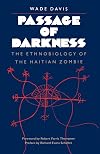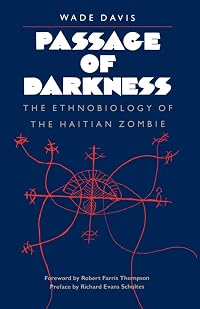
Passage of Darkness: The Ethnobiology of the Haitian Zombie
by Wade Davis
On This Page
Description
Interdisciplinary in nature, this study reveals a netowrk of power relations reaching all levels of Haitian political life. It sheds light on recent Haitian political history, including the meteoric rise under Duvalier of the Tonton Macoute. By explaining zombification as a rational process within the context of traditional Vodoun society, Davis demystifies one of the most exploited of folk beliefs, one that has been used to denegrate an entire people and their religion.Tags
Recommendations














Member Reviews
Wade Davis is an ethnobotanist. What is an ethnobotanist? Ethnobotanists study the relationships among cultures, cultural practices, and the botanical environments in which cultures live.
Ethnobotany is the perfect field to study and understand the zombie phenomenon, stripped of its Hollywood hype. Davis, in this book, undertakes a scientific investigation of zombification — the roles of the powders administered to victims, the spiritual beliefs in which zombification has a place, and the rites and practices that enact zombification in modern day Haiti.
Davis really takes up a series of questions:
Are there actual cases of zombies? If so, exactly, what is a real zombie?
What is the pharmacological basis for making someone a zombie?
What is show more the spiritual basis? How does the zombie fit into Haitian spiritual life?
What are the rites and practices that produce a zombie?
What role does zombification play in Haitian culture and politics?
He begins with some historical and cultural background on Haiti itself. That’s going to be important because, as an ethnobotanist/anthropologist, he believes that zombies and zombification really only are what they are within the culture in which they happen. Ultimately, he will claim that the very possibility of zombification depends on the spiritual beliefs of the victim and the cultural rites and structures in which it lives.
As to whether there are actual cases of zombies, Davis focuses on two relatively well-documented cases — Clairvius Narcisse and Francina Illeus. Narcisse in particular becomes a kind of model case. He was treated at an emergency room in a Haitian hospital, with a fever, body aches, and other more or less minor symptoms. But his condition deteriorated quickly, and he was pronounced dead by two doctors. He was buried in a cemetery under a concrete slab. Then, 18 years later, he re-appeared at a marketplace, recognized his sister, and re-introduced himself.
According to Narcisse, he had been in a dispute with his brother over a land inheritance, and it was his brother who had arranged for his zombification. He was buried, removed from his grave, beaten, and taken to work as a slave. When his master died, he wandered for 16 years before finally returning to his village after his brother’s death.
Narcisse’s story seems, at least in Davis’s telling, to stand up. The death certificate is real, and the identity of the man who showed up in the marketplace 18 years later was verified.
And Narcisse himself could tell his own story. He had been conscious throughout his ordeal, but unable to move or speak. He experienced his own death, burial, and resurrection, as well as his life afterwards.
As to what it actually is to be a zombie in Haitian culture, it’s a little different from the Hollywood version. At its core, what has happened to a zombie is that what makes him or her a person — a will, a character, an identity — has been separated from his or her body. The body, the “zombie cadavre,” goes on, is given a new name, and can be, as Narcisse was, made to work as a slave. It has no will or character of its own.
The other part, what makes the person a true person, called the “ti bon ange” (literally, the “small good angel”), is captured separately. It can be kept by the person, a “bokor” or “sorcerer”, who performs the zombification.
Taking it to be true that there are convincing cases, Davis then discusses how such a thing could be possible. His answer really has two parts.
One is pharmacological. He collects samples of poisons prepared by practitioners and submits them for chemical analysis. There are numerous ingredients or types of ingredients common across the samples he collects, including skin irritants, psychoactive substances, and, most importantly, puffer fish, a source for tetrodotoxin. Tetrodotoxin is a poison that induces a kind of paralysis, the kind that Narcisse reported, that permits the victim to retain consciousness.
Tetrodotoxin poisoning can be fatal, as sometimes happens with poorly prepared puffer fish as a Japanese delicacy. But it seems, by Davis’s account, that it is possible to administer the drug in a dose that is paralyzing but not fatal. The victim can fully recover, as sometimes happens also in the Japanese context.
The other part of zombification is spiritual and cultural. If tetrodotoxin could simply turn a person into a zombie, why wouldn’t it happen to some of those victims of poorly prepared puffer fish in the Japanese context?
The answer has to do with “set and setting”, the psychological and the social/physical contexts of a person undergoing a drug experience. In this case, the psychological context includes strong spiritual beliefs based in a Vodoun (Davis’s preferred term over the hype-laden term “Voodoo”) religion, in which zombification, the ti bon ange, and magical events have central roles. And the social/physical context includes rituals and practices — including the bokor’s performance, the victim’s burial and resurrection, etc.
The possibility of a zombie then depends on all of these factors working together. Davis opposes any idea that a drug can simply turn someone into a zombie. The spiritual and cultural factors are essential.
This may sound a bit magical — the mind playing tricks on the body. But certainly it is true that psychological (and cultural) factors can produce biological effects. Fear raises your heart rate. Depression suppresses your immune system. What is different here is that it is more than a psychological phenomenon (something that we could try to pass off as really biological in nature), it is a spiritual belief that works with psychological factors to produce the zombie experience. Narcisse’s belief in zombies and the ability of a bokor to make a man into a zombie, helped to turn his experience into his becoming a zombie himself.
Not to mention the terrifying experience that Narcisse went through, conscious while buried alive, removed from his grave, and helplessly beaten.
Davis goes on to elaborate on the place of zombification in Haitian culture, and in Haitian politics. Zombification appears to be a kind of punishment, either for violation of community mores or for betrayal of a “secret society.” In Narcisse’s case, he had violated a spate of community mores, involving land inheritance, selfishness, and failure to take responsibility for children he fathered.
The “secret societies” become a theme for much of the last third of the book. The Vodoun religious structures and hierarchies seem to make up a core of Haitian society. They aren’t “secret” in the sense of no one knowing they exist, but they do depend on secret rites, passwords, etc. known to their members, or some of their members.
In fact, their effectiveness depends on their public role. The urban government cannot reach into the mountains and villages without coordination with the Vodoun structures and roles. And it is a coordination, not a straight-forward expression of government authority. Davis discusses how this coordination played out during the Papa Doc Duvalier years (Papa Doc was thought by some to occupy a role within the Vodoun hierarchy himself), and hints at how it may have contributed to the downfall of his son, Baby Doc. In fact, in Davis’s recounting of Haitian history, Vodoun has always played a formidable role in both rebellion (including the Toussaint rebellion in the late 1700s) and in stable authority.
In the Haitian context then Vodoun religious beliefs and practices aren’t so strange. And zombification plays within those beliefs and practices, producing the context in which, with the bokor’s knowledge of plants and preparations, he can make a person a zombie.
Where does all of this leave us? The strength of Davis’s account, I think, is the ethnographic part — his accounts of Vodoun spirituality, practices, and its role in Haitian society and politics. I came away convinced that beliefs about zombies play an important role, certainly in village spiritual and cultural life. It seems natural, not bizarrely superstitious or even irrational, for Haitian villagers to believe in zombies, and even to fear that, if they violated their communities’ mores, they could be made zombies as punishment.
In order to take zombification as a confirmed, scientific reality, it would be great to have more well-documented cases to rely on. In fact, it may be that “successful” zombification is rare. The bokor has to really hit a small bulls-eye to turn someone into a zombie. The victim may simply die, or nothing may happen to them. It depends greatly on the bokor’s skill in preparing the poison and on the quality of the poison itself (the puffer fish seems to have varying levels of toxicity, across varieties, lifetimes, and seasons). The bokor's failures are explained away, and the successful cases, even if rare, establish the basis for belief.
That’s not the kind of scientific, strictly repeatable phenomenon that western science likes. Maybe so much the worse for western science.
The book is fascinating — as I read it, the zombie became more and more a natural, believable thing. Hollywood faded away, and what was left was something that seemed real and understandable. show less
Ethnobotany is the perfect field to study and understand the zombie phenomenon, stripped of its Hollywood hype. Davis, in this book, undertakes a scientific investigation of zombification — the roles of the powders administered to victims, the spiritual beliefs in which zombification has a place, and the rites and practices that enact zombification in modern day Haiti.
Davis really takes up a series of questions:
Are there actual cases of zombies? If so, exactly, what is a real zombie?
What is the pharmacological basis for making someone a zombie?
What is show more the spiritual basis? How does the zombie fit into Haitian spiritual life?
What are the rites and practices that produce a zombie?
What role does zombification play in Haitian culture and politics?
He begins with some historical and cultural background on Haiti itself. That’s going to be important because, as an ethnobotanist/anthropologist, he believes that zombies and zombification really only are what they are within the culture in which they happen. Ultimately, he will claim that the very possibility of zombification depends on the spiritual beliefs of the victim and the cultural rites and structures in which it lives.
As to whether there are actual cases of zombies, Davis focuses on two relatively well-documented cases — Clairvius Narcisse and Francina Illeus. Narcisse in particular becomes a kind of model case. He was treated at an emergency room in a Haitian hospital, with a fever, body aches, and other more or less minor symptoms. But his condition deteriorated quickly, and he was pronounced dead by two doctors. He was buried in a cemetery under a concrete slab. Then, 18 years later, he re-appeared at a marketplace, recognized his sister, and re-introduced himself.
According to Narcisse, he had been in a dispute with his brother over a land inheritance, and it was his brother who had arranged for his zombification. He was buried, removed from his grave, beaten, and taken to work as a slave. When his master died, he wandered for 16 years before finally returning to his village after his brother’s death.
Narcisse’s story seems, at least in Davis’s telling, to stand up. The death certificate is real, and the identity of the man who showed up in the marketplace 18 years later was verified.
And Narcisse himself could tell his own story. He had been conscious throughout his ordeal, but unable to move or speak. He experienced his own death, burial, and resurrection, as well as his life afterwards.
As to what it actually is to be a zombie in Haitian culture, it’s a little different from the Hollywood version. At its core, what has happened to a zombie is that what makes him or her a person — a will, a character, an identity — has been separated from his or her body. The body, the “zombie cadavre,” goes on, is given a new name, and can be, as Narcisse was, made to work as a slave. It has no will or character of its own.
The other part, what makes the person a true person, called the “ti bon ange” (literally, the “small good angel”), is captured separately. It can be kept by the person, a “bokor” or “sorcerer”, who performs the zombification.
Taking it to be true that there are convincing cases, Davis then discusses how such a thing could be possible. His answer really has two parts.
One is pharmacological. He collects samples of poisons prepared by practitioners and submits them for chemical analysis. There are numerous ingredients or types of ingredients common across the samples he collects, including skin irritants, psychoactive substances, and, most importantly, puffer fish, a source for tetrodotoxin. Tetrodotoxin is a poison that induces a kind of paralysis, the kind that Narcisse reported, that permits the victim to retain consciousness.
Tetrodotoxin poisoning can be fatal, as sometimes happens with poorly prepared puffer fish as a Japanese delicacy. But it seems, by Davis’s account, that it is possible to administer the drug in a dose that is paralyzing but not fatal. The victim can fully recover, as sometimes happens also in the Japanese context.
The other part of zombification is spiritual and cultural. If tetrodotoxin could simply turn a person into a zombie, why wouldn’t it happen to some of those victims of poorly prepared puffer fish in the Japanese context?
The answer has to do with “set and setting”, the psychological and the social/physical contexts of a person undergoing a drug experience. In this case, the psychological context includes strong spiritual beliefs based in a Vodoun (Davis’s preferred term over the hype-laden term “Voodoo”) religion, in which zombification, the ti bon ange, and magical events have central roles. And the social/physical context includes rituals and practices — including the bokor’s performance, the victim’s burial and resurrection, etc.
The possibility of a zombie then depends on all of these factors working together. Davis opposes any idea that a drug can simply turn someone into a zombie. The spiritual and cultural factors are essential.
This may sound a bit magical — the mind playing tricks on the body. But certainly it is true that psychological (and cultural) factors can produce biological effects. Fear raises your heart rate. Depression suppresses your immune system. What is different here is that it is more than a psychological phenomenon (something that we could try to pass off as really biological in nature), it is a spiritual belief that works with psychological factors to produce the zombie experience. Narcisse’s belief in zombies and the ability of a bokor to make a man into a zombie, helped to turn his experience into his becoming a zombie himself.
Not to mention the terrifying experience that Narcisse went through, conscious while buried alive, removed from his grave, and helplessly beaten.
Davis goes on to elaborate on the place of zombification in Haitian culture, and in Haitian politics. Zombification appears to be a kind of punishment, either for violation of community mores or for betrayal of a “secret society.” In Narcisse’s case, he had violated a spate of community mores, involving land inheritance, selfishness, and failure to take responsibility for children he fathered.
The “secret societies” become a theme for much of the last third of the book. The Vodoun religious structures and hierarchies seem to make up a core of Haitian society. They aren’t “secret” in the sense of no one knowing they exist, but they do depend on secret rites, passwords, etc. known to their members, or some of their members.
In fact, their effectiveness depends on their public role. The urban government cannot reach into the mountains and villages without coordination with the Vodoun structures and roles. And it is a coordination, not a straight-forward expression of government authority. Davis discusses how this coordination played out during the Papa Doc Duvalier years (Papa Doc was thought by some to occupy a role within the Vodoun hierarchy himself), and hints at how it may have contributed to the downfall of his son, Baby Doc. In fact, in Davis’s recounting of Haitian history, Vodoun has always played a formidable role in both rebellion (including the Toussaint rebellion in the late 1700s) and in stable authority.
In the Haitian context then Vodoun religious beliefs and practices aren’t so strange. And zombification plays within those beliefs and practices, producing the context in which, with the bokor’s knowledge of plants and preparations, he can make a person a zombie.
Where does all of this leave us? The strength of Davis’s account, I think, is the ethnographic part — his accounts of Vodoun spirituality, practices, and its role in Haitian society and politics. I came away convinced that beliefs about zombies play an important role, certainly in village spiritual and cultural life. It seems natural, not bizarrely superstitious or even irrational, for Haitian villagers to believe in zombies, and even to fear that, if they violated their communities’ mores, they could be made zombies as punishment.
In order to take zombification as a confirmed, scientific reality, it would be great to have more well-documented cases to rely on. In fact, it may be that “successful” zombification is rare. The bokor has to really hit a small bulls-eye to turn someone into a zombie. The victim may simply die, or nothing may happen to them. It depends greatly on the bokor’s skill in preparing the poison and on the quality of the poison itself (the puffer fish seems to have varying levels of toxicity, across varieties, lifetimes, and seasons). The bokor's failures are explained away, and the successful cases, even if rare, establish the basis for belief.
That’s not the kind of scientific, strictly repeatable phenomenon that western science likes. Maybe so much the worse for western science.
The book is fascinating — as I read it, the zombie became more and more a natural, believable thing. Hollywood faded away, and what was left was something that seemed real and understandable. show less
Zombies are all the rage these days. Heck, there are even warnings about them on the trafic signs. If you need a fix of zombie but a re getting a bit tired of the cliches, here are two classics that look at zombies in the context of West Indian legend. Wade Davis got interested in zombies via the case of Clairvius Narcisse, a Haitian man pronounced dead, buried, yet who rose again as a true survivor of zombiesm. Davis’s explorations found startling evidence about how poisons could manipulate the appearance of life and death to create the “living dead” as part of an elaborate means of social control.
http://fireandsword.blogspot.com/2009/03/zombies-some-practical-guides.html
http://fireandsword.blogspot.com/2009/03/zombies-some-practical-guides.html
Ratings
Members
- Recently Added By
Lists

Best Zombie Books
77 works; 9 members
Author Information

30+ Works 4,684 Members
Wade Davis is Explorer-in-Residence at the National Geographic Society. An ethnographer, photographer, filmmaker, and writer, he is the author of Light at the Edge of the World, One River, the international bestseller The Serpent and the Rainbow, and other books. His articles have appeared in Outside, Cond Nast Traveler, National Geographic, show more Scientific American, and many other publications. show less
Common Knowledge
- Important places
- Caribbean Region; French West Indies; Haiti; Hispaniola; West Indies
Classifications
- Genres
- Anthropology, Nonfiction, Religion & Spirituality, General Nonfiction, History
- DDC/MDS
- 299.65 — Religion Other religions Shintoism/Taoism/Other Mythologies Of African Origin Other Religious Practice
- LCC
- BL2530 .H3 .D37 — Philosophy, Psychology and Religion Religions. Mythology. Rationalism Religions. Mythology. Rationalism History and principles of religions American
- BISAC
Statistics
- Members
- 139
- Popularity
- 233,538
- Reviews
- 2
- Rating
- (4.29)
- Languages
- English
- Media
- Paper, Ebook
- ISBNs
- 4
- ASINs
- 1