
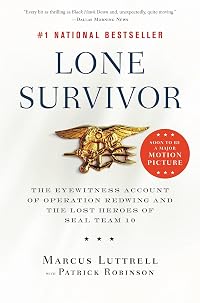
Lone Survivor : The Eyewitness Account of Operation Redwing and the Lost Heroes of SEAL Team 10
by Marcus Luttrell
On This Page
Description
Follow along a Navy SEAL's firsthand account of American heroism during a secret military operation in Afghanistan in this true story of survival and difficult choices.On a clear night in late June 2005, four U.S. Navy SEALs left their base in northern Afghanistan for the mountainous Pakistani border. Their mission was to capture or kill a notorious al Qaeda leader known to be ensconced in a Taliban stronghold surrounded by a small but heavily armed force. Less then twenty-four hours later, show more only one of those Navy SEALs remained alive.
This is the story of fire team leader Marcus Luttrell, the sole survivor of Operation Redwing, and the desperate battle in the mountains that led, ultimately, to the largest loss of life in Navy SEAL history. But it is also, more than anything, the story of his teammates, who fought ferociously beside him until he was the last one left-blasted unconscious by a rocket grenade, blown over a cliff, but still armed and still breathing. Over the next four days, badly injured and presumed dead, Luttrell fought off six al Qaeda assassins who were sent to finish him, then crawled for seven miles through the mountains before he was taken in by a Pashtun tribe, who risked everything to protect him from the encircling Taliban killers.
A six-foot-five-inch Texan, Leading Petty Officer Luttrell takes us, blow by blow, through the brutal training of America's warrior elite and the relentless rites of passage required by the Navy SEALs. He transports us to a monstrous battle fought in the desolate peaks of Afghanistan, where the beleaguered American team plummeted headlong a thousand feet down a mountain as they fought back through flying shale and rocks.
In this rich, moving chronicle of courage, honor, and patriotism, Marcus Luttrell delivers one of the most powerful narratives ever written about modern warfare — and a tribute to his teammates, who made the ultimate sacrifice for their country. show less
Tags
Recommendations

Member Recommendations
Member Reviews
The title Lone Survivor immediately references Lady Butler's famous painting "The remnants of an army" which shows assistant surgeon William Brydon returning as the sole survivor from the British retreat of Kabul in 1842. The US action in Afghanistan was less costly. Marcus Luttrell was part of a four man Navy SEALs team that was wiped out in Afghanistan during Operation Red Wings. The heavily scrubbed Wikipedia entry classifies this operation as a "temporary U.S. Pyrrhic victory; Long-term insurgent victory". With a 100% US casualty rate and not a single goal achieved, this assessment is only sustainable if one either takes Monty Python's Black Knight as a role model or considers the Alamo as a US victory. In reality, this minor action show more was a clear defeat, caused by bad US leadership both strategically down to the tactical level. Luttrell is not the man to understand complex matters. His memoirs about his time in Afghanistan nevertheless can serve as good data for two analyses.
Firstly, Luttrell offers a postcard introduction into the mindset of an authoritarian follower (and Republican voter). His mind effortlessly tolerates to hold hugely contradictory opinions and facts. While he is easily (and often wrongly) offended by accusations and actions of others he puts in one out-group (the liberal press, Europeans, liberals, Muslims, ...), he resents their undifferentiated portrait as a religious redneck, Texan, American, SEAL, soldier (his main in-groups). The out-groups seem in his mind to work together to crush his in-group and deserve to be punished. Thus, he thinks the torture at Abu Ghraib justified by 9/11 as the suicide terrorists as well as the Iraqi torture victims are both Muslims. Killing Afghanis is ok, because they are all Taliban, even if he owes his survival to a brave Afghani who protected the wounded Luttrell from certain death and risked his own life to save the American. Lutrell holds a special disdain for the Geneva Convention despite the fact that his survival is in accordance to its principles. It is truly an authoritarian madness to fight forcefully against something that improves everyone's (including their own) lives. The book does not make it clear whether the Rambo Jesus worshiping Luttrell has understood that his Muslim savior acted in the best Samaritan tradition as promoted by Jesus. He bound his wounds, took care of him and delivered him into the safety of American troops. If such an act did not open Luttrell's mind, what possibly could?
Secondly, the book can serve as a good case-study of failures in decision making in an isolated small group. A parallel read of Norman Maclean's Young Men and Fire and the analysis of the Mann Gulch catastrophe by Karl Weick is especially recommended. The failure of the SEAL team can be tracked back to their training. They lacked decision patterns what to do once detected. In their SEAL training, a blown cover meant "game over". In reality, it was the beginning of a far more dangerous chain of events. Not having decision patterns available to select from. the officer in command of the SEAL team had to improvise. Any mistakes would and did prove fatal. Once they were detected by goat herders, the SEALs pondered the wrong question (Should we shoot them?) but arrived (barely) at the correct answer because they didn't see a way to also dispose of the obvious goat herd around of them. Instead of aborting the mission and holding on to the goat herders, they let them go and failed to inform their HQ that their cover had been blown. The SEALs had handed over the initiative to the Taliban who only had to bag their hunters turned prey. The SEALs made their position even more awkward in moving towards the valley, letting the Taliban occupy the high ground. Thus, when the fire started, the Taliban didn't need much numerical superiority. The books speaks of hundreds of Taliban while the author's own more realistic after action report talks of about thirty Taliban. The Taliban outfought the SEALs because they were more mobile and had a clear mission. The Americans lost valuable time in shifting between defense, seeking to establish communication and flight. A drastic description of being on the receiving end of the enemy's superior OODA loop. HQ compounded the mistake and casualty list (19 KIA, 1 WIA) by sending a troop-carrying helicopter in which the Taliban promptly shot down.
As Luttrell himself mentions, the selection and training of the SEALs is to accomplish waterborne missions. The burly SEALs are at a disadvantage in the steep Afghanistan mountains which require scrawny climber physiques. The SEALs were also bogged down under bundles of equipment and ammo, while the Taliban traveled light with dedicated ammo and water carriers. The inhospitable rocks furthermore tore much of the SEALs' equipment off during their hasty movements. In the current glorification of the Special Forces, it is often forgotten that these aren't super soldiers but men specifically trained for certain missions ("special"). Using them like Swiss pocket knives is wasteful and ineffective. In contrast to the supposedly high language skill component of Special Forces soldiers, Luttrell went into action without knowing even basic words such as "water" and had to rely on the English language skills of the Afghanis to help him out. Luttrell was lucky to survive, meeting his own Samaritan. He does not seem to have learned much from this sorry affair though. show less
Firstly, Luttrell offers a postcard introduction into the mindset of an authoritarian follower (and Republican voter). His mind effortlessly tolerates to hold hugely contradictory opinions and facts. While he is easily (and often wrongly) offended by accusations and actions of others he puts in one out-group (the liberal press, Europeans, liberals, Muslims, ...), he resents their undifferentiated portrait as a religious redneck, Texan, American, SEAL, soldier (his main in-groups). The out-groups seem in his mind to work together to crush his in-group and deserve to be punished. Thus, he thinks the torture at Abu Ghraib justified by 9/11 as the suicide terrorists as well as the Iraqi torture victims are both Muslims. Killing Afghanis is ok, because they are all Taliban, even if he owes his survival to a brave Afghani who protected the wounded Luttrell from certain death and risked his own life to save the American. Lutrell holds a special disdain for the Geneva Convention despite the fact that his survival is in accordance to its principles. It is truly an authoritarian madness to fight forcefully against something that improves everyone's (including their own) lives. The book does not make it clear whether the Rambo Jesus worshiping Luttrell has understood that his Muslim savior acted in the best Samaritan tradition as promoted by Jesus. He bound his wounds, took care of him and delivered him into the safety of American troops. If such an act did not open Luttrell's mind, what possibly could?
Secondly, the book can serve as a good case-study of failures in decision making in an isolated small group. A parallel read of Norman Maclean's Young Men and Fire and the analysis of the Mann Gulch catastrophe by Karl Weick is especially recommended. The failure of the SEAL team can be tracked back to their training. They lacked decision patterns what to do once detected. In their SEAL training, a blown cover meant "game over". In reality, it was the beginning of a far more dangerous chain of events. Not having decision patterns available to select from. the officer in command of the SEAL team had to improvise. Any mistakes would and did prove fatal. Once they were detected by goat herders, the SEALs pondered the wrong question (Should we shoot them?) but arrived (barely) at the correct answer because they didn't see a way to also dispose of the obvious goat herd around of them. Instead of aborting the mission and holding on to the goat herders, they let them go and failed to inform their HQ that their cover had been blown. The SEALs had handed over the initiative to the Taliban who only had to bag their hunters turned prey. The SEALs made their position even more awkward in moving towards the valley, letting the Taliban occupy the high ground. Thus, when the fire started, the Taliban didn't need much numerical superiority. The books speaks of hundreds of Taliban while the author's own more realistic after action report talks of about thirty Taliban. The Taliban outfought the SEALs because they were more mobile and had a clear mission. The Americans lost valuable time in shifting between defense, seeking to establish communication and flight. A drastic description of being on the receiving end of the enemy's superior OODA loop. HQ compounded the mistake and casualty list (19 KIA, 1 WIA) by sending a troop-carrying helicopter in which the Taliban promptly shot down.
As Luttrell himself mentions, the selection and training of the SEALs is to accomplish waterborne missions. The burly SEALs are at a disadvantage in the steep Afghanistan mountains which require scrawny climber physiques. The SEALs were also bogged down under bundles of equipment and ammo, while the Taliban traveled light with dedicated ammo and water carriers. The inhospitable rocks furthermore tore much of the SEALs' equipment off during their hasty movements. In the current glorification of the Special Forces, it is often forgotten that these aren't super soldiers but men specifically trained for certain missions ("special"). Using them like Swiss pocket knives is wasteful and ineffective. In contrast to the supposedly high language skill component of Special Forces soldiers, Luttrell went into action without knowing even basic words such as "water" and had to rely on the English language skills of the Afghanis to help him out. Luttrell was lucky to survive, meeting his own Samaritan. He does not seem to have learned much from this sorry affair though. show less
Hard review to write... In one sense I loved this (audio) book - it's reads like a modern day Louis L'Amour adventure tale, full of action and gun-totin', fun-lovin', wise-crackin', ever-so-intelligent good guys doing their best to catch the evil ugly stinkin' loathsome sneaky bad guys and it's so very easy to distinguish the two. Why, don't-cha know? one wears a "Texas patch" and the other a turban. Life is easy.
OTOH it's (mostly) cringe-inducing, pathetic drivel: the author clumsily writes about his incredibly "intelligent" SEAL friends and spouts rah-rah shoot-em-up "we're #1!" trite-isms from start to finish. I can only exclaim "Well, bless his heart, he certainly deserves an gold star for effort". The book is so shallow, so show more UN-insightful, so plain ol' stupid... I don't know whether to laugh or cry. Oh man... BBooks like this, and American Sniper, make me sad - we as a country are not going to get anywhere until we get past "poster patriotism".
You won't miss a thing skipping this book. show less
OTOH it's (mostly) cringe-inducing, pathetic drivel: the author clumsily writes about his incredibly "intelligent" SEAL friends and spouts rah-rah shoot-em-up "we're #1!" trite-isms from start to finish. I can only exclaim "Well, bless his heart, he certainly deserves an gold star for effort". The book is so shallow, so show more UN-insightful, so plain ol' stupid... I don't know whether to laugh or cry. Oh man... BBooks like this, and American Sniper, make me sad - we as a country are not going to get anywhere until we get past "poster patriotism".
You won't miss a thing skipping this book. show less
Three seconds after I sat at my Mac, sipping coffee, on a clear Sunday morning and began wondering how many stars I would give this book, I shook my head and rolled my eyes at my own thoughts. After finishing Lone Survivor, get ready for that to happen more than once: it’s one of those books (like Narrative of the Life of Frederick Douglass or A Grief Observed) that serves as an antidote to complaint, a reminder of how good so many of us have it, and a necessary corrective to one’s ego. Really—who cares how many stars I give this book?
Readers of Othello often misunderstand the word “honest” when applied to Iago: when Cassio and others call him “honest Iago,” some readers point and say, “Aha! That’s ironic!” It is, of show more course, but “honest" doesn’t mean “truthful” here—it means “unpretentious,” “down-to-earth,” “base,” “unsophisticated.” It’s a word we use to describe the songs of Hank Williams (instead of Hayden), mass produced beer (instead of microbrew IPAs), and Marvel comics movies (instead of Rashamon). The former in each case is not so much inferior to the latter as it is different. It’s a matter of kind, rather than degree. That’s why Iago is so dangerous: not only because he’s duplicitous but because part of his act is that he comes across as incapable of being so. No one faults Agatha Christie for not writing like Henry James; I cannot fault Marcus Luttrell for not writing like Homer.
Lone Survivor is honest in this sense of the word. It’s a well-structured portrayal of Navy SEAL training and the awful events in which that training is tested. It made me better appreciate many aspects of military life that I—an academic cupcake—am better for having learned.
I find it interesting that some reviewers fault Luttrell for two things: his "arrogance" and for editorializing at times about the American media and how the SEALs’ actions would be reported. The first charge is easily answered: the guy is a SEAL and part of that training is to understand that you are one of the best in the world; that kind of thinking, I imagine, helps these guys when they are facing seemingly impossible odds. And the ways in which he speaks of his fellow SEALs and country demonstrate great humility. (Of course, the arrogance of those who presume to tell Luttrell how to comport himself is never questioned.)
Regarding the second charge: if not he, who is qualified to talk about such matters as rules of engagement and our role in Afghanistan? The awful events in which Operation Redwing falls apart occur because the SEALSs—the toughest and most steadfast men on the planet—are concerned by how their actions might play on cable news and in American courts. These men who made it through SEAL training were, as Luttrell states, “afraid of American civilian lawyers.” His words on this subject are worth considering:
I have only one piece of advice for what it’s worth: if you don’t want to get into a war where things go wrong, where the wrong people sometimes get killed, where innocent people sometimes have to die, then stay the hell out of it in the first place. Because that’s what happens. In all wars, down all the years of history. Terrible injustices, the killing of people who did not deserve to die. That’s what war is. And if you can’t cope with it, don’t do it. (313)
This is not a policy wonk, a professor, a talking head on TV, but someone who has been there and can see through the op-ed pages. He knows that Americans often want to have it both ways: let's have a war, yes, but one in which only the members of HYDRA are killed and everyone from SHIELD ends up back at Stark Tower. In an era where anyone with a Twitter account is empowered to express his or her expertise about matters he or she understands wholly through other Twitter accounts, Lone Survivor is an important book. show less
Readers of Othello often misunderstand the word “honest” when applied to Iago: when Cassio and others call him “honest Iago,” some readers point and say, “Aha! That’s ironic!” It is, of show more course, but “honest" doesn’t mean “truthful” here—it means “unpretentious,” “down-to-earth,” “base,” “unsophisticated.” It’s a word we use to describe the songs of Hank Williams (instead of Hayden), mass produced beer (instead of microbrew IPAs), and Marvel comics movies (instead of Rashamon). The former in each case is not so much inferior to the latter as it is different. It’s a matter of kind, rather than degree. That’s why Iago is so dangerous: not only because he’s duplicitous but because part of his act is that he comes across as incapable of being so. No one faults Agatha Christie for not writing like Henry James; I cannot fault Marcus Luttrell for not writing like Homer.
Lone Survivor is honest in this sense of the word. It’s a well-structured portrayal of Navy SEAL training and the awful events in which that training is tested. It made me better appreciate many aspects of military life that I—an academic cupcake—am better for having learned.
I find it interesting that some reviewers fault Luttrell for two things: his "arrogance" and for editorializing at times about the American media and how the SEALs’ actions would be reported. The first charge is easily answered: the guy is a SEAL and part of that training is to understand that you are one of the best in the world; that kind of thinking, I imagine, helps these guys when they are facing seemingly impossible odds. And the ways in which he speaks of his fellow SEALs and country demonstrate great humility. (Of course, the arrogance of those who presume to tell Luttrell how to comport himself is never questioned.)
Regarding the second charge: if not he, who is qualified to talk about such matters as rules of engagement and our role in Afghanistan? The awful events in which Operation Redwing falls apart occur because the SEALSs—the toughest and most steadfast men on the planet—are concerned by how their actions might play on cable news and in American courts. These men who made it through SEAL training were, as Luttrell states, “afraid of American civilian lawyers.” His words on this subject are worth considering:
I have only one piece of advice for what it’s worth: if you don’t want to get into a war where things go wrong, where the wrong people sometimes get killed, where innocent people sometimes have to die, then stay the hell out of it in the first place. Because that’s what happens. In all wars, down all the years of history. Terrible injustices, the killing of people who did not deserve to die. That’s what war is. And if you can’t cope with it, don’t do it. (313)
This is not a policy wonk, a professor, a talking head on TV, but someone who has been there and can see through the op-ed pages. He knows that Americans often want to have it both ways: let's have a war, yes, but one in which only the members of HYDRA are killed and everyone from SHIELD ends up back at Stark Tower. In an era where anyone with a Twitter account is empowered to express his or her expertise about matters he or she understands wholly through other Twitter accounts, Lone Survivor is an important book. show less
Marcus Luttrell, the only survivor of Operation Redwing, writes the story that includes the dubious distinction of the largest loss of life in Navy Seal history; Lone Survivor.
Luttrell’s story takes you into the brutal training and discipline required for the elite warriors, the Navy Seals. Interspersed with this detailed regimen is the story of four Navy SEALS in northern Afghanistan near the Pakinstan border during their mission to capture or kill an al Qaeda leader shielded by the Taliban. After twenty four hours, only one Seal remains alive. Luttrell writes as a tribute to his team who trained and fought with him, to the conditions of SEAL life and to the dedication and sacrifice these individuals offer.
Luttrell is opinionated, show more tough, dedicated and loyal. He questions the motives of left wing liberal war dissenters and their inability to understand the effect policies have on the front liners. While I strongly question the direction our foreign policy is taking our country, I clearly see Marcus Luttrell’s integrity and admire his passion and fortitude. His writing allows me to question whether we are underfunding, undermanning and undersupporting our courageous troups in their heroic and sacrificial efforts.
Luttrell survives due to a Pashtun custom of never refusing aid to one who asks. A tiny Pashtun tribe risks everything to protect and harbor this soldier who arrives four days after the fight having crawled and fallen into their village. A non-stop read, a fresh perspective on war and a window into the lives of the military serving in the Middle East show less
Luttrell’s story takes you into the brutal training and discipline required for the elite warriors, the Navy Seals. Interspersed with this detailed regimen is the story of four Navy SEALS in northern Afghanistan near the Pakinstan border during their mission to capture or kill an al Qaeda leader shielded by the Taliban. After twenty four hours, only one Seal remains alive. Luttrell writes as a tribute to his team who trained and fought with him, to the conditions of SEAL life and to the dedication and sacrifice these individuals offer.
Luttrell is opinionated, show more tough, dedicated and loyal. He questions the motives of left wing liberal war dissenters and their inability to understand the effect policies have on the front liners. While I strongly question the direction our foreign policy is taking our country, I clearly see Marcus Luttrell’s integrity and admire his passion and fortitude. His writing allows me to question whether we are underfunding, undermanning and undersupporting our courageous troups in their heroic and sacrificial efforts.
Luttrell survives due to a Pashtun custom of never refusing aid to one who asks. A tiny Pashtun tribe risks everything to protect and harbor this soldier who arrives four days after the fight having crawled and fallen into their village. A non-stop read, a fresh perspective on war and a window into the lives of the military serving in the Middle East show less
On the cover of the paperback edition I read is the following quote from the Dallas Morning News: "Every bit as thrilling as Black Hawk Down and, unexpectedly, quite moving." That actually sums up my opinion of the book as well. This is the story of Marcus Luttrell, a man who doggedly pursued, and then achieved his dream of becoming a US Navy SEAL. The earlier portion of the book introduces the reader to Marcus, following him through boot camp, and then through the fabled BUD/S course (I could never make it!). It really is incredible what these guys go through.
Nearly halfway through the book, Marcus begins to tell the story of the failed Operation Redwing, which saw 4 SEALs inserted into the mountains of northeast Afghanistan, and only show more one surviving to tell the tale. The insurmountable odds that Marcus Luttrell had to face are truly incredible. The story of the final moments of his squadmates contains more courage, more valor, than any 10 hollywood action films combined. These are the REAL heros. Not to be forgotten are the Pashtuns who found Marcus & tended to his wounds - protecting him from the Taliban, despite the threats levied against them.
Few books move me to tears, but this one did. I don't remember exactly where it was, but somewhere in the final 50 pages it hit me.
After reading the book, I've found online that apparently this book is very polarizing. Folks tend to love it or hate it. At this point it is apparent which camp I fall into. It seems that the most common gripe amongst those who dislike the book has to do with Marcus's political views which he shares. Make no mistake about it, Marcus Luttrell is a conservative, and doesn't split any hairs when it comes to sharing his opinion regarding such issues as the role of journalism in wartime, whether or not the Taliban or Al Qaeda insurgents should be subject to the articles of the Geneva Convention (Marcus says no), and the rules of engagement by which the military is forced to act (lest they be tried as criminals & jailed as murderers back home). By & large, I agree with Marcus. His opinions are going to piss a lot of people off (and they have). I'm amazed by how many people seem to think that he shouldn't have shared such views in the book - how it "ruins" the book. Well folks, its HIS story - I can't recall ever reading anyone's memoirs or autobiography in which you didn't get any opinion-based commentary.
I know there are some who will no doubt object to what I'm about to say, but if they just shot those 3 goat farmers who stumbled upon them early on in the mission, the Taliban might never have been alerted to their presence, and the SEALs might have accomplished their mission & extracted without casualties. I know that Marcus must still be haunted by this.
THE FALLEN HEROES - who cannot be honored enough:
Marcus's squadmates:
LT Michael P. Murphy, 29
STG2 Matthew Axelson, 29
GM2 Danny Dietz, 25
Those killed on board the rescue helicopter which was shot down by a Taliban RPG:
SEALs:
FCC Jacques J. Fontan, 36
ITCS Daniel R. Healy, 36
LCDR Erik S. Kristensen, 33
ET1 Jeffery A. Lucas, 33
LT Michael M. McGreevy, Jr., 30
QM2 James E. Suh, 28
HM1 Jeffrey S. Taylor, 30
MM2 Shane E. Patton, 22
US ARMY 160th Special Operations Aviation Regiment (the "Night Stalkers"):
SSG Shamus O. Goare, 29
CWO3 Corey J. Goodnature, 35
SGT Kip A. Jacoby, 21
SFC Marcus V. Muralles, 33
MSG James W. Ponder III, 36
MAJ Stephen C. Reich, 34
SFC Michael L. Russell, 31
CWO4 Chris J. Scherkenbach, 40 show less
Nearly halfway through the book, Marcus begins to tell the story of the failed Operation Redwing, which saw 4 SEALs inserted into the mountains of northeast Afghanistan, and only show more one surviving to tell the tale. The insurmountable odds that Marcus Luttrell had to face are truly incredible. The story of the final moments of his squadmates contains more courage, more valor, than any 10 hollywood action films combined. These are the REAL heros. Not to be forgotten are the Pashtuns who found Marcus & tended to his wounds - protecting him from the Taliban, despite the threats levied against them.
Few books move me to tears, but this one did. I don't remember exactly where it was, but somewhere in the final 50 pages it hit me.
After reading the book, I've found online that apparently this book is very polarizing. Folks tend to love it or hate it. At this point it is apparent which camp I fall into. It seems that the most common gripe amongst those who dislike the book has to do with Marcus's political views which he shares. Make no mistake about it, Marcus Luttrell is a conservative, and doesn't split any hairs when it comes to sharing his opinion regarding such issues as the role of journalism in wartime, whether or not the Taliban or Al Qaeda insurgents should be subject to the articles of the Geneva Convention (Marcus says no), and the rules of engagement by which the military is forced to act (lest they be tried as criminals & jailed as murderers back home). By & large, I agree with Marcus. His opinions are going to piss a lot of people off (and they have). I'm amazed by how many people seem to think that he shouldn't have shared such views in the book - how it "ruins" the book. Well folks, its HIS story - I can't recall ever reading anyone's memoirs or autobiography in which you didn't get any opinion-based commentary.
I know there are some who will no doubt object to what I'm about to say, but if they just shot those 3 goat farmers who stumbled upon them early on in the mission, the Taliban might never have been alerted to their presence, and the SEALs might have accomplished their mission & extracted without casualties. I know that Marcus must still be haunted by this.
THE FALLEN HEROES - who cannot be honored enough:
Marcus's squadmates:
LT Michael P. Murphy, 29
STG2 Matthew Axelson, 29
GM2 Danny Dietz, 25
Those killed on board the rescue helicopter which was shot down by a Taliban RPG:
SEALs:
FCC Jacques J. Fontan, 36
ITCS Daniel R. Healy, 36
LCDR Erik S. Kristensen, 33
ET1 Jeffery A. Lucas, 33
LT Michael M. McGreevy, Jr., 30
QM2 James E. Suh, 28
HM1 Jeffrey S. Taylor, 30
MM2 Shane E. Patton, 22
US ARMY 160th Special Operations Aviation Regiment (the "Night Stalkers"):
SSG Shamus O. Goare, 29
CWO3 Corey J. Goodnature, 35
SGT Kip A. Jacoby, 21
SFC Marcus V. Muralles, 33
MSG James W. Ponder III, 36
MAJ Stephen C. Reich, 34
SFC Michael L. Russell, 31
CWO4 Chris J. Scherkenbach, 40 show less
This is a tale of two books.
4 Stars to the portions of this book which detail the author's experience with SEAL training and the incredible tale of his fighting and surviving in Afganistan. This is really good stuff, pretty well written, and extremely engaging. I would widely recommend this book if the book was abridged to just this content. But unfortunately, there is a second side to the book...
1 star for the childish, unintelligent, political blather. It's not that I completely disagree with his politics, what little core I could discern from the rambling, it's that he gives absolutely no factual or rational basis for his droning. I wish his co-writer had been able to convince him that the political "discourse" distracts from the show more story. In fact, his story alone supports a good bit of what I think he is trying to convey politically. And if he would let the story stand on it's on merit, then most readers, of most political leanings, would see a perspective which would nudge them towards his important political principals.
This is a tough book to rate, and hard to recommend. The SEAL portions are excellent, the political portions are trash. To be honest, giving it 3 stars is generous, but I do want to recognize the important parts. Honestly, and I hate to say this, but it's really just best to go see the movie.
Recommended only for those readers who can sift through lots of drivel to get to pearls of excellence. show less
4 Stars to the portions of this book which detail the author's experience with SEAL training and the incredible tale of his fighting and surviving in Afganistan. This is really good stuff, pretty well written, and extremely engaging. I would widely recommend this book if the book was abridged to just this content. But unfortunately, there is a second side to the book...
1 star for the childish, unintelligent, political blather. It's not that I completely disagree with his politics, what little core I could discern from the rambling, it's that he gives absolutely no factual or rational basis for his droning. I wish his co-writer had been able to convince him that the political "discourse" distracts from the show more story. In fact, his story alone supports a good bit of what I think he is trying to convey politically. And if he would let the story stand on it's on merit, then most readers, of most political leanings, would see a perspective which would nudge them towards his important political principals.
This is a tough book to rate, and hard to recommend. The SEAL portions are excellent, the political portions are trash. To be honest, giving it 3 stars is generous, but I do want to recognize the important parts. Honestly, and I hate to say this, but it's really just best to go see the movie.
Recommended only for those readers who can sift through lots of drivel to get to pearls of excellence. show less
This book is a great look into what its like to become a Navy SEAL and the kind of dedication and determination it takes to attain that status. It's also a harrowing tale of Luttrell's escape from the Taliban and the people who helped him survive. My main complaint: the refrain of politics that runs throughout. I understand this is his story and his views are part of that story. I even understand how his views are almost certainly shaped by his experiences, ones that I cannot hope to comprehend. What I object to is the need for "owning the libs" in every chapter, especially when that involves somewhat misrepresenting the stance 'liberals' were taken when they objected to certain abuses perpetrated during the Afghanistan and Iraq Wars. show more That said, it was still worth a read. show less
Members
- Recently Added By
Published Reviews
ThingScore 25
Just because Luttrell got his facts wrong, criticized the rules of engagement needlessly, and misunderstands counter-insurgency, that doesn’t mean his memoir is bad art. Misguided definitely, but not necessarily a poor piece of writing.
Except Lone Survivor is a bad piece of writing, and I hope it will be forgotten in twenty years.
Except Lone Survivor is a bad piece of writing, and I hope it will be forgotten in twenty years.
added by Donogh
Lists

Independent Reading Suggestions
69 works; 3 members

Holding the Zero
56 works; 1 member

Wishlist
4 works; 1 member
Author Information

4 Works 4,021 Members
Marcus Luttrell (born November 7, 1975) is a former Petty Officer First Class and United States Navy SEAL. He received the Navy Cross for his actions in 2005 facing Taliban fighters during Operation Redwing. Born in Houston, Texas and raised in Willis, Texas, Luttrell joined the United States Navy in March 1999. He began Basic Underwater show more Demolition/SEAL (BUD/S) training with Class 226 in Coronado, California. He graduated with Class 228 after suffering a fractured femur early in his training. He was deployed to Afghanistan in 2005. Prior to Afghanistan, Luttrell had been part of SEAL Team 5 and participated in Operation Iraqi Freedom doing various operations there. Luttrell's New York Times bestselling book, Lone Survivor, tells the story of Operation Redwing and the navy SEAL Team 10 who were assigned to a mission to kill or capture Ahmad Shah (nom de guerre Mohammad Ismail), a high-ranking Taliban leader responsible for killings in eastern Afghanistan and the Hindu-Kush mountains. Luttrell was the only survivor of the SEAL team. In his next book, Service: A Navy SEAL at War, Luttrell recounts his experiences in Iraq as a member of SEAL Team 5 and offers new insights into his miraculous rescue during Operation Redwing. (Bowker Author Biography) show less
All Editions
Awards and Honors
Awards
Distinctions
Common Knowledge
- Canonical title
- Lone Survivor : The Eyewitness Account of Operation Redwing and the Lost Heroes of SEAL Team 10
- Original title
- Lone Survivor : The Eyewitness Account of Operation Redwing and the Lost Heroes of SEAL Team 10
- People/Characters
- Marcus Luttrell; Michael P. Murphy; Danny Dietz; Erik Kristensen; Matthew Axelson
- Important places
- Coronado, California, USA; Afghanistan
- Important events
- Operation Redwing; Operation Red Wings
- Related movies
- Lone Survivor (2013 | IMDb)
Classifications
Statistics
- Members
- 3,675
- Popularity
- 4,384
- Reviews
- 84
- Rating
- (4.06)
- Languages
- 5 — English, Estonian, French, German, Swedish
- Media
- Paper, Audiobook, Ebook
- ISBNs
- 33
- ASINs
- 29