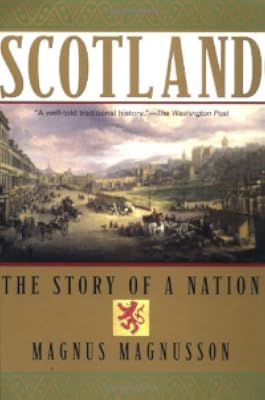
Scotland: The Story of a Nation
by Magnus Magnusson
On This Page
Description
A timely and vivid look at Scotland's long and difficult road to nationhood, re-exploring some cherished myths and unearthing a wealth of fascinating new detail. This edition contains a limited number of illustrations. Magnus Magnusson's starting point is Sir Walter Scott's classic version of Scotland's history, 'Tales of a Grandfather' (1827-29), which has molded the views of generations of Scottish schoolchildren. Like Scott, Magnus Magnusson is a master story teller. In investigating the show more many questions raised by the nation's turbulent and often poignant past, he gives full weight to the living treasure of local legends and tradition which he believes has as much resonance as academic analysis. Where did the 'Scots' come from? What is the truth about such historical figures as Macbeth, William Wallace and Robert Bruce? What was the significance of the tragic reign of Mary Queen of Scots? What was the impact of Bonnie Prince Charlie and his brutal defeat at Culloden? Incorporating the findings of many leading modern historians, 'Scotland: The Story of a Nation' casts the nation's history in a fascinating new light. It is essential reading for anyone with an interest in Scotland at this pivotal moment in its history. show lessTags
Recommendations









Member Reviews
Each chapter in this somewhat quirky history is preceded by a summary of the events to be discussed as they were described by Walter Scott (1771- 1832) in Tales of a Grandfather. As explained by the Walter Scott Digital Archive of Edinburgh University Library:
"While putting the finishing touches to his Life of Napoleon in May 1827, Scott had the idea of writing a History of Scotland addressed to his six-year-old grandchild . . . The project was partly inspired by the success of John Wilson Croker's Stories Selected from the History as England (1822), but Scott felt that Croker underestimated the intelligence of his juvenile audience. Children, Scott believed, disliked books 'written down' to their level, preferring a challenge to their show more understanding and curiosity. He hoped to cater, moreover, for both a juvenile and a popular audience and thus to find a way 'between what a child can comprehend and what shall not yet be absolutely uninteresting to the grown reader' (Journal, July 8, 1827)."
It’s also a history that includes extensive detail only up until the Battle of Culloden. With the end of the Jacobite Movement, there is only one more chapter covering the period after 1746, which is mostly about the personal history of Sir Walter Scott. A short Epilogue takes us to the 1990s. But Magnusson seemed to be “finished” even before the time of Bonnie Prince Charlie; clearly the author lost heart for the story of Scotland with the Act of Union in 1707 and “the end of an auld sang.”
Thus, most of the book is focused on warriors and royalty of old. Those looking for information on the cultural advances that followed Culloden and about the great Scottish Enlightenment should look elsewhere; there is practically nothing on any of that in this book. On the other hand, if you want to know how punitive the English were toward the Scots throughout the early history of the two countries, this is a great place to begin. You also get a large dose of how rough the austere Protestant fundamentalists were on their own people in Scotland. In fact, this is not a book at all about religious toleration or Christian mercy; religious realism, one might say, is more like it.
The author served at one time as Chair of the Ancient Monuments Board for Scotland, and so peppers his history with tidbits about where to find markers today commemorating some of the historical events he describes. Additionally, there is a chronology at the end of the book as well as a list of Kings and Queens of Scotland.
Evaluation: This is an entertaining book, often reading more like a television history broadcast than a standard history, with elements of a travelogue. The addition of passages from Tales of a Grandfather is very illuminating. It is rather heavy on battles though, and I wish the author had added more information on what happened after Culloden. On the other hand, it already weighs in at 700 pages.
A number of maps and pictures are included. show less
"While putting the finishing touches to his Life of Napoleon in May 1827, Scott had the idea of writing a History of Scotland addressed to his six-year-old grandchild . . . The project was partly inspired by the success of John Wilson Croker's Stories Selected from the History as England (1822), but Scott felt that Croker underestimated the intelligence of his juvenile audience. Children, Scott believed, disliked books 'written down' to their level, preferring a challenge to their show more understanding and curiosity. He hoped to cater, moreover, for both a juvenile and a popular audience and thus to find a way 'between what a child can comprehend and what shall not yet be absolutely uninteresting to the grown reader' (Journal, July 8, 1827)."
It’s also a history that includes extensive detail only up until the Battle of Culloden. With the end of the Jacobite Movement, there is only one more chapter covering the period after 1746, which is mostly about the personal history of Sir Walter Scott. A short Epilogue takes us to the 1990s. But Magnusson seemed to be “finished” even before the time of Bonnie Prince Charlie; clearly the author lost heart for the story of Scotland with the Act of Union in 1707 and “the end of an auld sang.”
Thus, most of the book is focused on warriors and royalty of old. Those looking for information on the cultural advances that followed Culloden and about the great Scottish Enlightenment should look elsewhere; there is practically nothing on any of that in this book. On the other hand, if you want to know how punitive the English were toward the Scots throughout the early history of the two countries, this is a great place to begin. You also get a large dose of how rough the austere Protestant fundamentalists were on their own people in Scotland. In fact, this is not a book at all about religious toleration or Christian mercy; religious realism, one might say, is more like it.
The author served at one time as Chair of the Ancient Monuments Board for Scotland, and so peppers his history with tidbits about where to find markers today commemorating some of the historical events he describes. Additionally, there is a chronology at the end of the book as well as a list of Kings and Queens of Scotland.
Evaluation: This is an entertaining book, often reading more like a television history broadcast than a standard history, with elements of a travelogue. The addition of passages from Tales of a Grandfather is very illuminating. It is rather heavy on battles though, and I wish the author had added more information on what happened after Culloden. On the other hand, it already weighs in at 700 pages.
A number of maps and pictures are included. show less
This is a fine book saddled with a rather weak gimmick. Magnus Magnusson has gone back to Walter Scott's Tales of a Grandfather and used excerpts of it as a sort of a literary framework. I found this weak; I quickly stopped reading the excerpts.
Also, there are no source notes.
Omit those facts -- which, for me at least, cost the book a star -- and you have a fine book. It reads well, it is as complete as can be expected in a book with such broad scope, and the index makes it easy to find material. Also, Magnusson does a good job of keeping relevant material together -- you won't have to do much page-skipping to find out all there is to know about Malcolm Canmore or James III or whoever you are looking for.
Despite the caveats, this is an show more excellent book. show less
Also, there are no source notes.
Omit those facts -- which, for me at least, cost the book a star -- and you have a fine book. It reads well, it is as complete as can be expected in a book with such broad scope, and the index makes it easy to find material. Also, Magnusson does a good job of keeping relevant material together -- you won't have to do much page-skipping to find out all there is to know about Malcolm Canmore or James III or whoever you are looking for.
Despite the caveats, this is an show more excellent book. show less
I read this book in preparation for a trip to Scotland. I am glad I did. For the first time, I believe I have a comprehensive grasp of the eternal conflict between Scotland and England, the importance of succession on the throne and influence of reformation. This is a very readable book, perhaps not in one sitting, but over time.
I have always been intrigued by English and Scottish history. Having recently returned from a two week golf trip to Scotland, I find myself even more deeply interested in the history and people of that country.
This is a very good, broad and comprehensive treatment of Scottish history and personages from the earliest time through the present. Much of what is written is seen through the prism of English history, as the two are necessarily intertwined. A few complaints, however.
The author routinely identifies places and monuments through reference to highway numbers. At times, the history reads like a travelogue. While this is undeniably helpful to Scottish readers who wish to visit those sites, the failure to include good maps leaves one show more wondering.
More disconcerting is the author’s insistence on rehabilitating virtually every historical personage of Scottish importance. To believe the author, almost every Scottish leader was a swell guy who has been mistreated by history. The phrase, “Recent research has painted a far more (a)sympathetic, (b)complimentary, (c)positive portrait of xxxxxxxxx than previously thought” appears over and over again as Magnusson goes about his job of rehabilitating previously poorly thought of leaders and Kings. Seriously, some of those fellows were probably just bad Kings. Deal with it.
Having said that, I find Scottish genealogy far easier to follow than the rat’s nest that was Medieval and Renaissance English royal politics. Trying to decipher the in-breeding and marriage alliances involved in the War of the Roses can cross your eyes, whereas James I begat James II, who begat James III, who begat James IV, who begat James V, who begat Mary (uh-oh). Of course, the near constant turmoil and political infighting only increased exponentially with the Reformation and introduction of religious strife to the region. To read the record, the 16th and 17th centuries were consumed with constant intrigue and rebellion, more often as not, focusing on the tug of war between royalty dominated Episcopalianism and church (and individual) led Presbyterianism (and forget about the poor stray Catholic that may be periodically drawn and quartered).
All in all, a very educational and time worthy effort for anyone curious about the development of Scotland as an independent nation and the historical personages that played a role in that process, both inside and outside the country. show less
This is a very good, broad and comprehensive treatment of Scottish history and personages from the earliest time through the present. Much of what is written is seen through the prism of English history, as the two are necessarily intertwined. A few complaints, however.
The author routinely identifies places and monuments through reference to highway numbers. At times, the history reads like a travelogue. While this is undeniably helpful to Scottish readers who wish to visit those sites, the failure to include good maps leaves one show more wondering.
More disconcerting is the author’s insistence on rehabilitating virtually every historical personage of Scottish importance. To believe the author, almost every Scottish leader was a swell guy who has been mistreated by history. The phrase, “Recent research has painted a far more (a)sympathetic, (b)complimentary, (c)positive portrait of xxxxxxxxx than previously thought” appears over and over again as Magnusson goes about his job of rehabilitating previously poorly thought of leaders and Kings. Seriously, some of those fellows were probably just bad Kings. Deal with it.
Having said that, I find Scottish genealogy far easier to follow than the rat’s nest that was Medieval and Renaissance English royal politics. Trying to decipher the in-breeding and marriage alliances involved in the War of the Roses can cross your eyes, whereas James I begat James II, who begat James III, who begat James IV, who begat James V, who begat Mary (uh-oh). Of course, the near constant turmoil and political infighting only increased exponentially with the Reformation and introduction of religious strife to the region. To read the record, the 16th and 17th centuries were consumed with constant intrigue and rebellion, more often as not, focusing on the tug of war between royalty dominated Episcopalianism and church (and individual) led Presbyterianism (and forget about the poor stray Catholic that may be periodically drawn and quartered).
All in all, a very educational and time worthy effort for anyone curious about the development of Scotland as an independent nation and the historical personages that played a role in that process, both inside and outside the country. show less
The book does what it advertises: it provides a story of Scotland, not a historical analysis. As an introduction and overview of Scottish history, it is an excellent resource, especially considering the ample span Magnusson is writing about. However, it is a fact-finding exercise rather than a problem-solving tool that history should be. Discussions about certain kings are quite ample, but they can be a bit biased. For example, he describes how Malcolm III is one of the most important king of Scots, yet he dedicated only 10 pages to him (of which about half are solely on St Margaret). Macbeth, on the other hand (one of the most important king of Scots, in my opinion), has 25 pages, even when there are only 7 primary sources on him, and show more numerous other on Malcolm. Therefore, Magnusson does not set to challenge or even propose alternative to problems in Scottish history, but merely to suggest their existence and expose them. And yes, I agree, some kings were simply bad (King Duncan, anyone?). show less
Magnusson often adds "tour guide book" type of information, especially in the footnotes. (I like this.) As others have noted, the book focuses on the political history of Scotland, especially upon the royal succession. It was my first book on Scottish history, and I'd recommend it to anyone who, like me, doesn't know much about Scotland's history. Now I'm ready for a broader history, with more than just politics.
Scotland: The Story of a Nation is a great book to fill in the gaps in your knowledge of Scottish history. Or even if you're knowledge is one big gap (as mine was), this book is a solid learning tool. Magnusson presents the knowledge in a straightforward, matter of fact style, but also includes random anecdotes and side-stories to keep the reader entertained. The information--ranging from the creation of a landform which eventually became Scotland to the creations of Sir Walter Scott--is arranged systematically and broken into digestible pieces. There are a wealth of battle maps and appendices, and a very healthy index.
The one complaint I have with this book (and oddly enough, it turned into rather a big deal for me), is that Magnusson show more often identifies locations by naming major modern highways. I found it jilting that just when I was engrossed in the history, the author would come along and name a road or highway for a reference point. I understand how this could be helpful for soon-to-be travelers or inhabitants of the region, but it was out of place and a little unneccesary for any other reader. A map of the country which named more than just the major cities and landforms would have worked much better. show less
The one complaint I have with this book (and oddly enough, it turned into rather a big deal for me), is that Magnusson show more often identifies locations by naming major modern highways. I found it jilting that just when I was engrossed in the history, the author would come along and name a road or highway for a reference point. I understand how this could be helpful for soon-to-be travelers or inhabitants of the region, but it was out of place and a little unneccesary for any other reader. A map of the country which named more than just the major cities and landforms would have worked much better. show less
Members
- Recently Added By
Lists

Most Popular Books Tagged Scotland
35 works; 2 members
Author Information

46+ Works 3,342 Members
Magnus Magnusson, awarded the Medlicott Medal of the British Historical Association, has published many books on the history of Scotland
Common Knowledge
- Canonical title
- Scotland: The Story of a Nation
- Original title
- Scotland: The Story of a Nation
- Original publication date
- 2000
- Important places
- Scotland, UK
- Original language
- English UK
Classifications
Statistics
- Members
- 830
- Popularity
- 33,161
- Reviews
- 10
- Rating
- (4.06)
- Languages
- English
- Media
- Paper, Ebook
- ISBNs
- 5
- ASINs
- 2