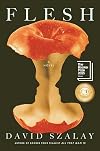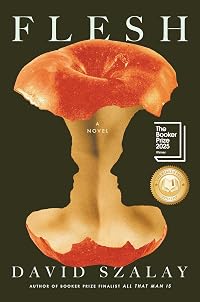
Flesh
by David Szalay
On This Page
Description
WINNER OF THE 2025 BOOKER PRIZEFinalist for the Kirkus Prize | Longlisted for the Carnegie Medal for Excellence
From "the shrewdest writer on contemporary masculinity we have" (Esquire), a "captivating...hypnotic...virtuosic" (The Baffler) novel about a man whose life veers off course due to a series of unforeseen circumstances.
Teenaged István lives with his mother in a quiet apartment complex in Hungary. Shy and new in town, he is a stranger to the social rituals practiced by his show more classmates and is soon isolated, drawn instead into a series of events that leave him forever a stranger to peers, his mother, and himself. In the years that follow, István is born along by the goodwill, or self-interest, of strangers, charting a rocky yet upward trajectory that lands him further from his childhood, and the defining events that abruptly ended it, than he could possibly have imagined.
A collection of intimate moments over the course of decades, Flesh chronicles a man at odds with himself—estranged from and by the circumstances and demands of a life not entirely under his control and the roles that he is asked to play. Shadowed by the specter of past tragedy and the apathy of modernity, the tension between István and all that alienates him hurtles forward until sudden tragedy again throws life as he knows it in jeopardy.
"Spare and detached on the page, lush in resonance beyond it" (NPR), Flesh traces the imperceptible but indelible contours of unresolved trauma and its aftermath amid the precarity and violence of an ever-globalizing Europe with incisive insight, unyielding pathos, and startling humanity. show less
Tags
Recommendations


















Member Reviews
My second from the Booker Prize longlist, and I'm still thinking about this one obsessively.
We stumble through the un-self-explored life of a Hungarian boy, István, raised by his single mom. Sparse prose and a character who rarely says more than, "ok", somehow create a vast swarm of subtext. Everything important is maybe outside words altogether, and here below the surface. Instead, we track the events of the life of István as a series of events. He's a Hungarian youth who is physically tough, imposing and attractive, but also emotionally unexpressive, if tolerant.
"Masculinity" is the word in all the reviews. It's a word that won't help you while reading this, and I would argue is better forgotten, but also one you can't escape when show more thinking back on the book. I tried. It's there. István is just an extreme. Tough, sexy, focused on sex, not clearly connecting; acting in wants, fighting blindly. The male ogre. But two things. He's not so simple, not a sociopath, or one without ethics. He has some real values, unexpressed as they may be. And, second, extreme as he is, there is an element of him that a lot of people associate with men - namely the lack of internal reflection, or of social self-exploration. He's quiet and under-spoken, and this is something common amongst men, not just ogres.
But, more to the point, the book hasn't left me. There is so much going on under the surface, that it leaves the reader as under-processed as István is of himself. And like many readers, I can't let it go at that. So, I ponder. Dead leaves, abuse and PSTD, parental impacts and drugs, Hamlet, money - unearned money, sex for money, sex. It's all swirling around here, in this iceberg text, 80% or so underwater, maybe 99%. I've said elsewhere it's raging underneath.
A lot of reviews complain that István is a bad character, as if literature should not explore them. Some say he's essentially good. He's not, sez me. He's a bad dude, and that's part of what makes this book so interesting, sez me.
So, I oddly adored this thing, my second from the still so promising Booker longlist. Recommended to readers who aren't looking for admirable people.
2025
https://www.librarything.com/topic/372264#8918141 show less
We stumble through the un-self-explored life of a Hungarian boy, István, raised by his single mom. Sparse prose and a character who rarely says more than, "ok", somehow create a vast swarm of subtext. Everything important is maybe outside words altogether, and here below the surface. Instead, we track the events of the life of István as a series of events. He's a Hungarian youth who is physically tough, imposing and attractive, but also emotionally unexpressive, if tolerant.
"Masculinity" is the word in all the reviews. It's a word that won't help you while reading this, and I would argue is better forgotten, but also one you can't escape when show more thinking back on the book. I tried. It's there. István is just an extreme. Tough, sexy, focused on sex, not clearly connecting; acting in wants, fighting blindly. The male ogre. But two things. He's not so simple, not a sociopath, or one without ethics. He has some real values, unexpressed as they may be. And, second, extreme as he is, there is an element of him that a lot of people associate with men - namely the lack of internal reflection, or of social self-exploration. He's quiet and under-spoken, and this is something common amongst men, not just ogres.
But, more to the point, the book hasn't left me. There is so much going on under the surface, that it leaves the reader as under-processed as István is of himself. And like many readers, I can't let it go at that. So, I ponder. Dead leaves, abuse and PSTD, parental impacts and drugs, Hamlet, money - unearned money, sex for money, sex. It's all swirling around here, in this iceberg text, 80% or so underwater, maybe 99%. I've said elsewhere it's raging underneath.
A lot of reviews complain that István is a bad character, as if literature should not explore them. Some say he's essentially good. He's not, sez me. He's a bad dude, and that's part of what makes this book so interesting, sez me.
So, I oddly adored this thing, my second from the still so promising Booker longlist. Recommended to readers who aren't looking for admirable people.
2025
https://www.librarything.com/topic/372264#8918141 show less
In Flesh, Szalay has written a novel about the Big Question: about the numbing strangeness of being alive; about what, if anything, it means to amble through time in a machine made of meat. Keiran Goddard The Guardian Mar 2025
Flesh is about the life of an ordinary man over a period of 50 years. István is a Hungarian, raised by his single mother whom he leaves behind to make a life in England. He appears soulless. Some reviewers have compared him to Sartre’s Meursault in L’ Étranger. But István has an inner morality. He just doesn’t analyze his own thoughts..
When asked a question or told what to do by his boss or a sexual partner he always answers with “OK”. Actually, I didn’t find this so odd. I have a 14 year-old show more grandchild and that’s how he talks to me. Whatever I say he answers “OK”. Has István stayed 14, the age he was when seduced by an older woman?
István has not developed emotionally since this first sexual encounter. Perhaps it’s because of this that all his later relationships involve older women who allow for and tolerate his passivity. They don’t push him to ask what he is thinking, they accept his silence as a trade-off for the sex.
There’s a lot of sex in the book which I didn’t really understand the why of. I once had a lover who told me that men think of sex in one way or another every 30 seconds. I took this as gospel and so it was nothing to me that István had sex at every chance he could.
István is shallow, emotionally undeveloped, and lacks ambition, although he’ll take what comes his way. He seems only to be introspective when it’s about sex, the only time he wonders about things.
On reading Flesh I was reminded of the sixties British kitchen-sink films. Films like. “A Taste of Honey”. Poverty of emotions as much as Stirling. I could see István there in those early books like The Butcher Boy and Clockwork Orange. The dull grayness of English housing estates. The lack of expectation. The passive acceptance of emotional and intellectual proverty.
I could feel the Oxford education of David Szalay peeping through -the intellectualization of England’s poverty. The ability to express complexity in short sharp sentences. Erudite beyond anything István could communicate.
I thoroughly enjoyed Flesh. I didn’t see it as a particularly masculine book although it’s about men. But women have men in their lives, and I’m sure most women have met an István. He’s not a rarity. But it’s rare to find a writer as splendid as Szalay.
Highly recommended. show less
Flesh is about the life of an ordinary man over a period of 50 years. István is a Hungarian, raised by his single mother whom he leaves behind to make a life in England. He appears soulless. Some reviewers have compared him to Sartre’s Meursault in L’ Étranger. But István has an inner morality. He just doesn’t analyze his own thoughts..
When asked a question or told what to do by his boss or a sexual partner he always answers with “OK”. Actually, I didn’t find this so odd. I have a 14 year-old show more grandchild and that’s how he talks to me. Whatever I say he answers “OK”. Has István stayed 14, the age he was when seduced by an older woman?
István has not developed emotionally since this first sexual encounter. Perhaps it’s because of this that all his later relationships involve older women who allow for and tolerate his passivity. They don’t push him to ask what he is thinking, they accept his silence as a trade-off for the sex.
There’s a lot of sex in the book which I didn’t really understand the why of. I once had a lover who told me that men think of sex in one way or another every 30 seconds. I took this as gospel and so it was nothing to me that István had sex at every chance he could.
István is shallow, emotionally undeveloped, and lacks ambition, although he’ll take what comes his way. He seems only to be introspective when it’s about sex, the only time he wonders about things.
On reading Flesh I was reminded of the sixties British kitchen-sink films. Films like. “A Taste of Honey”. Poverty of emotions as much as Stirling. I could see István there in those early books like The Butcher Boy and Clockwork Orange. The dull grayness of English housing estates. The lack of expectation. The passive acceptance of emotional and intellectual proverty.
I could feel the Oxford education of David Szalay peeping through -the intellectualization of England’s poverty. The ability to express complexity in short sharp sentences. Erudite beyond anything István could communicate.
I thoroughly enjoyed Flesh. I didn’t see it as a particularly masculine book although it’s about men. But women have men in their lives, and I’m sure most women have met an István. He’s not a rarity. But it’s rare to find a writer as splendid as Szalay.
Highly recommended. show less
I really liked this book. There was a Hemingway-esque sparseness to the prose which reflected the taciturn protagonist. Istvan was an interesting character, hard to get a read on, but he had a good story arc. He grows, slowly, and we follow that. He's had a lot of trauma ever since his early years and it shows how that mainifests itself throughout his life in different ways. He feels (perhaps, "feels" is too strong a word) like he is an object of history instead of a subject. (That presumes he even has this much self-awareness). Political vicissitudes, economics and the legal system dictate his life. He turns out to be a pretty relatable character, against all odds. There is a sexuality which is merely a fact of life for Istvan. There show more are no heroes and villains in this book. In fact, it portrays a rather cold world. No one seems to have an inner life of any sort. Objectives and motivations are left opaque and thematically express the inarticulation of dreams. However, I am left thinking of this story weeks after having read it and this is chiefly why I have given it 4 stars. show less
David Szalay is the author of six novels, several of which have won important literary prizes. The sixth, Flesh, won the 2025 Booker Prize.
Szalay was born in Canada to Canadian and Hungarian parents, has lived in Lebanon, England, Belgium, Hungary, and Austria. This is relevant in that the protagonist of Flesh, István, lives as a teenager in Hungary, runs drugs across the Croatian border, joins the army and is deployed to Iraq, and ends up in London for most of the book.
This gave me a sense of István as a displaced person without a strong sense of home. That’s not, however, a reflection he would make. In fact, there’s very little expression of self-reflection or even self-awareness on the part of any of the characters in the show more book.
Things happen to István because they happen – he does little to make anything happen.
What does happen to him is mostly driven by other people or circumstance, often unexpected by him or the reader – for which reason, I won’t go into too much plot detail (I’m certainly glad I didn’t read any reviews that gave away the story).
If there’s a single thing that stands out about Szalay’s writing, it’s that it’s almost entirely observational – transactional, even.
It’s a very spare writing style, realistic to the point of conveying the mundane nature of personal relationships.
She doesn’t phone until the next morning.
‘Where were you last night?’ he asks her.
‘Where was I?’
‘You weren’t working.’
‘I know.’
‘So?’
She laughs. ‘What’s it got do with you?’
‘Just wondering.’
‘I was out.’
‘Okay.’
‘Seeing someone.’
‘Who?’
‘A friend.’
‘A friend?’
‘Yeah, a friend.’
Not a lot of overt exposition going on there, but a lot of subtext. And that is characteristic of Flesh.
Another characteristic of the novel, perhaps signalled by its title, is that there is a lot of sex. This is also mostly transactional, and while István is an active participant, he remains removed from it, he has little emotional reaction to it.
In fact, in the whole book, there are lots of personal relationships but little romance, affection, or love. What there is, is largely unspoken, despite some life-shattering plot points.
The overall effect is that Szalay has written a quite devastating portrait of modern life. István is both a very particular, unusual person and simultaneously very ordinary.
He is attractive to, and attracted to, other people but he doesn’t become deeply engaged with them. He mostly goes through the motions of living, rather than experiencing life, even though that life comprises some shocking and deeply moving events, and ranges across extremely diverse circumstances.
It’s a strangely compelling literary style. The very spareness of the words makes you think deeply about the man and his life, especially because he doesn’t.
At the same time, Flesh is very easy to read and sometimes very hard to put down.
I’m not surprised it won the Booker.
Highly recommended. show less
Szalay was born in Canada to Canadian and Hungarian parents, has lived in Lebanon, England, Belgium, Hungary, and Austria. This is relevant in that the protagonist of Flesh, István, lives as a teenager in Hungary, runs drugs across the Croatian border, joins the army and is deployed to Iraq, and ends up in London for most of the book.
This gave me a sense of István as a displaced person without a strong sense of home. That’s not, however, a reflection he would make. In fact, there’s very little expression of self-reflection or even self-awareness on the part of any of the characters in the show more book.
Things happen to István because they happen – he does little to make anything happen.
What does happen to him is mostly driven by other people or circumstance, often unexpected by him or the reader – for which reason, I won’t go into too much plot detail (I’m certainly glad I didn’t read any reviews that gave away the story).
If there’s a single thing that stands out about Szalay’s writing, it’s that it’s almost entirely observational – transactional, even.
It’s a very spare writing style, realistic to the point of conveying the mundane nature of personal relationships.
She doesn’t phone until the next morning.
‘Where were you last night?’ he asks her.
‘Where was I?’
‘You weren’t working.’
‘I know.’
‘So?’
She laughs. ‘What’s it got do with you?’
‘Just wondering.’
‘I was out.’
‘Okay.’
‘Seeing someone.’
‘Who?’
‘A friend.’
‘A friend?’
‘Yeah, a friend.’
Not a lot of overt exposition going on there, but a lot of subtext. And that is characteristic of Flesh.
Another characteristic of the novel, perhaps signalled by its title, is that there is a lot of sex. This is also mostly transactional, and while István is an active participant, he remains removed from it, he has little emotional reaction to it.
In fact, in the whole book, there are lots of personal relationships but little romance, affection, or love. What there is, is largely unspoken, despite some life-shattering plot points.
The overall effect is that Szalay has written a quite devastating portrait of modern life. István is both a very particular, unusual person and simultaneously very ordinary.
He is attractive to, and attracted to, other people but he doesn’t become deeply engaged with them. He mostly goes through the motions of living, rather than experiencing life, even though that life comprises some shocking and deeply moving events, and ranges across extremely diverse circumstances.
It’s a strangely compelling literary style. The very spareness of the words makes you think deeply about the man and his life, especially because he doesn’t.
At the same time, Flesh is very easy to read and sometimes very hard to put down.
I’m not surprised it won the Booker.
Highly recommended. show less
This is the story about the social ascent and descent of Istvan, a man who doesn't stand out, who doesn't care much about anything, who experiences life as it happens to him. At some point, his step son Thomas is reported to have said, that Istvan "exemplifies a primitive form of masculinity", expressing his surprise "that (his mother) ever found that attractive" (P. 252). I admit I'm very much on Thomas' side, as Istvan is portrayed as a terribly passive character; personally I found him exquisitely boring (if that is possible): Istvan doesn't seem to be interested in anything but immediate enjoyment (mostly sex), though never actively seeking joy, just living through it. He hardly ever speaks more than two or three words in a row. show more Really, the dialogs in this book are probably the most minimalistic ones I've ever read: there are whole-page sequences of "Oh, really?", "Yeah?", "OK!", "Why not?" and "Why not!". The main protagonists of the story exchange so little content in their dialogs that I am surprised how immediate and real it all felt - an exchange of verbal signals that convey meaning, though without content. In some way, it's all about flesh, not spirit or wit.
Most of the time Istvan is rather passive; nearly everything appears to just happen to him; particularly his relationships, all of which begin with him being seduced or "sucked in". There are about five critical instants in which Istvan does take action, but these instants turn out to have been critical only after his taking action: he fights with a neighbour who accidentally gets killed - resulting in imprisonment; he hits a wall, leading to the therapy of his PTSD; he helps a stranger in a street fight, leading to his introduction to the High Society of London; he quarrels with his step-son in public, leading to a major economic backlash (if not disaster); he saves a man's life, making himself lose nearly everything that's left. None of these instants of "taking action" are described in detail, their occurrence in the text is as sudden and un-reflected as in Istvan's life - they're mainly understood post hoc, through their consequences.
The overall plot is fairly simple - I'll tell it because I believe it won't spoil reading the story of Istvan's life. It starts in Hungary, where Istvan grows up with his mother. After sexual abuse by a older woman (he is 15 at the time) he accidentally commits a crime and gets imprisoned. After his release and another unsuccessful relationship, he joins the military in the Iraq war. Upon his return, he lives with his mother again, drifting along until deciding to move to England, hoping for a better life. For several months he works in a night club in central London, accidentally getting in touch with a security company, through which he becomes the driver of an extremely rich entrepreneur's family. The entrepreneur's wife has a crush on him and, ultimately, the two get married and have a little son together. During the Covid pandemic, a series of events leads to Istvan losing nearly everything but his own life. He returns to Hungary, where he moves in with his mother again and leads a simple life, very much like he had started out.
The book is a real page turner. Despite Istvan himself being really quite boring, it is compelling to read how life happens to him; to find out what life will have in store for him in the next chapter. A very entertaining read about a man whom I'd never would want to meet. show less
Most of the time Istvan is rather passive; nearly everything appears to just happen to him; particularly his relationships, all of which begin with him being seduced or "sucked in". There are about five critical instants in which Istvan does take action, but these instants turn out to have been critical only after his taking action: he fights with a neighbour who accidentally gets killed - resulting in imprisonment; he hits a wall, leading to the therapy of his PTSD; he helps a stranger in a street fight, leading to his introduction to the High Society of London; he quarrels with his step-son in public, leading to a major economic backlash (if not disaster); he saves a man's life, making himself lose nearly everything that's left. None of these instants of "taking action" are described in detail, their occurrence in the text is as sudden and un-reflected as in Istvan's life - they're mainly understood post hoc, through their consequences.
The overall plot is fairly simple - I'll tell it because I believe it won't spoil reading the story of Istvan's life. It starts in Hungary, where Istvan grows up with his mother. After sexual abuse by a older woman (he is 15 at the time) he accidentally commits a crime and gets imprisoned. After his release and another unsuccessful relationship, he joins the military in the Iraq war. Upon his return, he lives with his mother again, drifting along until deciding to move to England, hoping for a better life. For several months he works in a night club in central London, accidentally getting in touch with a security company, through which he becomes the driver of an extremely rich entrepreneur's family. The entrepreneur's wife has a crush on him and, ultimately, the two get married and have a little son together. During the Covid pandemic, a series of events leads to Istvan losing nearly everything but his own life. He returns to Hungary, where he moves in with his mother again and leads a simple life, very much like he had started out.
The book is a real page turner. Despite Istvan himself being really quite boring, it is compelling to read how life happens to him; to find out what life will have in store for him in the next chapter. A very entertaining read about a man whom I'd never would want to meet. show less
David Szalay’s Booker Prize-winning novel, Flesh, is a peculiar work that holds the reader at a distance from the characters and searches for meaning in the emotionally truncated state of its protagonist. István’s story begins in Hungary, where he lives in a threadbare apartment complex with his mother. As an uncommunicative, somewhat surly teenager he is lured into a sexual liaison by the fortyish woman across the hall. This goes on for a month or two, until he confesses that he’s in love with her, at which point she tells him that she loves her husband and their liaison can’t continue. Overwhelmed by confusion and not sure what to do with his feelings, István confronts the husband in the corridor outside his apartment, and show more in the ensuing struggle the husband tumbles down the stairs and dies from his injuries. István is arrested and ends up in juvenile detention. Before this though, while detained by police and being questioned about why he did what he did, his response is, “I don’t know.” This is typical of István, whose response to much of what happens over the years that the novel encompasses is unquestioning, uncurious, animal acceptance. He returns home to live with his mother after being released, but can’t find work because of his criminal history, and after being spurned by a woman he likes he joins the army and ends up fighting on the front lines in Iraq. Hardened but also traumatized by military service and his incarceration, István moves to England and through a series of chance encounters finds employment in the security industry, eventually landing a job as driver for an ultra-wealthy couple. István and the wife, Helen—older than István but still decades younger than her husband—are soon embroiled in an affair. István’s unlikely rags-to-riches trajectory continues when the husband dies from cancer and he marries Helen, providing him with access to colossal wealth and opportunity. However, his stretch of good fortune ends with Helen’s untimely death and the intervention of Helen’s older son, Thomas, who, upon reaching age 25, claims his inheritance and cuts István out. Szalay’s terse dialogue, severely clipped, declarative prose and deliberate avoidance of lyricism prevent the reader from becoming involved in the story on a visceral level and feeling, to some extent, left out of the proceedings. However, an argument could be made that this is the proper narrative strategy for the story of a man living an unexamined life, someone whose main and perhaps only reason for being alive is to feed his immediate appetites. It might even be fair to say that Flesh fascinates for precisely this reason, that by stripping his protagonist of full-blooded emotional responses to his surroundings and circumstances, Szalay has created in István an elemental man whose journey through life becomes tragically one-dimensional. To be sure, the book is entertaining and even at times turns into a compulsively readable page-turner, and there’s no denying that István’s story generates considerable tension. But the reader might be forgiven for feeling in the end that Flesh is a novel that falls short of rewarding the effort of reading it. show less
This book was so interesting. After the first chapter, so much of the story happens off the page. Events are referred to passively, glossed over, or left entirely for the reader to infer. It’s a bold and captivating exercise in writing restraint, and unlike anything I’ve read before. The main character is deeply infuriating. He drifts passively through life while things simply happen to him. Everything is always just okay. It’s impossible to tell what he wants, what he enjoys, or if he has any real passion or drive at all. That frustration is exactly what makes the writing so good. I felt sad for how little investment he has in his own life, especially with how much motion and consequence accumulate around him. This is a book show more I’m dying to hear other readers’ reactions to. It made for an excellent book club discussion, and I suspect it lands differently depending on your perspective. show less
Members
- Recently Added By
Lists

2025 Booker Prize Longlist
13 works; 6 members

2026 Tournament of Books Longlist
70 works; 2 members

Globe and Mail | Canadian Fiction: November 22, 2025
10 works; 1 member
Globe and Mail | Canadian Fiction: December 13, 2025
10 works; 1 member

Books Read in 2025
4,128 works; 98 members

Books Read in 2026
2,035 works; 68 members

2026 Tournament of Books
18 works; 4 members
Globe and Mail | Canadian Fiction: December 20, 2025
10 works; 1 member
Globe and Mail | Canadian Fiction: December 27, 2025
10 works; 1 member

WBS - Book Club
71 works; 1 member

Take Four Books
130 works; 1 member
Author Information

9+ Works 2,249 Members
Some Editions
Awards and Honors
Awards
Distinctions
Work Relationships
Is contained in
Common Knowledge
- Canonical title
- Flesh
- Original publication date
- 2025
- Important places
- London, England, UK; England, UK; Hungary; Iraq
- First words
- When he's fifteen, he and his mother move to a new town and he starts at a new school.
- Last words
- (Click to show. Warning: May contain spoilers.)After that he lives alone.
- Blurbers
- Harvey, Samantha; Nicholls, David
Classifications
Statistics
- Members
- 993
- Popularity
- 26,435
- Reviews
- 49
- Rating
- (3.68)
- Languages
- Dutch, English, German, Italian
- Media
- Paper, Audiobook, Ebook
- ISBNs
- 18
- ASINs
- 7