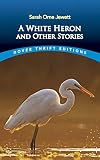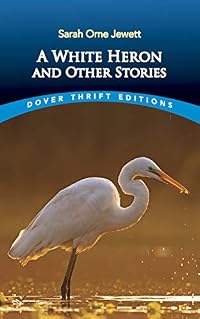
A White Heron and Other Stories (Dover Thrift Editions)
by Sarah Orne Jewett
On This Page
Description
A celebration of the past in stories dealing with female friendships and tales that portray the resilience with which her female characters respond to poverty. Includes "The Town Poor," "Miss Peck's Promotion," "The Passing of Sister Barsett," "The Denham Ladies," "Miss Tempy's Watchers," and 5 more.Tags
Recommendations

























Member Reviews
There was something magical about this book of short stories. It's not a fancy, high-flying magic, nor a showy, complex magic. It's a simpler magic--of things that are so normal and everyday, but that we have so swiftly forgotten, that it almost cannot be called magic at all. These stories were written, after all, between 1886 and 1900. But that's what makes them so picturesque, so quaint, so easy to fall in love with: they're of a time we've stepped away from, certainly, and there's very few occasions where any of us are able to again set foot into an understanding of what it's like to live in the world that Sarah Orne Jewett described in these little ditties.
Personally, I have. I have spent a great deal of my youth out in the show more mountains in my grandmother's home, in the thick of a forest, isolated from most people and towns. I've lived in that tender environment for months at a time, tending the house, stoking the fire and building it up when it dies down, cooking food on the stove top or above the fireplace. I've weeded the pebbled driveway and tended the garden, picked the harvest and had nothing more or less to do than rise, work, talk, and sleep--all to repeat it again the next coming day. And there's peace that comes with living life like that. That, I feel, is what embodies so much of this book.
Every short story written here is a story about the relationships between various peoples, and it shows through the simplicity and intimacy of a lifestyle that we've almost forgotten today, in this world where connections are expected, and intimacy is taken for granted--if it exists at all. We do not speak--we type. We do not absorb--we skim and summarize. We do not search for meaning--we take facts and leave the rest to the dust. This a book that involves the dusting of shelves, the walking to another's house just to say hello and share in some conversation and a meal. Where things are old-fashioned, but where they hold a delicious intimacy that we're starved for today, even in the simplest of interactions that are portrayed in this book. And not all of these people are friends! And sometimes I sat back in wonder at the fact that two people who did not quite like each other were still able to go places together and hold conversation, even when they disagreed on a point of great importance. It's amazing to see how you didn't have to be soul mates or exact replicas of one another in order to be the closest of companions, even a wonderfully appreciated friend. Just the magnitude of what is conveyed in this series of stories is incredible to me, and while the tales are not brimming with chaos and drama, the everyday is all the more wonderful because it's the everyday, and because it's something that... for the most part... we've forgotten or moved beyond today. It's something that, I'm afraid, we've almost lost.
To this day I look at my best friend and I say to her, "What a shame. When we were younger, and we lived within the same town, we never took advantage of that closeness. We were never together. We never spent time with each other. And now, all these years later, it's barely satisfying enough to spend hours on the phone, to webcam with each other, or to send messages back and forth on our messengers. I wish you lived right next to me! So I could come over whenever I wanted to see you! So that I could just walk right across town and say, 'Can I spend the night with you? I could really use the time away from home right now.' But that's no longer possible. And I wish, I wish we could do that now." I long to be able to do what these women did in these stories. I long for the ability to lead a life that it's all computers and technology, but would allow me to make a home for myself, to read, to do, and to spend time with those nearest to me when I wanted to. I miss the face-to-face of an actual conversation. I miss being able to see, touch, smell, and hear my friends. I miss the intimacy. I miss everything that this book has.
And this is perhaps why this book has become so gentle a weight in my heart, and why it's stirred up such feelings of contentment and softest admiration. It soothes the soul, and rests the mind. Some, perhaps, might find it slow to read because of this. Others may even deem it dull. But perhaps that's only because they've never had a chance to experience what this book contains. And, I'm afraid, many people will react to it in this way because they do not quite comprehend these feelings that stir in those who have experienced this type of lifestyle before. It is a far cry different than life today, that is true. And perhaps that's the problem, even where it's the solution. *Smiles* Nonetheless, it's a book that I feel is worth the reading.
I will say only one other thing before I finish my remarks on this book of short stories. At the beginning, before we ever read the story, there is a part where we get a slight biography about the author, Sarah Orne Jewett. It tells of our author as a woman who was sickly as a child, and who loved her home and community so dearly that she wanted to preserve it in her writings. She lost her father--who she admired greatly--and found solace in the companionship of Annie Fields, who was probably the reason for her focus on female friendships in most of her stories. Seven years before her death, she was in an accident that ended her ability to write, and in the end, this amazing woman who struggled through so much in her life, died of a stroke, only in her 50s. I think the peace and love that she conveys in these stories, that beauty that she's able to show so gently to us as readers, is much of who she is. Her very soul is portrayed in these words, and that's why they can evoke such feelings of depth and warmth in those of us who even understand a smidgeon of what it is she's trying to defend, and what she loves so dearly.
All in all, it was a lovely, serene read. If you're ever in the mood to read nothing too chaotic or dramatic, and want a change of pace, then this might be the book for you to look into. As I said, it's a far cry from what most things are written about today, but it's an endearing book nonetheless, in its own special way. Though I doubt it's for everyone, I think it's something that was worth the read, even if others may not feel the same way. This is the kind of book that some will enjoy, and others won't. So make sure to check it out somewhere else first before you go ahead and buy it. ^_^ Though I really do hope others find this just as enjoyable as I did. show less
Personally, I have. I have spent a great deal of my youth out in the show more mountains in my grandmother's home, in the thick of a forest, isolated from most people and towns. I've lived in that tender environment for months at a time, tending the house, stoking the fire and building it up when it dies down, cooking food on the stove top or above the fireplace. I've weeded the pebbled driveway and tended the garden, picked the harvest and had nothing more or less to do than rise, work, talk, and sleep--all to repeat it again the next coming day. And there's peace that comes with living life like that. That, I feel, is what embodies so much of this book.
Every short story written here is a story about the relationships between various peoples, and it shows through the simplicity and intimacy of a lifestyle that we've almost forgotten today, in this world where connections are expected, and intimacy is taken for granted--if it exists at all. We do not speak--we type. We do not absorb--we skim and summarize. We do not search for meaning--we take facts and leave the rest to the dust. This a book that involves the dusting of shelves, the walking to another's house just to say hello and share in some conversation and a meal. Where things are old-fashioned, but where they hold a delicious intimacy that we're starved for today, even in the simplest of interactions that are portrayed in this book. And not all of these people are friends! And sometimes I sat back in wonder at the fact that two people who did not quite like each other were still able to go places together and hold conversation, even when they disagreed on a point of great importance. It's amazing to see how you didn't have to be soul mates or exact replicas of one another in order to be the closest of companions, even a wonderfully appreciated friend. Just the magnitude of what is conveyed in this series of stories is incredible to me, and while the tales are not brimming with chaos and drama, the everyday is all the more wonderful because it's the everyday, and because it's something that... for the most part... we've forgotten or moved beyond today. It's something that, I'm afraid, we've almost lost.
To this day I look at my best friend and I say to her, "What a shame. When we were younger, and we lived within the same town, we never took advantage of that closeness. We were never together. We never spent time with each other. And now, all these years later, it's barely satisfying enough to spend hours on the phone, to webcam with each other, or to send messages back and forth on our messengers. I wish you lived right next to me! So I could come over whenever I wanted to see you! So that I could just walk right across town and say, 'Can I spend the night with you? I could really use the time away from home right now.' But that's no longer possible. And I wish, I wish we could do that now." I long to be able to do what these women did in these stories. I long for the ability to lead a life that it's all computers and technology, but would allow me to make a home for myself, to read, to do, and to spend time with those nearest to me when I wanted to. I miss the face-to-face of an actual conversation. I miss being able to see, touch, smell, and hear my friends. I miss the intimacy. I miss everything that this book has.
And this is perhaps why this book has become so gentle a weight in my heart, and why it's stirred up such feelings of contentment and softest admiration. It soothes the soul, and rests the mind. Some, perhaps, might find it slow to read because of this. Others may even deem it dull. But perhaps that's only because they've never had a chance to experience what this book contains. And, I'm afraid, many people will react to it in this way because they do not quite comprehend these feelings that stir in those who have experienced this type of lifestyle before. It is a far cry different than life today, that is true. And perhaps that's the problem, even where it's the solution. *Smiles* Nonetheless, it's a book that I feel is worth the reading.
I will say only one other thing before I finish my remarks on this book of short stories. At the beginning, before we ever read the story, there is a part where we get a slight biography about the author, Sarah Orne Jewett. It tells of our author as a woman who was sickly as a child, and who loved her home and community so dearly that she wanted to preserve it in her writings. She lost her father--who she admired greatly--and found solace in the companionship of Annie Fields, who was probably the reason for her focus on female friendships in most of her stories. Seven years before her death, she was in an accident that ended her ability to write, and in the end, this amazing woman who struggled through so much in her life, died of a stroke, only in her 50s. I think the peace and love that she conveys in these stories, that beauty that she's able to show so gently to us as readers, is much of who she is. Her very soul is portrayed in these words, and that's why they can evoke such feelings of depth and warmth in those of us who even understand a smidgeon of what it is she's trying to defend, and what she loves so dearly.
All in all, it was a lovely, serene read. If you're ever in the mood to read nothing too chaotic or dramatic, and want a change of pace, then this might be the book for you to look into. As I said, it's a far cry from what most things are written about today, but it's an endearing book nonetheless, in its own special way. Though I doubt it's for everyone, I think it's something that was worth the read, even if others may not feel the same way. This is the kind of book that some will enjoy, and others won't. So make sure to check it out somewhere else first before you go ahead and buy it. ^_^ Though I really do hope others find this just as enjoyable as I did. show less
I was waylaid by this book. I've been looking for a children's program from the 80s about a boy who finds a heron (or some such fowl) in a marsh (I don't remember much more of the program than that), and an internet search led me to the short story, A White Heron. It was fairly obvious that this short story was not related to the program I was seeking, but I was intrigued, so I purchased the collection of short stories by Jewett, thinking I really might only read the story in question. However, I liked the heron story enough to read another story, "The Gray Man", and Jewett's prose style and storytelling were both so enjoyable that I just had to read everything in this collection.
The way Jewett builds for the reader her marshy rural show more settings or her New England towns, people and all, reminds me of Sherwood Anderson's small-town Midwest or Thomas Hardy's Wessex--not in the material but in the technique. Jewett is capable of showing and evoking both sorrow and humor in turn, without resorting to extremes either of maudlin or slapstick; she even manages to satirize the most risible of human foibles without being mean-spirited. I was particularly interested in how she portrayed old age and the experience of aging. I can't say just why or how, but that was a new experience for me in reading. Best of all, she simply made me laugh.
CS Lewis once said of the poet Edmund Spenser that to read him was to grow in mental health. I felt the same reading Jewett's stories, as though I were bathing in some richly nourishing pool or enveloped in comforting and restoring amniotic fluid, waiting to be born renewed and fresh again back into the world.
Short stories are not something I've given much time to over the years, but I've come to realize lately how often I've truly enjoyed short stories when I've read them, and I plan to make an effort to read more widely in the form. show less
The way Jewett builds for the reader her marshy rural show more settings or her New England towns, people and all, reminds me of Sherwood Anderson's small-town Midwest or Thomas Hardy's Wessex--not in the material but in the technique. Jewett is capable of showing and evoking both sorrow and humor in turn, without resorting to extremes either of maudlin or slapstick; she even manages to satirize the most risible of human foibles without being mean-spirited. I was particularly interested in how she portrayed old age and the experience of aging. I can't say just why or how, but that was a new experience for me in reading. Best of all, she simply made me laugh.
CS Lewis once said of the poet Edmund Spenser that to read him was to grow in mental health. I felt the same reading Jewett's stories, as though I were bathing in some richly nourishing pool or enveloped in comforting and restoring amniotic fluid, waiting to be born renewed and fresh again back into the world.
Short stories are not something I've given much time to over the years, but I've come to realize lately how often I've truly enjoyed short stories when I've read them, and I plan to make an effort to read more widely in the form. show less
Another collection of stories by Ms. Jewett. The Two Browns was the least appealing of the stores. Her fiction based in the country is better, especially when woven with her wry sense of humor. Characters are where she shines. Still one of my favorite 19th century American writers.
An utterly charming collection of stories of rural New England of a time gone by but the people and customs all seem very familiar.
not my favorite collection of stories....but still enjoyable
Ratings
Members
- Recently Added By
Lists

Fiction (Mostly) in Selective Bibliography of American Literature 1775-1900
431 works; 3 members

Must-Read Maine
146 works; 90 members

Fiction: Historical
288 works; 3 members
Author Information

74+ Works 3,833 Members
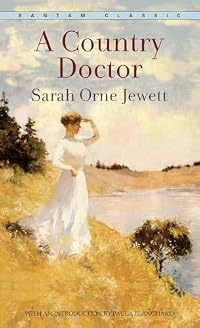
Theodora Sarah Orne Jewett was born in South Berwick, Maine on September 3, 1849. Unable to attend school because of arthritis, she learned about coastal life in New England as she accompanied her father, a doctor, on his rounds. He encouraged both her reading and her writing. When she began submitting fiction in 1867, using the pseudonyms A. D. show more Eliot, Alice Eliot, and Sarah C. Sweet, her chosen topic was often the life and people of her native, rural Maine. Her first published story appeared in the Atlantic Monthly in 1869 and her first short story collection, Deephaven, was published in 1877. Her first novel, A Country Doctor was published in 1884. Her other works include A Marsh Island (1885), A White Heron and Other Stories (1886), A Native of Winby (1893), Tales of New England (1894) and The Country of the Pointed Firs (1896). She stopped writing in 1902, after a fall left her with severe head injuries. She died of a cerebral hemorrhage on June 24, 1909. (Bowker Author Biography) show less
Series
Belongs to Publisher Series
Work Relationships
Contains
Common Knowledge
- Disambiguation notice
- Mismatched title to ISBN and cover
Classifications
Statistics
- Members
- 138
- Popularity
- 236,267
- Reviews
- 5
- Rating
- (3.86)
- Languages
- English, German
- Media
- Paper, Audiobook, Ebook
- ISBNs
- 20
- UPCs
- 1
- ASINs
- 5