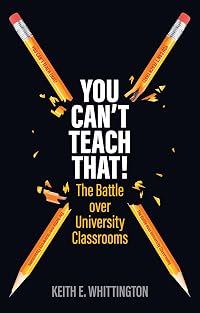
You Can't Teach That!: The Battle over University Classrooms
by Keith E. Whittington
On This Page
Description
"Who controls what is taught in American universities - professors or politicians? The answer is far from clear but suddenly urgent. Unprecedented efforts are now underway to restrict what ideas can be promoted and discussed in university classrooms. Professors at public universities have long assumed that their freedom to teach is unassailable and that there were firm constitutional protections shielding them from political interventions. Those assumptions might always have been more show more hopeful than sound. A battle over the control of the university classroom is now brewing, and the courts will be called upon to establish clearer guidelines as to what - if any - limits legislatures might have in dictating what is taught in public universities. In this path-breaking book, Keith Whittington argues that the First Amendment imposes meaningful limits on how government officials can restrict the ideas discussed on university campuses. In clear and accessible prose, he illuminates the legal status of academic freedom in the United States and shows how existing constitutional doctrine can be deployed to protect unbridled free inquiry." -- show lessTags
Member Reviews
Although compact this is a scholarly legal presentation that might be too much of a challenge for the general reader.. What comes through is how this country's current culture wars are evidencing in the university classroom through our state legislatures and then often to our courts. What also comes through is the clash of upholding free speech resulting in academic freedom and right of the state to instruct its employees. Add to this mix that professors and state legislatures can and do go beyond acceptable bounds. One is left with the feeling that these issues can not ever be resolved, they have an eternal quality about them, but, none the less, must be watched closely and dealt with.
Quotes: (page 54) “The Nearing case crystalized show more the emerging disagreement over whether a university professor was, as the philosopher John Dewey phrased it, 'a hired man.' A more senior and conservative professor at the business school warned trustees that they were giving truth to the suspicion ' that professors at the University of Pennsylvania are virtually employees of a few representatives of inherited or acquired wealth.' Were professors simply to be 'mouthpieces of rich men,' to be relieved of their duties whenever they stepped out of line? If so, then their scholarly judgments would be treated as little more than bought-and-sold-for propaganda.”
(page 72) “Unfortunately, after Keyishian in 1967, the Supreme Court has had little more to say about academic freedom. The court has never retreated from Brennan's bold insistence that the Constitution ' does not tolerate laws that cast a paw of orthodoxy over the classroom,' but it has not provided much guidance about what that might mean in practice. Judges across the country have understood that academic freedom has a precious status under the First Amendment, but they have been left to their own devices in figuring out where those principals might lead and how they should be vindicated. The Supreme Court has largely sat on the sidelines in the battle over university classrooms, since the days in which the baby boomers were staging sit-ins at universities across the country.”
(pages 109-110) “I argued in the last chapter that this legitimate interest that the government has in maintaining a well-functioning work place does not support political efforts to suppress disfavored speech in public university classrooms. Such efforts look much less like workplace management and much more simple politically motivated censorship, and any meaningful First Amendment protection must be sturdy enough to shield the classroom from would-be censors.”
(page 163) “There will always be some ideas that power holders deem to be subversive. The details of perceived threat change, but we should hold steadfast to our guiding principals, 'that no official, high or petty, can prescribe what shall be orthodox on politics, nationalism, religion, or other matters of opinion.? show less
Quotes: (page 54) “The Nearing case crystalized show more the emerging disagreement over whether a university professor was, as the philosopher John Dewey phrased it, 'a hired man.' A more senior and conservative professor at the business school warned trustees that they were giving truth to the suspicion ' that professors at the University of Pennsylvania are virtually employees of a few representatives of inherited or acquired wealth.' Were professors simply to be 'mouthpieces of rich men,' to be relieved of their duties whenever they stepped out of line? If so, then their scholarly judgments would be treated as little more than bought-and-sold-for propaganda.”
(page 72) “Unfortunately, after Keyishian in 1967, the Supreme Court has had little more to say about academic freedom. The court has never retreated from Brennan's bold insistence that the Constitution ' does not tolerate laws that cast a paw of orthodoxy over the classroom,' but it has not provided much guidance about what that might mean in practice. Judges across the country have understood that academic freedom has a precious status under the First Amendment, but they have been left to their own devices in figuring out where those principals might lead and how they should be vindicated. The Supreme Court has largely sat on the sidelines in the battle over university classrooms, since the days in which the baby boomers were staging sit-ins at universities across the country.”
(pages 109-110) “I argued in the last chapter that this legitimate interest that the government has in maintaining a well-functioning work place does not support political efforts to suppress disfavored speech in public university classrooms. Such efforts look much less like workplace management and much more simple politically motivated censorship, and any meaningful First Amendment protection must be sturdy enough to shield the classroom from would-be censors.”
(page 163) “There will always be some ideas that power holders deem to be subversive. The details of perceived threat change, but we should hold steadfast to our guiding principals, 'that no official, high or petty, can prescribe what shall be orthodox on politics, nationalism, religion, or other matters of opinion.? show less
Members
- Recently Added By
Author Information
14 Works 236 Members
Keith E. Whittington is the William Nelson Cromwell Professor of Politics at Princeton University.
Classifications
- Genres
- Politics and Government, Nonfiction
- DDC/MDS
- 378.1 — Society, government, & culture Education Higher education (Tertiary education) Organization and management; curriculums
- LCC
- LC72.2 .W466 — Education Special aspects of education Special aspects of education Social aspects of education Education and the state Academic freedom
- BISAC
Statistics
- Members
- 7
- Popularity
- 2,742,131
- Reviews
- 1
- Rating
- (3.50)
- Languages
- English
- Media
- Paper
- ISBNs
- 2