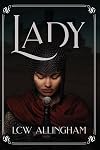
Lady
by L.C.W. Allingham
On This Page
Description
In the year 1464, while England recovers from the devastation of the War of the Roses, Baron Alexander FitzRoland is dying in his northern castle. His young wife, Rosalynde, recovering from the stillbirth of her first child, succumbs to despair like a dutiful lady should. When the castle gates are threatened, only Alexander's reputation as a brutal fighter is enough to frighten off their opportunistic enemy. The proper thing for Lady Rosalynde to do is to pray and submit to devastation. show more Instead, she puts on her husband's armor and rides to the gate disguised as the baron. From there, things only get more complicated. Between mastering the art of war, meeting with witches, struggling with self-doubt and maneuvering her complicated relationship with Alexander's lover, Robert, Lady Rosalynde balances on the razor thin line between duty and destiny. show lessTags
Member Reviews
I wasn't sure what to think about this book at first. I admit I was afraid the lgbt tag indicated this was going to be some kind "there's no way that a woman who isn't pretty and ultra feminine wasn't actually trans!" thing. But man, what a beautiful nuance! Our protagonist has a long journey of discovering that while she may not be the most lovely creature in existence, she's far harder on herself than anyone else is. And the dichotomy of her enjoying swordplay but also wanting to be a good wife and mother distresses her merely because of how society is. All the characters grow in a way that feels utterly believable. And what a fun treat to have a book set during the cousins' war/war of the roses where the main characters have show more basically no idea what's actually going on with any of that. They get a smattering of news that's a little outdated by the time they get it, but they have other things to deal with. (And we do eventually meet Edward and Elizabeth, and I've never seen Elizabeth Woodville portrayed quite like this - she feels like a fairy queen instead of the "tragic victim" or "horrible villain" I often see her as).
I did feel like the ending was a little abrupt, I think partly because I assumed when the kindle app said there was 5% left, that 5% was *of the story* and not a preview of some other book by some other author.
I started out not enjoying this book all that much - it felt slow and uninteresting - but by the end I didn't want to say goodbye to any of the characters. I don't know how a sequel would work with this narrative but I'd love to see more of these characters.
The actual narration is great, also. I'm super into historical fiction so I've seen lots of extremes - people who write in such "medievalish" style that the story is nearly incomprehensible although it's in English, and people who write in such a modern style that it's jarring and not charming. The characters felt like they made sense and the writing style made sense for the 1460s. Characters who are very understanding are implicitly oddballs, and the story doesn't act like it's totally normal for everyone to think that it's fine for a witch to be treating a baron, or whatever else.
Overall this was a fantastic read, so different from anything I've ever read before. I loved the author's note at the end - Allingham realized she'd never heard of a "lady knight" story that had a happy marriage in it. And you know what, I haven't either until this book.
SPOILERS
The actual lgbt representation is of our titular lady's husband and his boyfriend. I loved that both Rosalynde and Rupert mutually resented each other for understandable reasons, and I really loved that despite Roz's father asserting that Rupert is in love with her, he very much is not. He seems to grow to love her over the course of the story, but there's no indication that like he's the sole woman he's ever been in love with. He only likes men in that way and that doesn't change at any point. He has love for her but is not in love with her. I thought that was neat. show less
I did feel like the ending was a little abrupt, I think partly because I assumed when the kindle app said there was 5% left, that 5% was *of the story* and not a preview of some other book by some other author.
I started out not enjoying this book all that much - it felt slow and uninteresting - but by the end I didn't want to say goodbye to any of the characters. I don't know how a sequel would work with this narrative but I'd love to see more of these characters.
The actual narration is great, also. I'm super into historical fiction so I've seen lots of extremes - people who write in such "medievalish" style that the story is nearly incomprehensible although it's in English, and people who write in such a modern style that it's jarring and not charming. The characters felt like they made sense and the writing style made sense for the 1460s. Characters who are very understanding are implicitly oddballs, and the story doesn't act like it's totally normal for everyone to think that it's fine for a witch to be treating a baron, or whatever else.
Overall this was a fantastic read, so different from anything I've ever read before. I loved the author's note at the end - Allingham realized she'd never heard of a "lady knight" story that had a happy marriage in it. And you know what, I haven't either until this book.
SPOILERS
The actual lgbt representation is of our titular lady's husband and his boyfriend. I loved that both Rosalynde and Rupert mutually resented each other for understandable reasons, and I really loved that despite Roz's father asserting that Rupert is in love with her, he very much is not. He seems to grow to love her over the course of the story, but there's no indication that like he's the sole woman he's ever been in love with. He only likes men in that way and that doesn't change at any point. He has love for her but is not in love with her. I thought that was neat. show less
 This review was written for LibraryThing Early Reviewers.
An electronic copy of this book was provided for review by publishers Mirror World Publishing, via Library Thing.
~ ~ ~ ~ ~
This nicely-tuned historical, carries a feminist twist as it follows Baroness Rosalynde FitzRoland through the most perilous period of her young life. With the royal houses of York and Lancaster feuding their way through the Wars of the Roses, she must ward off attacks against her husband’s holdings, prompted by repeated rumors of his failing health.
In a desperate attempt to hide the truth of Alexander FitzRoland’s illness, Rosalynde – aided by her closest personal staff and advisors – dons her husband’s armor and impersonates him, mounting the castle ramparts and brusquely telling the ambitious younger son show more of a rival baron to take his toys and go home. (Or words to that effect.)
This is not exactly new territory for writers of historical fiction, but the masquerade is usually a brief segment, intended mostly to get the character into the adventure or romance tale that’s at the heart of the work. Not so here, because Allingham has built a plausible backstory for her heroine that makes the substitution work, and has placed her in a situation that is literally life or death for hundreds of people unless FitzRoland’s enemies can be held off by the fiction long enough to place the barony on a war footing.
There are plenty of personal challenges going on as well, with a well-drawn cast of characters inhabiting Rosalynde’s world, although some of the minor players never really come into sharp detail. There’s also that constant underlying thread of “you can’t do that” coming both from the people whose support she needs to get the job done and from the society in which she lives, when Church, Law, and Custom so strictly limited the options available to women.
Overall, this is a well-done work and an enjoyable read. show less
~ ~ ~ ~ ~
This nicely-tuned historical, carries a feminist twist as it follows Baroness Rosalynde FitzRoland through the most perilous period of her young life. With the royal houses of York and Lancaster feuding their way through the Wars of the Roses, she must ward off attacks against her husband’s holdings, prompted by repeated rumors of his failing health.
In a desperate attempt to hide the truth of Alexander FitzRoland’s illness, Rosalynde – aided by her closest personal staff and advisors – dons her husband’s armor and impersonates him, mounting the castle ramparts and brusquely telling the ambitious younger son show more of a rival baron to take his toys and go home. (Or words to that effect.)
This is not exactly new territory for writers of historical fiction, but the masquerade is usually a brief segment, intended mostly to get the character into the adventure or romance tale that’s at the heart of the work. Not so here, because Allingham has built a plausible backstory for her heroine that makes the substitution work, and has placed her in a situation that is literally life or death for hundreds of people unless FitzRoland’s enemies can be held off by the fiction long enough to place the barony on a war footing.
There are plenty of personal challenges going on as well, with a well-drawn cast of characters inhabiting Rosalynde’s world, although some of the minor players never really come into sharp detail. There’s also that constant underlying thread of “you can’t do that” coming both from the people whose support she needs to get the job done and from the society in which she lives, when Church, Law, and Custom so strictly limited the options available to women.
Overall, this is a well-done work and an enjoyable read. show less
This review was written for LibraryThing Early Reviewers.First of all, I loved the opening line: “My lips formed prayers, but they were poor tethers to hope as the pit seemed to open in my chest.”* It was an interesting study (of sorts) of medieval gender roles and had well written characters with believable viewpoints; one of the most striking to me was how everyone was sensitive to the husband's feelings regarding a lack of heir but not the MC's physical and emotional pain at having lost a pregnancy early on in the book. The descriptions were vivid, both senses and also just the overall vibe of the era.
I spent a lot of time looking up images of medieval garb and weapons and finding recipes of dishes described. I know a book is good when I go on side-quests while reading. 🤓
Definitely show more a good read and I learned some along the way as well.
*Excerpt From: Lady by LCW Allingham. This material may be protected by copyright. show less
I spent a lot of time looking up images of medieval garb and weapons and finding recipes of dishes described. I know a book is good when I go on side-quests while reading. 🤓
Definitely show more a good read and I learned some along the way as well.
*Excerpt From: Lady by LCW Allingham. This material may be protected by copyright. show less
This review was written for LibraryThing Early Reviewers.I'll admit, going in, I was worried that post-war turbulence and overlapping familial turmoil would overburden the plot. Thankfully, there is none of that. The reader is reminded of the greater political game only when necessary, with the story centering mostly within Casstone. The pacing was noticeably slow at times, with Rosalynde's training, worrying, and occasional check-in with the spy, Arthur, becoming cyclical. It could be improved with more revealing conversations with her old housekeeper Meg, her knights, and or her father. The knowledgeable healers Sarah and Amir, should've appeared earlier, to establish their friendship with Rosalynde more convincingly.
However, I was never deterred, because the dialogue remains engaging and show more the characters are written so respectfully. Rosalynde doesn't look down on her more traditionally feminine staff nor does she strain to fit in as "one of the boys." She is a tall, sensitive commander, that fights and rides like a man, but is still a loving wife who wishes to be a mother. Robert isn't a "sassy" best friend but instead a brave fighter who learns to respect and protect Rosalynde, and not just for Alexander's sake. Her knights are understandably upset and surprised at Rosalynde's behavior, but like Jeanne d'Arc, her resolve and willingness to forgive inspires their fierce loyalty. It's an embracing, queer, feminist tale, that I think many will appreciate as a much needed palate-cleanser.
This review has also been posted on my instagram page: hist.lovers_bookstagram. Thank you LibraryThing and L.C.W. Allingham for the ARC! show less
However, I was never deterred, because the dialogue remains engaging and show more the characters are written so respectfully. Rosalynde doesn't look down on her more traditionally feminine staff nor does she strain to fit in as "one of the boys." She is a tall, sensitive commander, that fights and rides like a man, but is still a loving wife who wishes to be a mother. Robert isn't a "sassy" best friend but instead a brave fighter who learns to respect and protect Rosalynde, and not just for Alexander's sake. Her knights are understandably upset and surprised at Rosalynde's behavior, but like Jeanne d'Arc, her resolve and willingness to forgive inspires their fierce loyalty. It's an embracing, queer, feminist tale, that I think many will appreciate as a much needed palate-cleanser.
This review has also been posted on my instagram page: hist.lovers_bookstagram. Thank you LibraryThing and L.C.W. Allingham for the ARC! show less
This review was written for LibraryThing Early Reviewers.Lady is a historical fiction novel about Rosalynde, a too-tall, too-strong woman on whom femininity has never sat comfortably. She's secretly trained in the sword from a young age, and when her husband is bed-bound with a mysterious illness just as neighboring lords start sniffing around his lands, she finally finds a reason to put her skills to use. Meanwhile, she's also grappling with infertility and interpersonal conflicts within the castle, most notably with her husband's lover, Robert, who is jealous of her, and with her cousin/lady-in-waiting, who disapproves of her knightly disguise.
The narrative is slow-paced and can at times feel a bit circular: Rosalynde fights off an encroachment from the neighboring lord, frets about her show more infertility, has tense interactions with her dying husband, argues with Robert and her cousin, then it all repeats. But she is an engaging heroine, and anyone who becomes sufficiently invested in her well-being will find the book compelling nonetheless.
The author clearly has some interest in approaching Rosalynde's gender-nonconformity and chafing against patriarchal oppression in a period-appropriate way, which I appreciated. Reasonably for her time and place, she largely frames things in terms of her Christian faith, and looks to Joan of Arc and various female saints as role models and as evidence that her actions and desires are not truly wrong or harmful. However, modern frameworks did slip in occasionally--there's a reference to "being outed" (vis-a-vis her crossdressing) and a number of references to "women's agency", and those felt quite anachronistic as ways for this character to conceptualize her experiences.
But these are ultimately minor quibbles, and the book is otherwise a solid character study of a woman struggling to find happiness in a society that has boxed her into an ill-fitting role. show less
The narrative is slow-paced and can at times feel a bit circular: Rosalynde fights off an encroachment from the neighboring lord, frets about her show more infertility, has tense interactions with her dying husband, argues with Robert and her cousin, then it all repeats. But she is an engaging heroine, and anyone who becomes sufficiently invested in her well-being will find the book compelling nonetheless.
The author clearly has some interest in approaching Rosalynde's gender-nonconformity and chafing against patriarchal oppression in a period-appropriate way, which I appreciated. Reasonably for her time and place, she largely frames things in terms of her Christian faith, and looks to Joan of Arc and various female saints as role models and as evidence that her actions and desires are not truly wrong or harmful. However, modern frameworks did slip in occasionally--there's a reference to "being outed" (vis-a-vis her crossdressing) and a number of references to "women's agency", and those felt quite anachronistic as ways for this character to conceptualize her experiences.
But these are ultimately minor quibbles, and the book is otherwise a solid character study of a woman struggling to find happiness in a society that has boxed her into an ill-fitting role. show less
This review was written for LibraryThing Early Reviewers.(I received a free copy of this book in exchange for an honest review.)
What a fascinating book!
Where most books about this period focus on the battles and (let's be honest) the men, this book focused on the woman left behind to guard her husband's castle. I loved the honest disability and infertility representation, and a protagonist voice that souned like a grown woman of her time, and not a 20th century teenager.
My only gripe was that the middle stages felt a lttle repetitive, with the training and the illness and the waiting for another attack, but this in no way reduced the impact of this book for me.
What a fascinating book!
Where most books about this period focus on the battles and (let's be honest) the men, this book focused on the woman left behind to guard her husband's castle. I loved the honest disability and infertility representation, and a protagonist voice that souned like a grown woman of her time, and not a 20th century teenager.
My only gripe was that the middle stages felt a lttle repetitive, with the training and the illness and the waiting for another attack, but this in no way reduced the impact of this book for me.
This review was written for LibraryThing Early Reviewers.What a fantastic book. Obviously well researched and written, so much so that it could be a historical novel.
Throughout history there are women who for one reason or another take on the mantle traditionally worn by males and perform it well, this is a story of one such woman. With her husband nearing death, she must don his armour and repel invading forces that would harm and destroy the way of living for all of her subjects.
The author skilfully entwines the lives of her friends and allies into the story as well creating a riveting scene which could be all too real.
Would enjoy reading other books by this author.
Throughout history there are women who for one reason or another take on the mantle traditionally worn by males and perform it well, this is a story of one such woman. With her husband nearing death, she must don his armour and repel invading forces that would harm and destroy the way of living for all of her subjects.
The author skilfully entwines the lives of her friends and allies into the story as well creating a riveting scene which could be all too real.
Would enjoy reading other books by this author.
This review was written for LibraryThing Early Reviewers.Members
- Recently Added By
Talk Discussions
Past Discussions
Lady, by LCW Allingham - SEPT 2024 LTER in Reviews of Early Reviewers Books (October 2024)
Author Information

4 Works 20 Members
Classifications
Statistics
- Members
- 17
- Popularity
- 1,450,796
- Reviews
- 13
- Rating
- (3.79)
- Languages
- English
- Media
- Paper, Ebook
- ISBNs
- 2
- ASINs
- 1