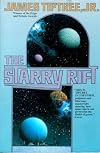
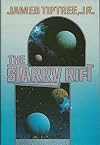
The Starry Rift
by James Jr. Tiptree
On This Page
Description
The Starry Rift presents three adventure stories of the human exploration of the Rift, a starless region of our galaxy beyond which lie non-human civilizations. In the first, a 15 year-old girls' wanderlust leads her to a friendship with an alien and a dilemma they must face together. The second is a tale of a free-spirited man who roams space assisting those in trouble or salvaging their ruins. His work brings him face to face with his past and the need to choose between love and freedom. show more The last story is that of a clash of cultures, two super powers engaging across the rift zone. We watch from both sides as events escalate toward war and individuals struggle to avoid that dire outcome. The stories are framed with encounters in a library, where an amphibious librarian assists two students, also alien to human eyes, in their exploration of human history. show lessTags
Recommendations


















Member Reviews
This trilogy of Tiptree short stories is held together by a framework that sets them as "historical" documents from the time when the human race was exploring their galaxy. Two of them touch briefly on how reproductive patterns of nonterrestrial races might differ from (and cause confusion or conflict with) human expectations. One deals with the curious social effects arising from the "coldsleep" that allowed humans to survive decades-long journeys in pre-FTL spacecraft. All are imbued with Tiptree's vividly-imagined future worlds.
Perhaps the best example of Tiptree's ability to go beyond space-opera here is the middle story, 'Goodnight, Sweethearts'. The basic plot is pretty straight-up adventure, wherein the loner protagonist (who show more runs a sort of roadside-assistance service, but in space) realizes the private liner he has just assisted has now blundered into the arms of the regional bad guys, and he's compelled, for various reasons, to attempt a rescue. His motivation is less altruistic than romantic -- one of the passengers is a woman with whom he has a romantic past.
Now, this sounds pretty much by-the-numbers, but Tiptree is also developing a strong undercurrent here of how futuristic technologies might impact everything from treatment for PTSD to what happens to personal relationships when lifespans can be extended into centuries by the suspended animation required for decades-long journeys through space. Ultimately, these factors lead the protagonist smack into a devastating moral choice -- but not necessarily the one readers might expect. show less
Perhaps the best example of Tiptree's ability to go beyond space-opera here is the middle story, 'Goodnight, Sweethearts'. The basic plot is pretty straight-up adventure, wherein the loner protagonist (who show more runs a sort of roadside-assistance service, but in space) realizes the private liner he has just assisted has now blundered into the arms of the regional bad guys, and he's compelled, for various reasons, to attempt a rescue. His motivation is less altruistic than romantic -- one of the passengers is a woman with whom he has a romantic past.
Now, this sounds pretty much by-the-numbers, but Tiptree is also developing a strong undercurrent here of how futuristic technologies might impact everything from treatment for PTSD to what happens to personal relationships when lifespans can be extended into centuries by the suspended animation required for decades-long journeys through space. Ultimately, these factors lead the protagonist smack into a devastating moral choice -- but not necessarily the one readers might expect. show less
I enjoyed this short set of interconnected novellas set in the same universe as the Tiptree/Sheldon novel, Brightness Falls From the Air. The framing device here felt a bit clunky but the stories themselves are of the fun, pulpy variety. They are more about the characters and the situations in which they find themselves rather than about hard sci-fi, so readers will likely have a better time if they don't go into this expecting to find science and space travel ideas that conform to actual physics.
The first story, The Only Neat Thing To Do, starts off with a very 'James H. Schmitz' type of feel to it with a plucky young heroine zipping off to adventure in her new spaceship, (without her parent's permission). But the story takes a very show more non-Schmitz-like darker turn that leads to a rather poignant ending. Story #2, Good Night, Sweet Hearts is the weakest of the three, but still not bad. Time-dilation, clones, and space pirates! The third tale, Collision, is also the longest and centers around an exploratory mission across The Rift that stumbles upon a new alien species. Half the tale, similar to Asimov's The Gods Themselves, is told from the alien's perspective, which lends an extra dimension to what is, in the end, a fairly standard alien contact story. That said, the characterization is good and the aliens are nicely realized.
Overall, this is a decent entry in Tiptree's catalog. It is not her best work but is still worth checking out if you are already a fan. show less
The first story, The Only Neat Thing To Do, starts off with a very 'James H. Schmitz' type of feel to it with a plucky young heroine zipping off to adventure in her new spaceship, (without her parent's permission). But the story takes a very show more non-Schmitz-like darker turn that leads to a rather poignant ending. Story #2, Good Night, Sweet Hearts is the weakest of the three, but still not bad. Time-dilation, clones, and space pirates! The third tale, Collision, is also the longest and centers around an exploratory mission across The Rift that stumbles upon a new alien species. Half the tale, similar to Asimov's The Gods Themselves, is told from the alien's perspective, which lends an extra dimension to what is, in the end, a fairly standard alien contact story. That said, the characterization is good and the aliens are nicely realized.
Overall, this is a decent entry in Tiptree's catalog. It is not her best work but is still worth checking out if you are already a fan. show less
Overall a pretty enjoyable collection of three novellas. I don't have enough familiarity with Tiptree to know how this compares with her other work, but it ranks up there with the inventiveness and good plotting that I know of her other work.
The first novella, "The Only Neat Thing to Do" is indeed neat. It's a great concept for an alien species and story itself is tight and focused. I could have gone for more story with Coati Cass, so that was a little disappointing. Maybe I'll be pleasantly surprised to find out that she appears in earlier Tiptree.
The second novella, "Good Night Sweethearts" was okay. Maybe I'm a little burnt out on clones and the mind-bendiness of meeting up with younger/older versions of people you know.
The third show more novella, "Collision" was my favorite. It is a good first contact tale, complete with a clash of customs and clash of assumptive biological needs. I very much like how the narrative set in Zeillor time/space is spend developing a more sophisticated mutual understanding of different species and using that new knowledge to differentiate one species from others with which it is habitually grouped. show less
The first novella, "The Only Neat Thing to Do" is indeed neat. It's a great concept for an alien species and story itself is tight and focused. I could have gone for more story with Coati Cass, so that was a little disappointing. Maybe I'll be pleasantly surprised to find out that she appears in earlier Tiptree.
The second novella, "Good Night Sweethearts" was okay. Maybe I'm a little burnt out on clones and the mind-bendiness of meeting up with younger/older versions of people you know.
The third show more novella, "Collision" was my favorite. It is a good first contact tale, complete with a clash of customs and clash of assumptive biological needs. I very much like how the narrative set in Zeillor time/space is spend developing a more sophisticated mutual understanding of different species and using that new knowledge to differentiate one species from others with which it is habitually grouped. show less
The Starry Rift by James Tiptree is enjoyable, slightly off-beat science fiction, written by a woman using a male pseudonym in the 1970s when the genre was largely a male domain.
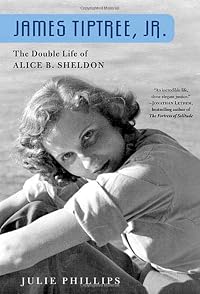
James Tiptee, jr., is a story in herself. Frustrated by her limited opportunities for expressing her creativity, Alice Sheldon took the man’s name and became famous in the 1970s as a male author of science fiction. She won prizes for her writing and was known for being both “hard-edged” and being unusually sensitive in her portrayal of women creatures. As a book critic for the New York Times put it, “Only when she became someone else could she tell the truth about herself. Only in writing about the alien could she speak about her body and her show more experience.“ I just added a recent, well-regarded new biography of Sheldon/Tiptree by Julia Phillips to my wishlist.
In The Starry Rift Tiptree brings us three adventure stories of the human exploration of the Rift, a starless region of our galaxy beyond which lay non-human civilizations. The first story is about a 15 year-old girl whose wanderlust leads her to a friendship with an alien and a dilemma they must face together. The second is a tale of a free-spirited man who roams space assisting those in trouble or salvaging their ruins. His work brings him face to face with his past and the need to choose between love and freedom. The last story is that of a clash of cultures, two super powers engaging across the rift zone. We watch from both sides as events escalate toward war and individuals struggle to avoid that dire outcome. The stories are framed with encounters in a library, where an amphibious librarian assists two students, also alien to human eyes, in their exploration of human history.
The stories are compelling, mixing sheer adventure with deeper moral questions. The gadgetry of classic science fiction is much in evidence. I didn’t understand, or even try to understand, much of the technical talk, but its presence helped create the right mood. And yes, her female characters are particularly well drawn.
GENDER
I picked up this book planning to read it for the Gender in Fantasy and Science Fiction Challenge, which failed to materialize. None the less, I read it looking for how Tiptree treated issues of gender.
Sometimes typical twentieth-century gender roles seem to be in place, but here and there are some sharp suggestions of alternatives. The fact that the young adventurer in the first story is a girl rather than the more typical boy is one. In addition, women hold significant leadership positions in the hierarchy of human space administration, not something that would have been possible when the story was written. An example is the women executive in the last story.
Even more striking is the alien civilization where three genders rather than two are required for reproduction. The man and woman of this culture seem less bound by gender definitions than humans generally are. Although the extra being was by definition neither male nor female, I found it hard not to see it as a nurturing and sacrificial female nanny. Interestingly this third-gendered creature is the one that saves the lives of all the aliens on the ship before dying itself.
I reccomend Rift to all who enjoy adventure, science fiction, or different views of gender. show less
James Tiptee, jr., is a story in herself. Frustrated by her limited opportunities for expressing her creativity, Alice Sheldon took the man’s name and became famous in the 1970s as a male author of science fiction. She won prizes for her writing and was known for being both “hard-edged” and being unusually sensitive in her portrayal of women creatures. As a book critic for the New York Times put it, “Only when she became someone else could she tell the truth about herself. Only in writing about the alien could she speak about her body and her show more experience.“ I just added a recent, well-regarded new biography of Sheldon/Tiptree by Julia Phillips to my wishlist.
In The Starry Rift Tiptree brings us three adventure stories of the human exploration of the Rift, a starless region of our galaxy beyond which lay non-human civilizations. The first story is about a 15 year-old girl whose wanderlust leads her to a friendship with an alien and a dilemma they must face together. The second is a tale of a free-spirited man who roams space assisting those in trouble or salvaging their ruins. His work brings him face to face with his past and the need to choose between love and freedom. The last story is that of a clash of cultures, two super powers engaging across the rift zone. We watch from both sides as events escalate toward war and individuals struggle to avoid that dire outcome. The stories are framed with encounters in a library, where an amphibious librarian assists two students, also alien to human eyes, in their exploration of human history.
The stories are compelling, mixing sheer adventure with deeper moral questions. The gadgetry of classic science fiction is much in evidence. I didn’t understand, or even try to understand, much of the technical talk, but its presence helped create the right mood. And yes, her female characters are particularly well drawn.
GENDER
I picked up this book planning to read it for the Gender in Fantasy and Science Fiction Challenge, which failed to materialize. None the less, I read it looking for how Tiptree treated issues of gender.
Sometimes typical twentieth-century gender roles seem to be in place, but here and there are some sharp suggestions of alternatives. The fact that the young adventurer in the first story is a girl rather than the more typical boy is one. In addition, women hold significant leadership positions in the hierarchy of human space administration, not something that would have been possible when the story was written. An example is the women executive in the last story.
Even more striking is the alien civilization where three genders rather than two are required for reproduction. The man and woman of this culture seem less bound by gender definitions than humans generally are. Although the extra being was by definition neither male nor female, I found it hard not to see it as a nurturing and sacrificial female nanny. Interestingly this third-gendered creature is the one that saves the lives of all the aliens on the ship before dying itself.
I reccomend Rift to all who enjoy adventure, science fiction, or different views of gender. show less
Three of Tiptree’s short stories repurposed around the flimsy premise that a pair of aliens have gone to their university library to learn about ancient history – as told in the short stories. You may have seen this listed as a novel. I thought it was a novel. It’s not a novel. More like one of those movies where they film four stories and use the excuse of watching a black cat travel between the locations – or think the Twilight Zone movie from the 80s.
But who’s gonna complain?! Three stories by Tiptree – three very good stories from Tiptree. They are all based on explorations within the rift – an area devoid of stars. “The Only Neat Thing To Do” is an award winner and nominee for the Hugo. Combined with “Good show more Night, Sweethearts” and “Collision”, it is a nice little collection of three good stories that are great examples of Tiptree as a story teller and as someone who always manages to explore different angles of human experience through the SF basics of space travel and the discovery of alien life forms.
The story of the library that provides the framework for this book is a waste, and if you are really wanting to explore Tiptree’s writing, find a heftier collection. But as a quick distraction with solid writing and compelling tales, then take a quick dip this direction. show less
But who’s gonna complain?! Three stories by Tiptree – three very good stories from Tiptree. They are all based on explorations within the rift – an area devoid of stars. “The Only Neat Thing To Do” is an award winner and nominee for the Hugo. Combined with “Good show more Night, Sweethearts” and “Collision”, it is a nice little collection of three good stories that are great examples of Tiptree as a story teller and as someone who always manages to explore different angles of human experience through the SF basics of space travel and the discovery of alien life forms.
The story of the library that provides the framework for this book is a waste, and if you are really wanting to explore Tiptree’s writing, find a heftier collection. But as a quick distraction with solid writing and compelling tales, then take a quick dip this direction. show less
I was somewhat disappointed by this collection of two novellas and a novelette from an author whose short fiction I typically rave about. I thought that "The Only Neat Thing to Do" was great - Tiptree at her best, but I never really got engaged by "Good Night, Sweethearts," and while "Collision" offered interesting narrative format, aliens, and characters, some of the plotting felt quite contrived. Add to that a very sketchy framing story that feels like something written in a couple hours on a tight deadline, and you have a book that doesn't really work all that well. I'd recommend seeking out "The Only Neat Thing to Do" elsewhere.
The Starry Rift by James Tiptree Jr is one of only two collections of short stories readily available as ebooks. I admit I chose to buy it first partly because it was only $3 and partly because it was shorter and I could more easily fit it in before getting to Letters to Tiptree.
The Starry Rift is set up with a framing narrative about two students seeking library materials for class. The books the librarian gives them form the three stories contained within this collection. The stories are all set around the same general region of space: Federation Base 900, the frontier outpost on the edge of the Rift. (Hence the title.) The Rift is an area of space devoid of stars, apparently not quite in between spiral arms of the Milky Way, but show more something like that.
I have to say, the science in this book was a bit off. Some of it was quaint — as in, not up to date, as would be expected of an older book like this — and some of it did not entirely make sense. I was a bit confused about the relativistic and also normal time passing effects of space travel which didn't seem to be addressed in the first story but were explained more in the third. On the other hand, the scientific points in these stories were generally not dwelt upon, decreasing the likelihood of an egregious error. None of the stories were about new inventions; they were all, first and foremost, about characters in unusual situations. (But aliens who have FTL comms but not pretty fundamental chemistry? Come on!)
Anyway, as per usual I have made comments on the individual stories which you can find below. In general, I would recommend this collection as a good example of classic SF. While the science may not have stood the test of time, the concepts explored in the stories mostly have.
The Only Neat Thing to Do — A fourteen year old girl (with rich parents) gets a space coupe from her parents, tricks it out with extra fuel tanks and goes exploring to the edge of Human-explored space. It started out as a fun adventure, if a little unlikely since fourteen year olds can't have cars, and took some interesting and then emotional turns. (I really wasn't expecting the sort of ending it had.) There were a few weird science-related moments but they weren't dwelled on by the narrative, so I found them easier to skip over than in most books. (Why do so many books use bad science as a lynchpin?) As a first introduction to Tiptree, I found it a solid story. (Coming back after finishing the collection, this was my favourite of the three.)
Good Night, Sweethearts — A space salvager/repairman/portable refueller comes across a stranded ship that's out of fuel. It transpires that it contains someone from his past. A past that, almost interestingly (it could have been explored further), he doesn't remember due to what I gathered to be PTSD-type treatment he received after being in a war. Some external action provides excitement and the climax and the main character is left with some difficult decisions. I was disappointed with how much these objectified the female characters. I also found his final choice baffling, though perhaps less so, given some of what I've recently learnt about the author's life.
Collision — This is the story of first (well, second) contact between the human Federation and a large alien empire. Told from points of view on both sides, we learn a lot about the culture and unusual biology of the aliens before the human protagonists come across them. The biological procedure of reproduction was very unusual — honestly it struck me as a bit inefficient — for all that the aliens resemble kangaroos in superficial ways. I liked that after explaining the mechanics of it, the notion turned out to be relevant to the plot in an unexpected way. On the human side of things, the story starts off being told through long-delayed communications capsules. We listen to the story along with the people at base, knowing only that the explorers survive long enough to send the capsule, but nit whether there'll be another capsule. Although this is actually a relatively cheery story in the end, there is still some death, notably of the only two human women (although they didn't die because they were women). It's still less bleak than the first story in this collection.
4 / 5 stars
Read more reviews on my blog. show less
The Starry Rift is set up with a framing narrative about two students seeking library materials for class. The books the librarian gives them form the three stories contained within this collection. The stories are all set around the same general region of space: Federation Base 900, the frontier outpost on the edge of the Rift. (Hence the title.) The Rift is an area of space devoid of stars, apparently not quite in between spiral arms of the Milky Way, but show more something like that.
I have to say, the science in this book was a bit off. Some of it was quaint — as in, not up to date, as would be expected of an older book like this — and some of it did not entirely make sense. I was a bit confused about the relativistic and also normal time passing effects of space travel which didn't seem to be addressed in the first story but were explained more in the third. On the other hand, the scientific points in these stories were generally not dwelt upon, decreasing the likelihood of an egregious error. None of the stories were about new inventions; they were all, first and foremost, about characters in unusual situations. (But aliens who have FTL comms but not pretty fundamental chemistry? Come on!)
Anyway, as per usual I have made comments on the individual stories which you can find below. In general, I would recommend this collection as a good example of classic SF. While the science may not have stood the test of time, the concepts explored in the stories mostly have.
The Only Neat Thing to Do — A fourteen year old girl (with rich parents) gets a space coupe from her parents, tricks it out with extra fuel tanks and goes exploring to the edge of Human-explored space. It started out as a fun adventure, if a little unlikely since fourteen year olds can't have cars, and took some interesting and then emotional turns. (I really wasn't expecting the sort of ending it had.) There were a few weird science-related moments but they weren't dwelled on by the narrative, so I found them easier to skip over than in most books. (Why do so many books use bad science as a lynchpin?) As a first introduction to Tiptree, I found it a solid story. (Coming back after finishing the collection, this was my favourite of the three.)
Good Night, Sweethearts — A space salvager/repairman/portable refueller comes across a stranded ship that's out of fuel. It transpires that it contains someone from his past. A past that, almost interestingly (it could have been explored further), he doesn't remember due to what I gathered to be PTSD-type treatment he received after being in a war. Some external action provides excitement and the climax and the main character is left with some difficult decisions. I was disappointed with how much these objectified the female characters. I also found his final choice baffling, though perhaps less so, given some of what I've recently learnt about the author's life.
Collision — This is the story of first (well, second) contact between the human Federation and a large alien empire. Told from points of view on both sides, we learn a lot about the culture and unusual biology of the aliens before the human protagonists come across them. The biological procedure of reproduction was very unusual — honestly it struck me as a bit inefficient — for all that the aliens resemble kangaroos in superficial ways. I liked that after explaining the mechanics of it, the notion turned out to be relevant to the plot in an unexpected way. On the human side of things, the story starts off being told through long-delayed communications capsules. We listen to the story along with the people at base, knowing only that the explorers survive long enough to send the capsule, but nit whether there'll be another capsule. Although this is actually a relatively cheery story in the end, there is still some death, notably of the only two human women (although they didn't die because they were women). It's still less bleak than the first story in this collection.
4 / 5 stars
Read more reviews on my blog. show less
Members
- Recently Added By
Author Information

121+ Works 6,902 Members
James Tiptree, Jr., was the pseudonym that Alice Bradley Sheldon began to use for her writing in 1967. Born in Chicago, she grew up in Africa and India, worked for the CIA, and earned a Ph.D. in psychology. In 1987, when Tiptree and her husband became gravely ill, she killed him and herself
Some Editions
Series
Belongs to Publisher Series
James Tiptree Jr. Werkausgabe (Sämtliche Erzählungen 6)
Work Relationships
Has as a commentary on the text
Common Knowledge
- Canonical title
- The Starry Rift
- Original title
- The Starry Rift
- Original publication date
- 1986
- First words
- Moa Blue, Chief Assistant Librarian, snuffles his way back to the Historical Specialties carousel.
- Last words
- (Click to show. Warning: May contain spoilers.)"Now here's Gildy to say thanks and good-bye, too--Gildy, go on--with love, Rosavan."
- Original language
- English
Classifications
Statistics
- Members
- 448
- Popularity
- 67,722
- Reviews
- 11
- Rating
- (3.77)
- Languages
- English, German, Italian
- Media
- Paper, Ebook
- ISBNs
- 7
- ASINs
- 8