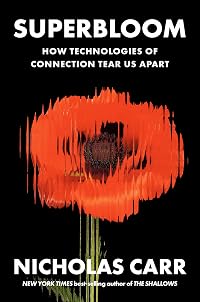
Superbloom: How Technologies of Connection Tear Us Apart
by Nicholas Carr
On This Page
Description
From the author of The Shallows, a bracing exploration of how social media has warped our sense of self and society. From the telegraph and telephone in the 1800s to the internet and social media in our own day, the public has welcomed new communication systems. Whenever people gain more power to share information, the assumption goes, society prospers. Superbloom tells a startlingly different story. As communication becomes more mechanized and efficient, it breeds confusion more than show more understanding, strife more than harmony. Media technologies all too often bring out the worst in us. A celebrated commentator on the human consequences of technology, Nicholas Carr reorients the conversation around modern communication, challenging some of our most cherished beliefs about self-expression, free speech, and media democratization. He reveals how messaging apps strip nuance from conversation, how "digital crowding" erodes empathy and triggers aggression, how online political debates narrow our minds and distort our perceptions, and how advances in AI are further blurring the already hazy line between fantasy and reality. Even as Carr shows how tech companies and their tools of connection have failed us, he forces us to confront inconvenient truths about our own nature. The human psyche, it turns out, is profoundly ill-suited to the "superbloom" of information that technology has unleashed. With rich psychological insights and vivid examples drawn from history and science, Superbloom provides both a panoramic view of how media shapes society and an intimate examination of the fate of the self in a time of radical dislocation. It may be too late to change the system, Carr counsels, but it's not too late to change ourselves. show lessTags
Recommendations






























Member Reviews
Fantastic meditation on the ways society has rewired its thinking and its ways of being to our technology. A natural companion piece to The Anxious Generation, Carr wrestles with the choices and non choices that have led us to this moment. While lighter on solutions than Anxious Gen, for me Carr's additional time on the psychological and sociological causes of our social media addiction is time we'll spent.
Hard to understand how to give this engaging, deeply researched and multifaceted argument less than 4 stars. It's a very accessible introduction to the field and generously cites the authors and works on whose shoulders it stands.
Hard to understand how to give this engaging, deeply researched and multifaceted argument less than 4 stars. It's a very accessible introduction to the field and generously cites the authors and works on whose shoulders it stands.
Author Carr details how the psychological theory of relationships explains how device-mediated interactions, unlike face-to-face dealings, create more instances of interpersonal antipathy than ones of empathy. And this is partly due to machine-forced ruptures of individuals' privacy. So there's a link, I gather, between social media's societal divisiveness and the general problem of digital tech's gross neglect of people's privacy rights. Carr also starkly details how AI, by actually *creating* some of social media's content, may now reshape the internet and the larger world into a deepfake-soaked dystopia. Some of the other things he provides: the history of how most emailers adopted slapdash habits, paving the way for show more instant-messaging chitchat and "textspeak" to arise; a credible claim that Facebook's introduction of microtargeted "news feeds" was a critical milestone; an analysis showing that social media, far from being democratizers, are amplifiers of polarization and hostility; and the "dislocated I" effect, whereby users must take care to manage their various online identities. All important aspects of today's problematic world, splendidly laid out. show less
Lots of correlation, not a lot of causation. Carr seems to believe that every innovation in communications technology past telling stories around a campfire in a cave has made things worse. Sure, he goes after the usual soft targets of Zuckerberg, Musk, Altman, Andreesen, etc., but his rejection of technology goes far beyond AI and social media. He all but blames the telegraph for the devastation in WWI, and his innate disgust at the entire concept of virtual reality is palpable.
Despite the author's prejudice the book is still worth reading, as the current state of things obviously leaves much room for improvement, and he does a good job of laying out the problems and the challenges in finding viable solutions.
Despite the author's prejudice the book is still worth reading, as the current state of things obviously leaves much room for improvement, and he does a good job of laying out the problems and the challenges in finding viable solutions.
Ratings
Members
- Recently Added By
Published Reviews
ThingScore 100
added by JohnRoberts6294
Lists


Author Information

12+ Works 5,384 Members
Awards and Honors
Common Knowledge
- Canonical title
- Superbloom: How Technologies of Connection Tear Us Apart
- Original title
- Superbloom: How Technologies of Connection Tear Us Apart
- Original publication date
- 2024
- Original language
- English
Classifications
- Genres
- Technology, Sociology, General Nonfiction, Nonfiction
- DDC/MDS
- 303.483 — Society, government, & culture Social sciences, sociology & anthropology Social processes Social change Causes of change Development of science and technology
- LCC
- HM851 .C37 — Social sciences Sociology (General) Sociology Social change
- BISAC
Statistics
- Members
- 157
- Popularity
- 209,123
- Reviews
- 3
- Rating
- (3.76)
- Languages
- English
- Media
- Paper, Audiobook, Ebook
- ISBNs
- 4
- ASINs
- 3