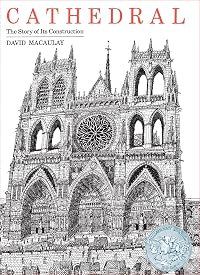
Cathedral: The Story of Its Construction
by David Macaulay
On This Page
Description
Text and detailed drawings follow the planning and construction of a magnificent Gothic cathedral in the imaginary French town of Chutreaux during the thirteenth century.Tags
Recommendations




















Member Reviews
Originally published in black and white, Macaulay thought color might bring Cathedral to a new height. He was right. The story of how a cathedral is built is clear and concise. Even though the Chutreaux cathedral in Macaulay's story is fictional, the meticulously detailed diagrams used to build the medieval structure, are not. This book will make you look at these impossibly beautiful buildings in a completely new way. Yes, everyone knows cathedrals were built as houses of the lord, to praise and thank a certain god, but the messages hidden in the architecture are wonderful. For example, every window tells a different specific story. What is most amazing is how long it took to build Macaulay's fictional cathedral. It is easy to forget show more what a massive undertaking construction was during the thirteenth century. The roof alone wasn't finished for nine years and in that time the original master builder and Bishop Chutreaux both die and are replaced approximately at the same time. They never see the fruits of their labor. show less
This book follows the story of a barely there narrative about the construction of a 13th century cathedral. A special focus is put on the tools and techniques used by the people involved addressing the engineering problems they faced and the variety of solutions they employed and the historical and technological context to those solutions. Several of the named characters die or significantly age over the course of the story to emphasize the time investment of the construction; and the change in the town as more workers and travelers and traders, artists and artisans are drawn to the construction shows the economic and some of the societal impact of cathedral even as it is being built.
Interesting! I do like Macaulay - he does a gorgeous job (as usual) of describing the structure of the cathedral from the concept and the foundations up to the arches of the roof, the spires, and the stained glass windows. And the illustrations are full of rich little bits - not just what the text is describing, but the birds in the roof, the way the houses change over the years, all the little details. Worth reading, worth rereading and spending some time examining each illustration in detail.
I read this aloud to my children (ages 3 and 7) as an addendum to the older one's history lesson for the week. It was recommended in the workbook that accompanies volume 2 of Susan Wise Bauer's The Story of the World, and I'm very glad we picked it up. Both of my kids enjoyed it, and so did I. The drawings are enjoyable and precise, and the text isn't overly wordy. I liked that Macaulay emphasized the participation of three generations of the community in building the cathedral; it helped to put into perspective just how large a project this was.
And I finally learned what exactly a flying buttress is. Maybe I'll recognize them if I ever see a cathedral in person.
And I finally learned what exactly a flying buttress is. Maybe I'll recognize them if I ever see a cathedral in person.
David Macauley has written a series of informative books about architectural wonders. Cathedral describes the construction of an imaginary cathedral in Chutreaux in France, in order to illustrate the methods of the actual construction of a Gothic cathedral, most of which were built between the 12th and 14th centuries in Europe. As he points out though, whereas his theoretical cathedral was built uninterrupted, in real life this was rarely the case: “owing to either financial or structural problems or both, the completion of may such undertakings was delayed for as long as two hundred years.”
A glossary is included in the back of the book.
Evaluation: This book will more than satisfy both kids and adults curious about the amazing steps show more taken to create such enormous buildings without any modern equipment. Fine pen and ink drawings add to understanding the process. show less
A glossary is included in the back of the book.
Evaluation: This book will more than satisfy both kids and adults curious about the amazing steps show more taken to create such enormous buildings without any modern equipment. Fine pen and ink drawings add to understanding the process. show less
Imagine what readers, teachers, librarians, and publishers thought when this, a children's picture book about the building of a fictional medieval French cathedral illustrated in black and white pen-and-ink, was released in 1973. The text is accompanied by large-scale drawings of stunning birds-eye views interspersed with instructional sketches of life on the ground. It must have blown everyone's minds. It was named a Caldecott Honor book.
(these samples don't do it justice - you must see it in its original large format.)
Despite loving David Macaulay's PBS programs Cathedral and Castle since childhood, I had never read this book until now. The programs followed me through my education from elementary school to community college and I show more later bought them on DVD so I could continue watching them at home and share them with my children. His drawing style influenced my own, which I believe later influenced my daughter's. I had the opportunity to meet Macaulay after a lecture at Utah State University in October, 2014 and he was as smart, kind, and creative as I always thought he was. He not only signed our copy of Cathedral, but he also left an original drawing on the title page. I'll treasure it forever. show less
(these samples don't do it justice - you must see it in its original large format.)
Despite loving David Macaulay's PBS programs Cathedral and Castle since childhood, I had never read this book until now. The programs followed me through my education from elementary school to community college and I show more later bought them on DVD so I could continue watching them at home and share them with my children. His drawing style influenced my own, which I believe later influenced my daughter's. I had the opportunity to meet Macaulay after a lecture at Utah State University in October, 2014 and he was as smart, kind, and creative as I always thought he was. He not only signed our copy of Cathedral, but he also left an original drawing on the title page. I'll treasure it forever. show less
This is Macaulay's first book (1973) and with Castle is probably his most popular, but he had yet to fully develop his techniques and while the basics are there, it is thin in comparison to the only other Macaulay book I've read (Mill, 1983). Still it provides an intimate and detailed cross-generational perspective, the sense of passages of time through the lives of people contrasted with the permanence of architecture is very well done. The Cathedral no longer seems a cold stone monument but embodies vibrant and living hopes and dreams.
--Review by Stephen Balbach, via CoolReading (c) 2008 cc-by-nd
--Review by Stephen Balbach, via CoolReading (c) 2008 cc-by-nd
Members
- Recently Added By
Lists

Favorite Childhood Books
1,651 works; 515 members

CCE 1000 Good Books List
1,033 works; 12 members

Elevenses
316 works; 88 members

Caldecott Honor Books
296 works; 23 members

al.vick-series
381 works; 2 members

Children's Books About Science and Math
461 works; 12 members
1001 Children's Books You Must Read Before You Grow Up
774 works; 101 members

r/History Recommended Reading List
603 works; 12 members

The Story of the World: History for the Classical Child: Activity Book Two
415 works; 2 members

Five star books
1,767 works; 110 members

Book Review Roundup
254 works; 2 members

Books We Loved As Children
603 works; 253 members

Favorite Kids Science Books
129 works; 1 member

Read Aloud Revival
108 works; 4 members
Author Information

David Macaulay was born on December 2, 1946 in Lancashire, England, but moved to Bloomfield, New Jersey when he was 11. He received a bachelor's degree in architecture from the Rhode Island School of Design (RISD). Before becoming an author and illustrator, he worked as an interior designer, a junior high school teacher, and instructor of interior show more design at RISD from 1969 to 1973. His first book, Cathedral: The Story of Its Construction, was published in 1973. His other books include City, Castle, Pyramid, Mill, Underground, Mosque, The Way Things Work, Rome Antics, Shortcut,and How Machines Work. He has received numerous awards including a Caldecott Honor Medal in 1991 for Black and White and the Washington Children's Book Guild Award for a Body of Non-Fiction Work in 1977. He won the Royal Society young people¿s book prize for the best science books for children for his book How Machines Work. (Bowker Author Biography) show less
Awards and Honors
Awards
Work Relationships
Has the adaptation
Is expanded in
Common Knowledge
- Original title
- Cathedral: The Story of Its Construction
- Original publication date
- 1973
- Related movies
- David Macaulay: Cathedral (1986 | IMDb)
- Dedication
- for Janice
with special thanks to Mary and Hardu - First words
- For hundreds of years the people of Europe were taught by the church that God was the most important force in their lives.
- Last words
- (Click to show. Warning: May contain spoilers.)The people of Chutreaux had constructed the longest, widest, highest, and most beautiful cathedral in all of France.
Classifications
Statistics
- Members
- 3,484
- Popularity
- 4,774
- Reviews
- 29
- Rating
- (4.25)
- Languages
- 8 — Chinese, Dutch, English, Finnish, French, German, Spanish, Swedish
- Media
- Paper, Ebook
- ISBNs
- 36
- UPCs
- 2
- ASINs
- 22