On This Page
Description
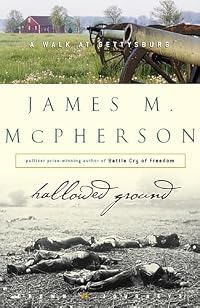
"In a larger sense, we can not dedicate-we can not consecrate-we can not hallow-this ground. The brave men, living and dead, who struggled here, have consecrated it, far above our power to add or detract."--President Abraham Lincoln. James M. McPherson, the Pulitzer Prize-winning author of Battle Cry of Freedom, and arguably the finest Civil War historian in the world, walks us through the site of the bloodiest and perhaps most consequential battle ever fought by Americans. The events that show more occurred at Gettysburg are etched into our collective memory, as they served to change the course of the Civil War and with it the course of history. More than any other place in the United States, Gettysburg is indeed hallowed ground. It's no surprise that it is one of the nation's most visited sites (nearly two million annual visitors), attracting tourists, military buffs, and students of American history. McPherson, who has led countless tours of Gettysburg over the years, makes stops at Seminary Ridge, the Peach Orchard, Cemetery Hill, and Little Round Top, among other key locations. He reflects on the meaning of the battle, describes the events of those terrible three days in July 1863, and places the struggle in the greater context of American and world history. Along the way, he intersperses stories of his own encounters with the place over several decades, as well as debunking several popular myths about the battle itself. What brought those 165,000 soldiers-75,000 Confederate, 90,000 Union-to Gettysburg? Why did they lock themselves in such a death grip across these once bucolic fields until 11,000 of them were killed or mortally wounded, another 29,000 were wounded and survived, and about 10,000 were "missing"-mostly captured? What was accomplished by all of this carnage? Join James M. McPherson on a walk across this hallowed ground as he be encompasses the depth of meaning and historical impact of a place that helped define the nation's character. show lessTags
Recommendations






Member Reviews
James McPherson has done it again, just when I think that there is nothing more to be said about the battle of Gettysburg, he goes ahead and proves me wrong. "Hallowed Ground: A Walk at Gettysburg", is not intended to provide a thorough examination of this penultimate Civil War battle, instead it serves as historical guidebook.
While taking readers on a tour of the Gettysburg National Park (as well as areas of the town itself), McPherson provides the history of those sites, detailing the events that transpired on this ground, the leaders, the ordinary participants, the fighting and the outcome. It is helped in this by being presented in chronological order, from the first shot fired by a Union infantryman at a Confederate, through the show more near disaster due to General Sickles' mistake and the fierce battle for Little Round Top, down to Meade's decision not to attack the Confederates on 4 July 1863.
In addition, McPherson's way with words and his ability to make fascinating events all the more fascinating and compelling, leads to the success of this "historical Guidebook", bringing even me to tears at several points.
"Hallowed Ground: A Walk at Gettysburg" is an excellent read. I would recommend it enthusiastically for readers who are only familiar with the basics of the battle of Gettysburg and wish to learn more, as a good place to start their exploration. I would also recommend it for even the most knowledgeable researcher, for the new light being shed on very old events, ones which should not be forgotten. And thanks to James McPherson, they never will be. show less
While taking readers on a tour of the Gettysburg National Park (as well as areas of the town itself), McPherson provides the history of those sites, detailing the events that transpired on this ground, the leaders, the ordinary participants, the fighting and the outcome. It is helped in this by being presented in chronological order, from the first shot fired by a Union infantryman at a Confederate, through the show more near disaster due to General Sickles' mistake and the fierce battle for Little Round Top, down to Meade's decision not to attack the Confederates on 4 July 1863.
In addition, McPherson's way with words and his ability to make fascinating events all the more fascinating and compelling, leads to the success of this "historical Guidebook", bringing even me to tears at several points.
"Hallowed Ground: A Walk at Gettysburg" is an excellent read. I would recommend it enthusiastically for readers who are only familiar with the basics of the battle of Gettysburg and wish to learn more, as a good place to start their exploration. I would also recommend it for even the most knowledgeable researcher, for the new light being shed on very old events, ones which should not be forgotten. And thanks to James McPherson, they never will be. show less
James McPherson has done it again, just when I think that there is nothing more to be said about the battle of Gettysburg, he goes ahead and proves me wrong. "Hallowed Ground: A Walk at Gettysburg", is not intended to provide a thorough examination of this penultimate Civil War battle, instead it serves as historical guidebook.
While taking readers on a tour of the Gettysburg National Park (as well as areas of the town itself), McPherson provides the history of those sites, detailing the events that transpired on this ground, the leaders, the ordinary participants, the fighting and the outcome. It is helped in this by being presented in chronological order, from the first shot fired by a Union infantryman at a Confederate, through the show more near disaster due to General Sickles' mistake and the fierce battle for Little Round Top, down to Meade's decision not to attack the Confederates on 4 July 1863.
In addition, McPherson's way with words and his ability to make fascinating events all the more fascinating and compelling, leads to the success of this "historical Guidebook", bringing even me to tears at several points.
"Hallowed Ground: A Walk at Gettysburg" is an excellent read. I would recommend it enthusiastically for readers who are only familiar with the basics of the battle of Gettysburg and wish to learn more, as a good place to start their exploration. I would also recommend it for even the most knowledgeable researcher, for the new light being shed on very old events, ones which should not be forgotten. And thanks to James McPherson, they never will be. show less
While taking readers on a tour of the Gettysburg National Park (as well as areas of the town itself), McPherson provides the history of those sites, detailing the events that transpired on this ground, the leaders, the ordinary participants, the fighting and the outcome. It is helped in this by being presented in chronological order, from the first shot fired by a Union infantryman at a Confederate, through the show more near disaster due to General Sickles' mistake and the fierce battle for Little Round Top, down to Meade's decision not to attack the Confederates on 4 July 1863.
In addition, McPherson's way with words and his ability to make fascinating events all the more fascinating and compelling, leads to the success of this "historical Guidebook", bringing even me to tears at several points.
"Hallowed Ground: A Walk at Gettysburg" is an excellent read. I would recommend it enthusiastically for readers who are only familiar with the basics of the battle of Gettysburg and wish to learn more, as a good place to start their exploration. I would also recommend it for even the most knowledgeable researcher, for the new light being shed on very old events, ones which should not be forgotten. And thanks to James McPherson, they never will be. show less
James McPherson has done it again, just when I think that there is nothing more to be said about the battle of Gettysburg, he goes ahead and proves me wrong. "Hallowed Ground: A Walk at Gettysburg", is not intended to provide a thorough examination of this penultimate Civil War battle, instead it serves as historical guidebook.
While taking readers on a tour of the Gettysburg National Park (as well as areas of the town itself), McPherson provides the history of those sites, detailing the events that transpired on this ground, the leaders, the ordinary participants, the fighting and the outcome. It is helped in this by being presented in chronological order, from the first shot fired by a Union infantryman at a Confederate, through the show more near disaster due to General Sickles' mistake and the fierce battle for Little Round Top, down to Meade's decision not to attack the Confederates on 4 July 1863.
In addition, McPherson's way with words and his ability to make fascinating events all the more fascinating and compelling, leads to the success of this "historical Guidebook", bringing even me to tears at several points.
"Hallowed Ground: A Walk at Gettysburg" is an excellent read. I would recommend it enthusiastically for readers who are only familiar with the basics of the battle of Gettysburg and wish to learn more, as a good place to start their exploration. I would also recommend it for even the most knowledgeable researcher, for the new light being shed on very old events, ones which should not be forgotten. And thanks to James McPherson, they never will be. show less
While taking readers on a tour of the Gettysburg National Park (as well as areas of the town itself), McPherson provides the history of those sites, detailing the events that transpired on this ground, the leaders, the ordinary participants, the fighting and the outcome. It is helped in this by being presented in chronological order, from the first shot fired by a Union infantryman at a Confederate, through the show more near disaster due to General Sickles' mistake and the fierce battle for Little Round Top, down to Meade's decision not to attack the Confederates on 4 July 1863.
In addition, McPherson's way with words and his ability to make fascinating events all the more fascinating and compelling, leads to the success of this "historical Guidebook", bringing even me to tears at several points.
"Hallowed Ground: A Walk at Gettysburg" is an excellent read. I would recommend it enthusiastically for readers who are only familiar with the basics of the battle of Gettysburg and wish to learn more, as a good place to start their exploration. I would also recommend it for even the most knowledgeable researcher, for the new light being shed on very old events, ones which should not be forgotten. And thanks to James McPherson, they never will be. show less
A very short and informative volume - "A Walk at Gettysburg: Hallowed Ground"- where Professor McPherson describes the three day battle by describing the monuments, markers, and directions of travel. Gettysburg can be enjoyed in many different ways: walking, on a tour bus, biking, or driving. While the book was written in 2003, it is still full of useful information. Like many of the places Professor McPherson mentions: Normandy, Antietam, Lexington, Concord, and Yorktown, to name a few, Gettysburg is a place to visit and be in awe of the sacrifice made by those who took part in the events of July 1863. It is worth reading the small volume.
Excellent work by a noted professor of American History. This short, 2 hour listen is descriptive of the Civil War battle field at Gettysburg. Not only does McPherson provide the basics of the battle but also some unknown factoids and vignettes not previously known. For example, Daniel Sickles lost a leg and it's still in Philadelphia; he was also largely responsible for the battle field as we see it today. The book should be accompanied by a visit to Gettysburg because it references information on the ground today versus what one would have seen in 1863. It is constructed like an Army "staff ride," designed to teach others about past military history in preparation for the future.
This book packs much Gettysburg information into its 144 pages, so it is likely a good supplement to other works on the battle. McPherson takes a chronological approach (Day 1 thru 3) as he walks the reader through the battlefield and there are the usual maps illustrating the various union and confederate positions throughout the 3 days. There is the question about who this book is written for, something that, having read it, is not clear to me. Since there are no maps of the path that he is taking through the National Military Park, his reference points ("we next head north...") are mostly confusing or meaningless to the reader who has never been to Gettysburg. On the other hand the book is too long to be read as an onsite visitor show more guide and besides, what kind of visitor guide would have no map corresponding to the author's narrative path? It probably would be interesting to read after visiting the site, but then you might find that you had missed things that he mentions and that could be aggravating. So probably it would be best to read it prior to a visit to Gettysburg, and just live with the fact that although you cannot visualize much of what he is pointing out in the book nor where he is leading you, your visit will be all the more rewarding and informative for having read it. show less
Hallowed Ground: A Walk at Gettysburg (The Illustrated Edition) by James McPherson is a nice work about both the battle and the park as it now is. The addition of photographs, drawings and maps makes this a far more valuable work than it was previously.
For those of us who have visited multiple times we will be reminded of many things we may have forgotten. For those who haven't yet visited this can serve as a guide (though I would caution that it is not an exhaustive guide) or simply as a substitute. Separate chapters cover each day of the battle so this is both a popular history book as well as a guide to the park.
While historians and Civil War buffs won't find much new here it still brings together many of the things a casual Civil show more War fan needs. It would make a nice display book on a coffee table of other such location.
Reviewed from a copy made available by the publisher via Edelweiss. show less
For those of us who have visited multiple times we will be reminded of many things we may have forgotten. For those who haven't yet visited this can serve as a guide (though I would caution that it is not an exhaustive guide) or simply as a substitute. Separate chapters cover each day of the battle so this is both a popular history book as well as a guide to the park.
While historians and Civil War buffs won't find much new here it still brings together many of the things a casual Civil show more War fan needs. It would make a nice display book on a coffee table of other such location.
Reviewed from a copy made available by the publisher via Edelweiss. show less
Members
- Recently Added By
Author Information

67+ Works 16,492 Members
James M. McPherson is the author of Battle Cry of Freedom: The Civil War Era, which won a Pulitzer Prize in history, and For Cause and Comrades: Why Men Fought in the Civil War, a Lincoln Prize winner. He is the George Henry Davis Professor of American History at Princeton University in New Jersey, where he also lives. His newest book, entitled show more Abraham Lincoln, celebrates the 200th anniversary of Lincoln's birth with a short, but detailed look at this president's life. (Bowker Author Biography) James M. McPherson, McPherson was born in 1936 and received a Ph.D. from Johns Hopkins University in 1963. He began teaching at Princeton University in the mid 1960's and is the author of several articles, reviews and essays on the Civil War, specifically focusing on the role of slaves in their own liberation and the activities of the abolitionists. His earliest work, "The Struggle for Equality," studied the activities of the Abolitionist movement following the Emancipation Proclamation. "Battle Cry of Freedom" won the Pulitzer Prize for History in 1989. "Drawn With the Sword" (1996) is a collection of essays, with one entitled "The War that Never Goes Away," that is introduced by a passage from Abraham Lincoln's second inaugural address on March 4, 1865 from which its title came: "Fondly do we hope - and fervently do we pray - that this mighty scourge of war may speedily pass away. Yet, if God wills that it continue, until all the wealth piled by the bond-man's two hundred and fifty years of unrequited toil shall be sunk, and until every drop of blood drawn with the lash, shall be paid by another drawn with the sword, as was said three thousand years ago, so still it must be said, 'the judgments of the Lord, are true and righteous altogether.'" "From Limited to Total War: 1861-1865" shows the depth of the political and social transformation brought about during the Civil War. It told how the human cost of the Civil War exceeded that of any country during World War I and explains the background to Lincoln's announcement of the Emancipation Proclamation, in 1862. The book also recounts the exploits of the Fifty-fourth Massachusetts Volunteer Infantry, one of the first black regiments organized in the Civil War, and their attack on Fort Wagner in July 1863. It pays tribute to Robert Gould Shaw, the white commanding officer of the regiment, who died in the attack and was buried in a mass grave with many of his men. Professor McPherson's writings are not just about the middle decades of the nineteenth century but are also about the last decades of the twentieth century. The political turmoil prior to the Civil War, the violence of the war, Lincoln's legacy and the impeachment of Andrew Johnson shed some light on contemporary events. (Bowker Author Biography) show less
Awards and Honors
Notable Lists
Series

Common Knowledge
- Canonical title
- Hallowed Ground: A Walk at Gettysburg
- People/Characters
- John Buford; Joshua Lawrence Chamberlain; Winfield Scott Hancock; Henry Heth; Robert E. Lee; James Longstreet (show all 13); George Gordon Meade; William C. Oates; George E. Pickett; John F. Reynolds; Daniel E. Sickles; J. E. B. Stuart; Strong Vincent
- Important places
- USA; Adams County, Pennsylvania, USA; Cemetery Hill, Gettysburg, Pennsylvania, USA; Cemetery Ridge, Gettysburg, Pennsylvania, USA; Culp's Hill, Gettysburg, Pennsylvania, USA; Devil's Den, Gettysburg, Pennsylvania, USA (show all 12); Gettysburg, Pennsylvania, USA; Gettysburg National Military Park; Little Round Top, Gettysburg, Pennsylvania, USA; Peach Orchard, Gettysburg, Pennsylvania, USA; Pennsylvania, USA; Seminary Ridge, Gettysburg, Pennsylvania, USA
- Important events
- American Civil War (1861 | 1865); Gettysburg Campaign (1863); Battle of Gettysburg (1863-07-01 | 1863-07-03)
- Dedication
- To James McPherson Long
May he too befriend
Mr. Lincoln - First words
- In his Address at the dedication of the cemetery for Union soldiers killed in the battle of Gettysburg, President Abraham Lincoln acknowledged that "in a larger sense, we can not dedicate - we can not consecrate - we can not ... (show all)hallow this ground." (Prologue)
- Last words
- (Click to show. Warning: May contain spoilers.)Gettysburg is important not primarily as the high-water mark of the Confederacy, but as the place where "this nation, under God, shall have a new birth of freedom."
Classifications
- Genres
- Nonfiction, History, Travel, General Nonfiction
- DDC/MDS
- 973.7349 — History & geography History of North America United States Abraham Lincoln, (1861-1865) Civil War Operations Campaign of 1863 Battle of Gettysburg, Pa. (1-3 July)
- LCC
- E475.56 .M43 — History of the United States United States Civil War period, 1861-1865 The Civil War, 1861-1865
- BISAC
Statistics
- Members
- 513
- Popularity
- 57,957
- Reviews
- 14
- Rating
- (3.95)
- Languages
- English
- Media
- Paper, Audiobook, Ebook
- ISBNs
- 7
- ASINs
- 8