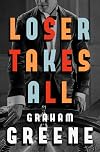
Loser Takes All
by Graham Greene 
On This Page
Description
A Monte Carlo honeymoon becomes a gamble in Graham Greene's "superbly well told" comedy of love, marriage, and risk (J. B. Priestley). A modest London accountant on a budget, Mr. Bertram has settled on a honeymoon at the seaside resort of Bournemouth with his fiance?e, Cary. However, Bertram's boss, the solicitous Herbert Dreuther, won't hear of anything so common. Bertram and Cary are to be married in Monte Carlo, after which they'll be Dreuther's guests on his private yacht and sail down show more the coast of Italy. It sounds too lovely to be true. And surely Bertram can afford one night at the Ho?tel de Paris. But when the absentminded Dreuther fails to show, and days turn into weeks, Bertram and Cary find themselves well beyond their means. Unable to check out, trapped in luxury, and with nowhere to turn but the casino, Bertram has a plan-and absolutely no idea what there is left to lose. show lessTags
Recommendations

























Member Reviews
This is a tight little book, novella-length really, about a modest, comfort-inclined accountant, Bertram, whose plan for a budget wedding and honeymoon with his fiance, Cary, are thrown up in the air when one of Bertram's firm's owners, nicknamed "Gom" for "Grand Old Man", suggests that Bertram and Cary instead sail to Monte Carlo on his yacht and wed there.
Bertram and Cary take the ride, which takes them out of the element in which they thrived together. They get in over their heads at their hotel and casino in Monte Carlo when Gom fails to show up on time. Bertram, though, develops a "system" and begins to win big in the casino and plots a kind of blindside revenge on Gom.
The whole story is an unhinging of Bertram and his relationship show more with Cary. The undercurrent is class. Gom's 8th floor office in the clouds, his disdain for Bertram's modest wedding plan and offhanded suggestion of the yacht and Monte Carlo, his failure to show up for the wedding, and the clubbiness among all three of the firm's co-owners all depict a gulf between the Goms of the world and the Bertrams. Bertram's winnings suddenly put him in an advantaged position, but it's also a temptation. And his advantaged position is no more earned or deserved than Gom's birthright was earned or deserved.
The temptation is to see it all as a story of "money can't buy happiness." But there's always more to it than that with Graham Greene.
This isn't one of my favorite Greene books. He called some of his books "entertainments". I'd put this one in that class. I enjoyed reading it, it made me think, but it's not The Power and the Glory, or even The Comedians. show less
Bertram and Cary take the ride, which takes them out of the element in which they thrived together. They get in over their heads at their hotel and casino in Monte Carlo when Gom fails to show up on time. Bertram, though, develops a "system" and begins to win big in the casino and plots a kind of blindside revenge on Gom.
The whole story is an unhinging of Bertram and his relationship show more with Cary. The undercurrent is class. Gom's 8th floor office in the clouds, his disdain for Bertram's modest wedding plan and offhanded suggestion of the yacht and Monte Carlo, his failure to show up for the wedding, and the clubbiness among all three of the firm's co-owners all depict a gulf between the Goms of the world and the Bertrams. Bertram's winnings suddenly put him in an advantaged position, but it's also a temptation. And his advantaged position is no more earned or deserved than Gom's birthright was earned or deserved.
The temptation is to see it all as a story of "money can't buy happiness." But there's always more to it than that with Graham Greene.
This isn't one of my favorite Greene books. He called some of his books "entertainments". I'd put this one in that class. I enjoyed reading it, it made me think, but it's not The Power and the Glory, or even The Comedians. show less
Desperately needing a frivolous escape from Trump, I was content with the seeming superficiality of this story. Man gets married in Monte Carlo.
Then mid-book it became very Chekhov. This shallow plot masks much deeper universal truths about the traps people allow themselves to fall into and the deeds they do to rehabilitate themselves.
Then mid-book it became very Chekhov. This shallow plot masks much deeper universal truths about the traps people allow themselves to fall into and the deeds they do to rehabilitate themselves.
Summary: On a honeymoon in Monte Carlo, Bertram’s gambling successes force a choice between love and money.
Mr. Bertram is getting married. Neither he nor Cary are affluent. He’s a low level accountant in a business firm, with few aspirations for advancement. But they are excited to share a frugal life with each other, beginning with a modest honeymoon in Bournemouth.
All that changes one day when he is called on to resolve some accounting problems for the firm’s director, Mr. Dreuther. He does so in short order. Bertram mentions his wedding plans and Dreuther insists on what is an enticing alternative. He invites him to go to Monte Carlo to get married, and then join him on his yacht for a sailing honeymoon. How can he and Cary say show more no to that!
They arrive in Monte Carlo. But there is no Mr. Dreuther. Bertram and Cary marry and enjoy their honeymoon suite. But they had not planned to stay. Bertram visits the casino in hopes of winning enough to afford it. They are living on snacks. At one point, the hotel even fronts him a loan as a member of Dreuther’s firm. He keeps losing until his “system” starts working and he wins enough to pay back the loan. He keeps winning, and at one point gains the balance of controlling shares in his firm from another firm director who has been losing at the tables.
But as he spends all his waking hours gambling or thinking about it, he loses something else. He loses Cary, who loved the hungry and poor Bertram, not this rich stranger. It all comes to a head when Bertram discovers Cary has moved out of their suite to be with a hungry young man she has met during all those days Bertram left her alone.
Then Dreuther shows up, pleading a breakdown to excuse his delay. He finds Bertram alone and hears the sad tale. Instead of counselling him to accept a failed marriage, Dreuther suggests a plan to win Cary back, a plan suggested by the book’s title.
The story is a kind of parable on the saying, “One cannot serve two masters.” In this case, Bertram must choose between love and money, and he chose poorly. Fortunately, we do not have to wait long in this short novel to discover whether Dreuther’s plan will allow him to redeem his poor choice. show less
Mr. Bertram is getting married. Neither he nor Cary are affluent. He’s a low level accountant in a business firm, with few aspirations for advancement. But they are excited to share a frugal life with each other, beginning with a modest honeymoon in Bournemouth.
All that changes one day when he is called on to resolve some accounting problems for the firm’s director, Mr. Dreuther. He does so in short order. Bertram mentions his wedding plans and Dreuther insists on what is an enticing alternative. He invites him to go to Monte Carlo to get married, and then join him on his yacht for a sailing honeymoon. How can he and Cary say show more no to that!
They arrive in Monte Carlo. But there is no Mr. Dreuther. Bertram and Cary marry and enjoy their honeymoon suite. But they had not planned to stay. Bertram visits the casino in hopes of winning enough to afford it. They are living on snacks. At one point, the hotel even fronts him a loan as a member of Dreuther’s firm. He keeps losing until his “system” starts working and he wins enough to pay back the loan. He keeps winning, and at one point gains the balance of controlling shares in his firm from another firm director who has been losing at the tables.
But as he spends all his waking hours gambling or thinking about it, he loses something else. He loses Cary, who loved the hungry and poor Bertram, not this rich stranger. It all comes to a head when Bertram discovers Cary has moved out of their suite to be with a hungry young man she has met during all those days Bertram left her alone.
Then Dreuther shows up, pleading a breakdown to excuse his delay. He finds Bertram alone and hears the sad tale. Instead of counselling him to accept a failed marriage, Dreuther suggests a plan to win Cary back, a plan suggested by the book’s title.
The story is a kind of parable on the saying, “One cannot serve two masters.” In this case, Bertram must choose between love and money, and he chose poorly. Fortunately, we do not have to wait long in this short novel to discover whether Dreuther’s plan will allow him to redeem his poor choice. show less
I SUPPOSE the small greenish statue of a man in a wig on a horse is one of the famous statues of the world. I said to Cary, ‘Do you see how shiny the right knee is? It’s been touched so often for luck, like St Peter’s foot in Rome.’
She rubbed the knee carefully and tenderly as though she were polishing it.
‘Are you superstitious?’ I said. ‘
Yes.’
‘I’m not.’
‘I’m so superstitious I never walk under ladders. I throw salt over my right shoulder. I try not to tread on the cracks in pavements. Darling, you’re marrying the most superstitious woman in the world. Lots of people aren’t happy. We are. I’m not going to risk a thing.’
There is not much I can say about Loser Takes All other than it is a delightful story show more of a newlywed couple on honeymoon. I have heard Loser Takes All being compared to Coward's Private Lives and just for once I have to admit that this comparison also came to my mind when reading Greene's story.
However, where wit and humor and sheer slapstick in Private Lives shows a couple (or two) that is very sure of itself, Greene's approach is different: His story is based on a couple who isn't sure of anything at all, and in the course of the book, this uncertainty keeps the story interesting.
"ONE adapts oneself to money much more easily than to poverty: Rousseau might have written that man was born rich and is everywhere impoverished." show less
She rubbed the knee carefully and tenderly as though she were polishing it.
‘Are you superstitious?’ I said. ‘
Yes.’
‘I’m not.’
‘I’m so superstitious I never walk under ladders. I throw salt over my right shoulder. I try not to tread on the cracks in pavements. Darling, you’re marrying the most superstitious woman in the world. Lots of people aren’t happy. We are. I’m not going to risk a thing.’
There is not much I can say about Loser Takes All other than it is a delightful story show more of a newlywed couple on honeymoon. I have heard Loser Takes All being compared to Coward's Private Lives and just for once I have to admit that this comparison also came to my mind when reading Greene's story.
However, where wit and humor and sheer slapstick in Private Lives shows a couple (or two) that is very sure of itself, Greene's approach is different: His story is based on a couple who isn't sure of anything at all, and in the course of the book, this uncertainty keeps the story interesting.
"ONE adapts oneself to money much more easily than to poverty: Rousseau might have written that man was born rich and is everywhere impoverished." show less
I saw someone else mention that this was like watching one of the better movies on TCM (in fact, this was made into a movie in 1956 with a screenplay by Greene). I had the same feeling. The great thing about the book is that you get to read some of Greene's wonderful descriptions of people. Whether it be one of his "entertainments" or no, his craftsmanship is notable.
A decently crafted little moral story about an assistant accountant whose life is overturned by a sequence of happenings that begins with the ostensible kindness of a god-like senior partner in offering to host his wedding in Monaco instead of Maida Vale. Left on their own, the couple initially cope with misfortune and impending poverty, are rescued at a critical moment, and when casino winnings reach a heretofore unattainable level of wealth, find the basis of their relationship fundamentally altered for the worse. The crisis comes when Bertram is successful in his last gamble just as the missing senior partner arrives, this time as a caring and benevolent deus ex machina. By throwing away what he has won, Bertram is able to once again show more win back his wife, fulfilling the prediction in the title. show less
An utterly romantic novelette with too many thinly painted characters to even entertain. Both plot and protagonist are severely cliché-ridden. Apart from the usual striking sentence or two, there is not much here to attract the reader. Especially the people that visit the casino are straight from the cliché book, while the young woman that will love her new husband only if he stays (relatively) poor is totally unconvincing without any background information on her state of mind. Could be the least interesting piece of Greene prose I have ever read. Stick to Brighton Rock, instead.
Members
- Recently Added By
Author Information

356+ Works 87,436 Members
Born in 1904, Graham Greene was the son of a headmaster and the fourth of six children. Preferring to stay home and read rather than endure the teasing at school that was a by-product of his father's occupation, Greene attempted suicide several times and eventually dropped out of school at the age of 15. His parents sent him to an analyst in show more London who recommended he try writing as therapy. He completed his first novel by the time he graduated from college in 1925. Greene wrote both entertainments and serious novels. Catholicism was a recurring theme in his work, notable examples being The Power and the Glory (1940) and The End of the Affair (1951). Popular suspense novels include: The Heart of the Matter, Our Man in Havana and The Quiet American. Greene was also a world traveler and he used his experiences as the basis for many books. One popular example, Journey Without Maps (1936), was based on a trip through the jungles of Liberia. Greene also wrote and adapted screenplays, including that of the 1949 film, The Third Man, which starred Orson Welles. He died in Vevey, Switzerland in 1991. (Bowker Author Biography) show less
Graham Greene has a Legacy Library. Legacy libraries are the personal libraries of famous readers, entered by LibraryThing members from the Legacy Libraries group.
Some Editions
Awards and Honors
Series
Belongs to Publisher Series
Work Relationships
Is contained in
Has as a student's study guide
Common Knowledge
- Canonical title*
- Heirate nie in Monte Carlo
- Original title
- Loser Takes All
- Original publication date
- 1955
- Important places
- Monte Carlo, Monaco
- Related movies
- Loser Takes All (1956 | IMDb)
- First words*
- Die kleine grünliche Statue des Reiters mit der Perücke dürfte wohl zu den berühmtesten Plastiken der Welt gehören.
- Last words*
- (Click to show. Warning: May contain spoilers.)"Nein. Komm lieber wieder zu mir."
- Original language
- English
*Some information comes from Common Knowledge in other languages. Click "Edit" for more information.
Classifications
Statistics
- Members
- 513
- Popularity
- 58,627
- Reviews
- 14
- Rating
- (3.29)
- Languages
- 7 — Dutch, English, Estonian, German, Norwegian (Bokmål), Spanish, Turkish
- Media
- Paper, Ebook
- ISBNs
- 24
- ASINs
- 19