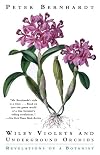
Wily Violets and Underground Orchids: Revelations of a Botanist
by Peter Bernhardt
On This Page
Description
In this book, Peter Bernhardt takes us on a grand tour of the botanical realm, weaving engaging descriptions of the lovely shapes and intriguing habits of flowering plants with considerations of broader questions, such as why there are only six basic shapes of flowers and why the orchid family is so numerous and so bizarre. Everyone from amateur naturalists and gardeners to plant scientists will find Wily Violets and Underground Orchids a lively guide to botanical lore.Tags
Recommendations






















Member Reviews
A curious book describing all sorts of interesting things about plants. Mostly it's about the intricate relationship flowers have with their pollinators, be it birds, insects or small mammals. A lot of the focus is on Australian plants. There's also a chapter on tallgrass prairie, and several about orchids.
I think what fascinated me most was reading about the mistletoes that grow in Australia. There are so many but they are so well-camouflaged that most people don't even notice them. They grow as parasites on other trees, and usually their leaves mimic the shape of the host leaves. What's so interesting is the debate about why the mistletoes look like their hosts. One theory is simply that they have evolved to blend in and thus avoid show more browsing animals that would eat them. Another is that trees make hormones in their roots that determine leaf shape, then send the hormones up to the leaves through their xylem. Since mistletoes don't have their own roots, and absorb whatever is in flowing through their host's xylem, they also take in the hormones; thus their leaves look the same. Isn't that interesting?
I was also really intrigued to read about the giant water lilies (that can support the weight of a person) and how difficult it was for botanists to learn to propagate and grow them in greenhouses. One botanist, after studying how the thin leaf structure could support so much weight, applied the same physics to architecture, and amazed everyone with his glass palace!
If you're interesting in plants- especially orchids and mistletoes, I'd say this book is a pretty good one.
from the Dogear Diary show less
I think what fascinated me most was reading about the mistletoes that grow in Australia. There are so many but they are so well-camouflaged that most people don't even notice them. They grow as parasites on other trees, and usually their leaves mimic the shape of the host leaves. What's so interesting is the debate about why the mistletoes look like their hosts. One theory is simply that they have evolved to blend in and thus avoid show more browsing animals that would eat them. Another is that trees make hormones in their roots that determine leaf shape, then send the hormones up to the leaves through their xylem. Since mistletoes don't have their own roots, and absorb whatever is in flowing through their host's xylem, they also take in the hormones; thus their leaves look the same. Isn't that interesting?
I was also really intrigued to read about the giant water lilies (that can support the weight of a person) and how difficult it was for botanists to learn to propagate and grow them in greenhouses. One botanist, after studying how the thin leaf structure could support so much weight, applied the same physics to architecture, and amazed everyone with his glass palace!
If you're interesting in plants- especially orchids and mistletoes, I'd say this book is a pretty good one.
from the Dogear Diary show less
Ratings
Members
- Recently Added By
Author Information
7+ Works 216 Members
Peter Bernhardt is a professor of botany at St. Louis University.
Common Knowledge
- Dedication
- To the memory of Sarah Samuels--
who knew that her grandson would make his way. - First words
- One September fifteen years ago, when I first assumed my Peace Corps appointment in El Salvador, I accepted an invitation to spend a weekend on the countries Pacific coast.
- Last words
- (Click to show. Warning: May contain spoilers.)The earth conceals many more tantalizing stories of botany. Will there be enough time and qualified people to tell them?
Classifications
Statistics
- Members
- 106
- Popularity
- 304,749
- Reviews
- 1
- Rating
- (3.88)
- Languages
- English
- Media
- Paper
- ISBNs
- 4
- ASINs
- 1