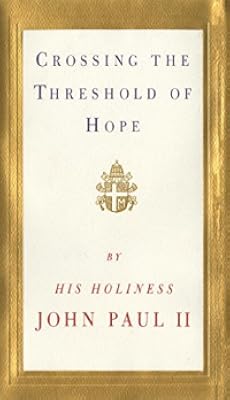
Crossing the Threshold of Hope
by Pope John Paul II (Author), Vittorio Messori (Editor)
On This Page
Description
A great international bestseller, the book in which, on the eve of the millennium, Pope John Paul II brings to an accessible level the great theological concerns of our lives. He goes to the heart of his personal beliefs and speaks with passion about the existence of God; about the dignity of man; about pain, suffering, and evil; about eternal life and the meaning of salvation; about hope; about the relationship of Christianity to other faiths and of Catholicism to other branches of the show more Christian faith. With the humility and generosity of spirit for which he is known, John Paul II speaks directly and forthrightly to all people. His Message: show lessTags
Recommendations





Member Reviews
Pope John Paul presents his ideas about faith. He is curiously silent about having any communication whatsoever with "God", that is, any actual divine being. He is convicted by the tradition, and thinks the promise of eternal life gives us "hope".
The first chapter is "The Pope: A Scandal and a Mystery." This chapter unfolds little of either, but clearly positions both in the Papacy itself -- a "scandal" to logic and good sense, and in its displaced "father", a mystery and "sign of contradiction." [3]
Our author admits that the Church is changing in the face of discoveries of many recent documents from out of almost all previous ages of the Church, which offer proof that the Church has changed over time. For example, the interviewer show more points out "Recently in the Church, words have multiplied. {!?} It seems that in the last twenty years more 'documents' have been produced at every level of the Church than in the entire preceding twenty centuries." [178]
And "It must be admitted that this eschatological vision [set forth in the recent Lumen Gentium ] was only faintly present in traditional preaching." [182] He also notes an "insensitivity" to Hell in an afterlife, while "hells on earth" created in this century offer an even greater animadversion. [183] Last Things and eschatology has become "irrelevant to contemporary man". He admits that "the problem of hell has always disturbed thinkers in the Church, beginning with Origen and continuing in our time...Bulgakov and ...Balthasar." [185, without pausing over Origen's unitarianism and the Church persecution]. "In point of fact, the ancient councils rejected the theory of the 'final apocatastasis'."
In the face of paradox, mystery and perplexity, the Pope offers the comfort of silence: "The silence of the Church is, therefore, the only appropriate position for Christian faith." [186]
This work of personal explication is filled with jewels of truth. He clearly condemns the Nazi thugs who took over a great nation and conquered a great continent. But he visits no condemnation upon the wealth, the victory of the criminals who plundered and continue to plunder the vulnerable.
He does visit Auschwitz. This former Polish Bishop notes that Auschwitz is a ceaseless admonishment "constructed on principles of racial hatred and greed for power". He adds "Anti-Semitism is a great sin against humanity, that all racial hatred inevitably leads to the trampling of human dignity." [97]
{While true, that seems to leave the Jews exposed as victims. They suffered quite alone, in Auschwitz, and now while the injustice and thievery remains largely unrepaid, he recognizes them without restitution. Has "human dignity" been restored by justice, or is it still left in the Jewish blood and mud of the camp?} He notes the destroyed synagogues are not rebuilt. [97] Therefore, nor is human dignity restored.
The Papa answers many of the questions put to and indulged by him with paradox. For example, in a mystifying excursus through the "rays of fatherhood" in the father-son paradigm illuminated by the Trinitarian mystery of God Himself in history, Original Sin is the "real fact" which is "truly the key for interpreting reality". [228]
He summarizes his message of himself in the following paradox: "In order to set contemporary man free from fear of himself, of the world, of others, of earthly powers, of oppressive systems, in order to set him free from every manifestation of a servile fear before that 'prevailing force' which believers call God, it is necessary to pray fervently that he will bear and cultivate in his heart that true fear of God, which is the beginning of wisdom." show less
The first chapter is "The Pope: A Scandal and a Mystery." This chapter unfolds little of either, but clearly positions both in the Papacy itself -- a "scandal" to logic and good sense, and in its displaced "father", a mystery and "sign of contradiction." [3]
Our author admits that the Church is changing in the face of discoveries of many recent documents from out of almost all previous ages of the Church, which offer proof that the Church has changed over time. For example, the interviewer show more points out "Recently in the Church, words have multiplied. {!?} It seems that in the last twenty years more 'documents' have been produced at every level of the Church than in the entire preceding twenty centuries." [178]
And "It must be admitted that this eschatological vision [set forth in the recent Lumen Gentium ] was only faintly present in traditional preaching." [182] He also notes an "insensitivity" to Hell in an afterlife, while "hells on earth" created in this century offer an even greater animadversion. [183] Last Things and eschatology has become "irrelevant to contemporary man". He admits that "the problem of hell has always disturbed thinkers in the Church, beginning with Origen and continuing in our time...Bulgakov and ...Balthasar." [185, without pausing over Origen's unitarianism and the Church persecution]. "In point of fact, the ancient councils rejected the theory of the 'final apocatastasis'."
In the face of paradox, mystery and perplexity, the Pope offers the comfort of silence: "The silence of the Church is, therefore, the only appropriate position for Christian faith." [186]
This work of personal explication is filled with jewels of truth. He clearly condemns the Nazi thugs who took over a great nation and conquered a great continent. But he visits no condemnation upon the wealth, the victory of the criminals who plundered and continue to plunder the vulnerable.
He does visit Auschwitz. This former Polish Bishop notes that Auschwitz is a ceaseless admonishment "constructed on principles of racial hatred and greed for power". He adds "Anti-Semitism is a great sin against humanity, that all racial hatred inevitably leads to the trampling of human dignity." [97]
{While true, that seems to leave the Jews exposed as victims. They suffered quite alone, in Auschwitz, and now while the injustice and thievery remains largely unrepaid, he recognizes them without restitution. Has "human dignity" been restored by justice, or is it still left in the Jewish blood and mud of the camp?} He notes the destroyed synagogues are not rebuilt. [97] Therefore, nor is human dignity restored.
The Papa answers many of the questions put to and indulged by him with paradox. For example, in a mystifying excursus through the "rays of fatherhood" in the father-son paradigm illuminated by the Trinitarian mystery of God Himself in history, Original Sin is the "real fact" which is "truly the key for interpreting reality". [228]
He summarizes his message of himself in the following paradox: "In order to set contemporary man free from fear of himself, of the world, of others, of earthly powers, of oppressive systems, in order to set him free from every manifestation of a servile fear before that 'prevailing force' which believers call God, it is necessary to pray fervently that he will bear and cultivate in his heart that true fear of God, which is the beginning of wisdom." show less
What a wondrous, beautiful book! Does not shy away from the tough, profound questions. And provides even more astonishingly profound answers.
I read this over the course of several months, and was richly rewarded with many opportunities to reconsider my own life and beliefs. If only to know the man who was vicar of the church through most of my lifetime, this book was truly revealing.
The title has direct link to the meaning behind Pope JP II's first proclamation as Pope, "Be not afraid!"
I read this over the course of several months, and was richly rewarded with many opportunities to reconsider my own life and beliefs. If only to know the man who was vicar of the church through most of my lifetime, this book was truly revealing.
The title has direct link to the meaning behind Pope JP II's first proclamation as Pope, "Be not afraid!"
I really enjoyed this little series of questions from a journalist and answers from the beloved pope St. John Paul II. Much of what is presented here is reiteration of his other writings, but it is nice to have another glimpse of his great intellect, knowledge, faith and respect for human dignity. He is ever the professor here, answering the questions as a scholar and as a pastor. My favorite parts, though, are the anecdotes from and references to his life in Poland. It left me with a smile.
This is the first of JPII's books that I've read and it's a bit difficult to transition from Benedict XVI's lyrical books on Jesus to this short question and answer format book by his predecessor. That said, the book reveals a lot of insight on several issues-- notably his high regard for the fruits that Vatican II would eventually bear and which we are just starting to see. Given that he was writing this eighteen years ago (when things still looked pretty dim), it impresses me that he was so consistent that the Council was a necessary and valuable step in Catholic thought and the evolution of ecumenism. I wouldn't use this as an introduction to Catholic thought, however-- it's pretty philosophical at times and a bit much to spring on show more someone who isn't already acquainted with the basics of Catholicism. show less
I appreciate that he was attempting a conversation here, although the polemical style is one which does not engage me. He is arguing with a point of view which seems foreign to me. I appreciate, though, the complexity of the subject and his willingness to engage. The commitment to non-violence was evident; his insights were ones of a holy man.
I put this down years ago and I'm still on page 144. Nevertheless it is an outstanding book. I loved the chapter, "Is there really hope in the young?" Where Pope John Paul II discusses his discovery of the fundamental importance of youth. "What is youth? Is is not only a period of life that corresponds to a certain number of years, it is also a time given by Providence to every person and given to him as a responsibility. During that time he searches, like the young man in the Gospel, for answers to basic questions; he searches not only for themeaning of life but also for a concrete way to go about living his life. This is the most fundamental characteristic of youth. Every mentor, beginning with parents, let alone eveyr pastor, must be show more aware of this characteristic and must know how to identify it in every boy and girl. I will say more: He must love this fundamental aspect of youth. show less
A great international bestseller, the book in which, on the eve of the millennium, Pope John Paul II brings to an accessible level the great theological concerns of our lives. He goes to the heart of his personal beliefs and speaks with passion about the existence of God; about the dignity of man; about pain, suffering, and evil; about eternal life and the meaning of salvation; about hope; about the relationship of Christianity to other faiths and of Catholicism to other branches of the Christian faith.
With the humility and generosity of spirit for which he is known, John Paul II speaks directly and forthrightly to all people.
With the humility and generosity of spirit for which he is known, John Paul II speaks directly and forthrightly to all people.
Members
- Recently Added By
Published Reviews
"Despite Messori straining every nerve to help ... the Pope emerges as the master of the flat statement, the bland certainty."
added by private library
Author Information

Pope John Paul II was born Karol Wojtyla on May 18, 1920 in Wadowice, Poland. He studied poetry and drama at Jagiellonian University. During World War II, he worked in a stone quarry and chemical factory while preparing for the priesthood. He received a Ph.D. from Rome's Angelicum Institute and a doctorate in theology at the Catholic University of show more Lublin. He was ordained in 1946 and became Auxiliary Bishop of Krakow in 1958. He was a university chaplain and taught ethics at Krakow and Lublin. In 1964, he became Archbishop of Krakow and in 1967, a Cardinal. On October 16, 1978, he was elected as the first non-Italian Pope since 1523. On May 13, 1981, Pope John Paul II was shot in an assassination attempt entering St. Peter's Square in the Vatican, but recovered fully. During the 1980's and 90's, the Pope visited Africa, Asia, the Americas and in 1993, to the Baltic republics, which was the first Papal visit to countries of the former Union of Soviet Socialist Republics (USSR). He greatly influenced the restoring of democracy and religious freedom in Eastern Europe and reaffirmed the Roman Catholic teachings against homosexuality, abortion, "artificial" methods of reproduction, birth control and priest celibacy. He rejected the ordination of women and opposed direct political participation and office holding of priests. His extensive ethical and theological writings included Fruitful and Responsible Love, Sign of Contradiction, Redemptor Hominis (Redeemer of Man), Evangelium Vitae (The Gospel of Life), and Ut Unum Sint (That They May Be One). After developing septic shock, he died on April 2, 2005. He was proclaimed venerable by Pope Benedict XVI on December 19, 2009 and was beatified on May 1, 2011. (Bowker Author Biography) show less

Some Editions
Awards and Honors
Awards
Distinctions
Series
Belongs to Publisher Series
Work Relationships
Has as a reference guide/companion
Common Knowledge
- Canonical title*
- Cruzando el umbral de la Esperanza
- Original title
- Varcare la soglia della speranza
- Original publication date
- 1994
- First words
- Your Holiness, my first question will go right to the point.
- Last words
- (Click to show. Warning: May contain spoilers.)The Pope who began his papacy with the words "Be not afraid!" tries to be completely faithful to this exhortation and is always ready to be at the service of man, nations, and humanity in the spirit of this truth of the Gospel.
*Some information comes from Common Knowledge in other languages. Click "Edit" for more information.
Classifications
Statistics
- Members
- 3,281
- Popularity
- 5,197
- Reviews
- 23
- Rating
- (3.90)
- Languages
- 18 — Catalan, Chinese, Czech, Dutch, English, Estonian, Finnish, French, German, Hungarian, Italian, Maltese, Norwegian (Bokmål), Polish, Russian, Spanish, Swedish, Portuguese (Portugal)
- Media
- Paper, Audiobook, Ebook
- ISBNs
- 68
- UPCs
- 2
- ASINs
- 11