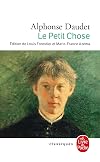
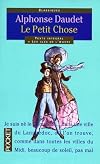
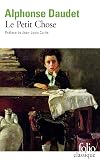
Little What's-His-Name
by Alphonse Daudet
On This Page
Description
Alphonse Daudet's (1840-1897) first published novel appeared in 1868. Its first chapters form one of the most touching of autobiographies.Tags
Recommendations




















Member Reviews
Mon Dieu! Que d'émotions d'enfance! Le pauvre pauvre pauvre petit chose. Il faut que je le relise
Le Petit Chose (1868), variously published in English as Little Good-For-Nothing or Little What's-His-Name, was Daudet's first published prose. It is an autobiographical memoir of his childhood and young adulthood in the south of France in part 1; and in part 2 his early days in Paris as a struggling writer, up until his marriage. It was written when he was between the ages of 25 and 28. Generally it is recognized that part 1 is magical while part 2 is overly sentimental and shows Daudet in a less sympathetic light. This review is of part 1 only.
Daudet is always at his best with a child's view of the world, and recounting his own childhood experiences is some of his best writing. As the 1898 English translation introduction says, "it is show more one of the most perfect representations in literature of childhood's hopes and fears and of youth's aspirations and defeats. It is perfect because it is real. The little Robinson Crusoe of the unused silk factory at Nimes with his red-headed Friday, Rouget, and his parrot; the ever-weeping Jacques; the cockroaches that swarmed in the wretched apartments at Lyons; the scene of the broken pitcher, with M. Eyssette's unending refrain, "Jacques, tu es un ane!" these things will never fade from the reader's mind because the author has seen them, heard them, lived them."
Likewise the scenes of a terrible boarding school are as vivid as anything by Dickens or Bronte, "We too stand somewhat in dread of M. Viot and his keys, we too wonder what Little Black Eyes makes of life, we too have confidence in the rugged, uncouth Abbe Germane. We should have liked to sit with the tiny scholars in order to hear Le Petit Chose tell them stories; we are glad to find him repentant toward Bamban; we take his part in the famous "Affaire Boucoyran"; and we are surprised to find how much we also are affected by the sight of the swinging ring with the loop-knot attached made of a violet necktie."
Le Petit Chose is today out of print and almost completely unknown among English readers, but for French readers it is his 2nd or 3rd most popular book. Recommended highly for Francophiles and lovers of literary biographies.
Read via Internet Archive.
--Review by Stephen Balbach, via CoolReading (c) 2008 cc-by-nd show less
Daudet is always at his best with a child's view of the world, and recounting his own childhood experiences is some of his best writing. As the 1898 English translation introduction says, "it is show more one of the most perfect representations in literature of childhood's hopes and fears and of youth's aspirations and defeats. It is perfect because it is real. The little Robinson Crusoe of the unused silk factory at Nimes with his red-headed Friday, Rouget, and his parrot; the ever-weeping Jacques; the cockroaches that swarmed in the wretched apartments at Lyons; the scene of the broken pitcher, with M. Eyssette's unending refrain, "Jacques, tu es un ane!" these things will never fade from the reader's mind because the author has seen them, heard them, lived them."
Likewise the scenes of a terrible boarding school are as vivid as anything by Dickens or Bronte, "We too stand somewhat in dread of M. Viot and his keys, we too wonder what Little Black Eyes makes of life, we too have confidence in the rugged, uncouth Abbe Germane. We should have liked to sit with the tiny scholars in order to hear Le Petit Chose tell them stories; we are glad to find him repentant toward Bamban; we take his part in the famous "Affaire Boucoyran"; and we are surprised to find how much we also are affected by the sight of the swinging ring with the loop-knot attached made of a violet necktie."
Le Petit Chose is today out of print and almost completely unknown among English readers, but for French readers it is his 2nd or 3rd most popular book. Recommended highly for Francophiles and lovers of literary biographies.
Read via Internet Archive.
--Review by Stephen Balbach, via CoolReading (c) 2008 cc-by-nd show less
« Le Petit Chose », être sensible et doux, tour à tour la victime de personnages cruels qui exploitent sa candeur, ou profitant sans scrupules de l'abnégation que sa faiblesse provoque chez d'autres... Ce sont surtout les souffrances endurées par l'enfant en butte aux sarcasmes de ses camarades plus riches, et les humiliations du « pion » de collège qui ont rendu célèbre le personnage du « Petit Chose ».
Aug 14, 2010French
Très bien écrit, mélo qui finit bien
Sep 13, 2013French
H-2
Sep 24, 2020Catalan
Ratings
Members
- Recently Added By
Lists

Books with racist aspects you wished you had been warned about
29 works; 10 members
Author Information

Novelist and short-story writer Alphonse Daudet was born on May 13, 1840 in Nimes, France. At the age of 14, he wrote his first novel. He worked as a teacher in Alais, a journalist in Paris, and as a private secretary for Duke de Morny from 1861 to 1865. He married fellow writer Julia Allard in 1867. He enlisted in the army during the show more Franco-Prussian war. He is primarily remembered for his sentimental tales of provincial life in the south of France. His novel Fromont the Younger and Risler the Elder won an award from the Academie Francaise. He died on December 16, 1897 in Paris. (Bowker Author Biography) show less
Awards and Honors
Awards
Work Relationships
Is contained in
Common Knowledge
- Canonical title
- Little What's-His-Name
- Original title
- Le Petit Chose
- Original publication date
- 1868
- People/Characters*
- Daniel Eyssette
- First words
- I was born on the 13th of May, 18_, in a town of Languedoc, where, as in all Southern towns, there is a great deal of sunshine, not a little dust, a Carmelite convent, and a few Roman remains.
- Last words
- (Click to show. Warning: May contain spoilers.)In the bottom of his heart, Little What's-His-Name sheds a last tear for his blue butterflies; and taking the paper in both hands- Come, be a man, Little What's-His-Name! - he reads aloud in a steady voice the sign for the shop, in which his future is written in letters a foot long:
CHINA AND GLASS
EYSSETTE AND PIERROTTE
SUCCESSORS TO LALOUETTE - Publisher's editor*
- Forestier, Louis
- Original language*
- Français
- Disambiguation notice
- Known as "Little What's-His-Name" or "Little Good-For-Nothing"
*Some information comes from Common Knowledge in other languages. Click "Edit" for more information.
Classifications
Statistics
- Members
- 386
- Popularity
- 80,936
- Reviews
- 5
- Rating
- (3.81)
- Languages
- 8 — Chinese, English, French, German, Norwegian (Bokmål), Romanian, Spanish, Turkish
- Media
- Paper, Audiobook, Ebook
- ISBNs
- 65
- ASINs
- 41