4 Plays: Hamlet; King Lear; Macbeth; Othello
by William Shakespeare
On This Page
Description
In this 1961 study, Kenneth Muir considers Hamlet, Othello, King Lear and Macbeth.Tags
Recommendations

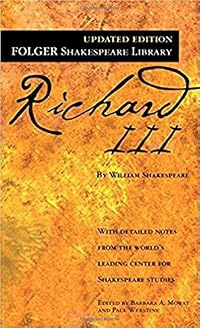
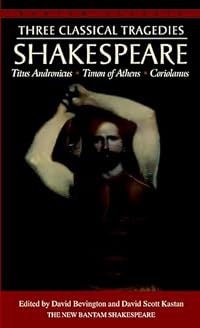
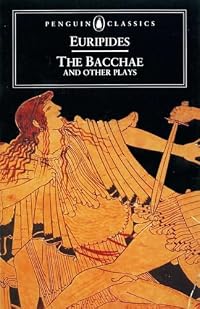
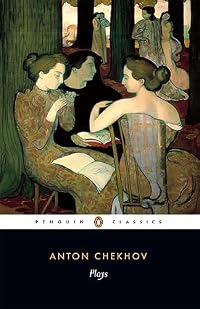







Member Reviews
HAMLET: It's been probably more than five years since the last time I read any Shakespeare, and I was surprised to find that I actually enjoyed it (rather than just "appreciated" it). I'm impatient, so 400-year-old verse, no matter how good the writer is, just isn't going to be my thing - but the story is just damn good. The ending was a little disappointing, though (but there's a lot of action, so it's probably a lot better when you're watching instead of reading). 3/5. 6/17/08.
OTHELLO: Not very good. The plot is simple and straightforward with no reason to be dragged out over five acts. The characters are melodramatic and without depth. I entertained myself by imagining it performed by the cast of The Honeymooners, which actually fit show more really well. It's almost exactly like a long episode of The Honeymooners, except Norton is evil, and Ralph kills Alice. 1.5/5. 8/2/08.
KING LEAR: Pretty enjoyable -- much better than Othello, not as good as Hamlet. The biggest fault is the parade-of-corpses ending; sort of a lazy way to make sure it has the requisite body count to qualify as a tragedy. It isn't particularly tragic; except for Cordelia (who isn't a big character) and maybe Gloucester (who I didn't find very sympathetic), everyone who dies has it coming. And there's a lot of humor; I'll be interested to see a film version to see how humorously it's actually played. 3/5. 11/24/08.
MACBETH: A short, fast read. There's not much depth to it; sometimes it seems more like an excuse for stage effects than literature. But it kept me entertained. 3/5. 2/7/09. show less
OTHELLO: Not very good. The plot is simple and straightforward with no reason to be dragged out over five acts. The characters are melodramatic and without depth. I entertained myself by imagining it performed by the cast of The Honeymooners, which actually fit show more really well. It's almost exactly like a long episode of The Honeymooners, except Norton is evil, and Ralph kills Alice. 1.5/5. 8/2/08.
KING LEAR: Pretty enjoyable -- much better than Othello, not as good as Hamlet. The biggest fault is the parade-of-corpses ending; sort of a lazy way to make sure it has the requisite body count to qualify as a tragedy. It isn't particularly tragic; except for Cordelia (who isn't a big character) and maybe Gloucester (who I didn't find very sympathetic), everyone who dies has it coming. And there's a lot of humor; I'll be interested to see a film version to see how humorously it's actually played. 3/5. 11/24/08.
MACBETH: A short, fast read. There's not much depth to it; sometimes it seems more like an excuse for stage effects than literature. But it kept me entertained. 3/5. 2/7/09. show less
Ratings
Members
- Recently Added By
Lists

Reading LIst
648 works; 1 member
Author Information

6,012+ Works 440,411 Members
William Shakespeare, 1564 - 1616 Although there are many myths and mysteries surrounding William Shakespeare, a great deal is actually known about his life. He was born in Stratford-Upon-Avon, son of John Shakespeare, a prosperous merchant and local politician and Mary Arden, who had the wealth to send their oldest son to Stratford Grammar School. show more At 18, Shakespeare married Anne Hathaway, the 27-year-old daughter of a local farmer, and they had their first daughter six months later. He probably developed an interest in theatre by watching plays performed by traveling players in Stratford while still in his youth. Some time before 1592, he left his family to take up residence in London, where he began acting and writing plays and poetry. By 1594 Shakespeare had become a member and part owner of an acting company called The Lord Chamberlain's Men, where he soon became the company's principal playwright. His plays enjoyed great popularity and high critical acclaim in the newly built Globe Theatre. It was through his popularity that the troupe gained the attention of the new king, James I, who appointed them the King's Players in 1603. Before retiring to Stratford in 1613, after the Globe burned down, he wrote more than three dozen plays (that we are sure of) and more than 150 sonnets. He was celebrated by Ben Jonson, one of the leading playwrights of the day, as a writer who would be "not for an age, but for all time," a prediction that has proved to be true. Today, Shakespeare towers over all other English writers and has few rivals in any language. His genius and creativity continue to astound scholars, and his plays continue to delight audiences. Many have served as the basis for operas, ballets, musical compositions, and films. While Jonson and other writers labored over their plays, Shakespeare seems to have had the ability to turn out work of exceptionally high caliber at an amazing speed. At the height of his career, he wrote an average of two plays a year as well as dozens of poems, songs, and possibly even verses for tombstones and heraldic shields, all while he continued to act in the plays performed by the Lord Chamberlain's Men. This staggering output is even more impressive when one considers its variety. Except for the English history plays, he never wrote the same kind of play twice. He seems to have had a good deal of fun in trying his hand at every kind of play. Shakespeare wrote 154 sonnets, all published on 1609, most of which were dedicated to his patron Henry Wriothsley, The Earl of Southhampton. He also wrote 13 comedies, 13 histories, 6 tragedies, and 4 tragecomedies. He died at Stratford-upon-Avon April 23, 1616, and was buried two days later on the grounds of Holy Trinity Church in Stratford. His cause of death was unknown, but it is surmised that he knew he was dying. (Bowker Author Biography) show less
Some Editions
Series
Belongs to Publisher Series
Work Relationships
Contains
Common Knowledge
- Canonical title
- 4 Plays: Hamlet; King Lear; Macbeth; Othello
- Alternate titles
- Four Great Tragedies; Four Tragedies
- Original publication date
- 1982 (Signet Classics ∙ as Four Great Tragedies) (Signet Classics ∙ as Four Great Tragedies); 1994 (Penguin Classics ∙ as Four Tragedies) (Penguin Classics ∙ as Four Tragedies); 1998 (Signet Classics ∙ Revised Edition) (Signet Classics ∙ Revised Edition); 1988 (Bantam) (Bantam); 2005 (Bantam Classic, The New Bantam Shakespeare, updated) (Bantam Classic, The New Bantam Shakespeare, updated)
- Disambiguation notice
- This page is intended for single volumes that contain exactly these four tragedies: Hamlet, Othello, King Lear and Macbeth. Alternative titles, editions, editors, introductions, etc. are welcome as... (show all) long as the plays themselves are the same. For example, the Signet Classics and the Penguin Classics belong here.
Please do not combine with single volumes which contain different plays. For example, the 2005 Dover Thrift edition titled Four Great Tragedies should not be combined because it contains only three of the four plays; King Lear is replaced by Romeo and Juliet.
Classifications
Statistics
- Members
- 1,268
- Popularity
- 19,209
- Reviews
- 2
- Rating
- (4.43)
- Languages
- 6 — Chinese, Dutch, English, Finnish, Italian, Korean
- Media
- Paper, Audiobook, Ebook
- ISBNs
- 22
- ASINs
- 6