Some Things in This World: Poems
by Joyce Thomas
On This Page
Tags
Member Reviews
The title poem in this collection, "Some Things in This World," begins: "Some things in this world would break your heart / if you let them." And the truth is, this would be a better caption on the back of the book than what's currently there, which suggests a very different collection than the one which has actually been published.
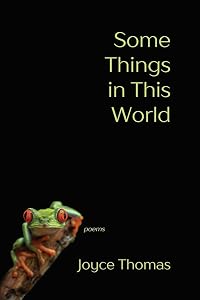
The description of the book suggests a focus on the natural world, it says that the collection is 'at times elegiac, at times playful...[and] uses the power and transcendent possibilities of the sympathetic imaginative and the transformative magic of language to hold a mirror to our world.' The description makes me think there'll be much reflection in the work, but also hope, or at least description which is show more not outright despairing. Instead, the collection itself reads as an elegy, seemingly without any hope for redemption or a future that can include Nature. Even where an occasional moment of magic in nature is honored, or where the beauty of nature comes through, Thomas' focus quickly turns the focus of the moment dark, to the extent that I'm not sure I could have made myself pick the book back up if I hadn't read it in one sitting where I didn't have anything else to read at hand. Simply put, while Thomas' language is lovely, the poems are nearly all so depressing, and so heavy with despair, dread, and/or death, that it's difficult to appreciate the collection. Much as I hate to say it, the cover would be more fitting if the frog on the cover were dead, and that would be fair warning to readers of what they'll find in the collection.
I can't say I'll read another poem by the author, though I might have appreciated some of these if I'd found them isolation within a journal or anthology; truth be told, this one's probably going to stick with me for all the wrong reasons, and I suspect I'll end up having a cynical eye for book descriptions coming from this publisher in the future, much as I hate to say that.
This isn't one I'd recommend unless you're specifically looking for a collection that focuses in on despair written onto nature and the way we've found ways to ruin our environment, without any hope for a future that might involve some respect for it. show less
The description of the book suggests a focus on the natural world, it says that the collection is 'at times elegiac, at times playful...[and] uses the power and transcendent possibilities of the sympathetic imaginative and the transformative magic of language to hold a mirror to our world.' The description makes me think there'll be much reflection in the work, but also hope, or at least description which is show more not outright despairing. Instead, the collection itself reads as an elegy, seemingly without any hope for redemption or a future that can include Nature. Even where an occasional moment of magic in nature is honored, or where the beauty of nature comes through, Thomas' focus quickly turns the focus of the moment dark, to the extent that I'm not sure I could have made myself pick the book back up if I hadn't read it in one sitting where I didn't have anything else to read at hand. Simply put, while Thomas' language is lovely, the poems are nearly all so depressing, and so heavy with despair, dread, and/or death, that it's difficult to appreciate the collection. Much as I hate to say it, the cover would be more fitting if the frog on the cover were dead, and that would be fair warning to readers of what they'll find in the collection.
I can't say I'll read another poem by the author, though I might have appreciated some of these if I'd found them isolation within a journal or anthology; truth be told, this one's probably going to stick with me for all the wrong reasons, and I suspect I'll end up having a cynical eye for book descriptions coming from this publisher in the future, much as I hate to say that.
This isn't one I'd recommend unless you're specifically looking for a collection that focuses in on despair written onto nature and the way we've found ways to ruin our environment, without any hope for a future that might involve some respect for it. show less
 This review was written for LibraryThing Early Reviewers.
Joyce Thomas's poetry book Some Things in This World is a very clear window into the life of the poet in general. Equal parts languid and livid, Thomas shows that pain and pride may be two halves of the same coin. Much of the book rails against humanity's crimes against nature, and the rest deals with humanity's crimes against itself. It will capably hold your attention for an afternoon, but will come calling later for a second read.
This review was written for LibraryThing Early Reviewers.Joyce's poetry takes those wonderful small moments, and lets you in. You experience them, you feel perhaps as the speaker feels, and you walk away with a nod.
The poetry is well written, to the point, and masterful. Joyce Thomas has a delightful sharpness in tone and wit that reminds me of Dorothy Parker, but with a focus on this silly world around us and our silly relationship with nature. I'm so happy I requested this advance copy and enjoyed it more than any other I've reviewed in the past.
The poetry is well written, to the point, and masterful. Joyce Thomas has a delightful sharpness in tone and wit that reminds me of Dorothy Parker, but with a focus on this silly world around us and our silly relationship with nature. I'm so happy I requested this advance copy and enjoyed it more than any other I've reviewed in the past.
This review was written for LibraryThing Early Reviewers.I am not a big poetry reader although I do, on occasion, pick up a book and read a poem. When I received Some Things in the World, by Joyce Thomas, I was happy to see it is a small book (62 pages) as I did not want to tackle reading a poetry book as I would a novel. I enjoy sampling poems, opening a book and randomly choosing one then later in the day another.
The first I read was In Praise of Three Legged Dogs, as my family had a three legged dog when I was growing up. It is a bitter-sweet poem of such dogs and brought me back to our dog, Jayne.
Later I read Ladies in their Hats, which harkened back to a past era where fancy hats were the rage. Hats adorned with the feathers of birds killed just for their plumes. It was a bit show more depressing. And that, I found to be the overall feel of these poems.
None are too long or overly involved language wise. They are often looking at the sad side of life and experience.
1968 and The Dog in Life, take us back to the turbulent times in the late 60's. An authors memories and reactions and revelations of those days.
I think these would be great in a school where the English Teacher could coordinate with a History teacher.
Overall I enjoyed these poems and will probably go back to this book on occasion as I do with poetry. show less
The first I read was In Praise of Three Legged Dogs, as my family had a three legged dog when I was growing up. It is a bitter-sweet poem of such dogs and brought me back to our dog, Jayne.
Later I read Ladies in their Hats, which harkened back to a past era where fancy hats were the rage. Hats adorned with the feathers of birds killed just for their plumes. It was a bit show more depressing. And that, I found to be the overall feel of these poems.
None are too long or overly involved language wise. They are often looking at the sad side of life and experience.
1968 and The Dog in Life, take us back to the turbulent times in the late 60's. An authors memories and reactions and revelations of those days.
I think these would be great in a school where the English Teacher could coordinate with a History teacher.
Overall I enjoyed these poems and will probably go back to this book on occasion as I do with poetry. show less
This review was written for LibraryThing Early Reviewers.Joyce Thomas has a way of putting herself into her poems, her memories, her thoughts, events from her life. That is something not every poet can do.
Usually, though, before picking out a poetry book, I’ll look up some the author’s work to get an idea if they write the kind of poetry I can understand and feel and relate to. Unfortunately I didn’t do that with Some Things in This World. So, I was confused, didn't know whether to blame myself or the author, and mostly didn’t grasp what was happening in this book.
I did like "Used to Be" though, where Thomas uses two fifteen-line stanzas to contrast her childhood experiences of "the desk I crouched beneath" during civil defense drills, with present day school kids when "assault show more rifles rend children unrecognizable" and where "shelter in place / means forever". show less
Usually, though, before picking out a poetry book, I’ll look up some the author’s work to get an idea if they write the kind of poetry I can understand and feel and relate to. Unfortunately I didn’t do that with Some Things in This World. So, I was confused, didn't know whether to blame myself or the author, and mostly didn’t grasp what was happening in this book.
I did like "Used to Be" though, where Thomas uses two fifteen-line stanzas to contrast her childhood experiences of "the desk I crouched beneath" during civil defense drills, with present day school kids when "assault show more rifles rend children unrecognizable" and where "shelter in place / means forever". show less
This review was written for LibraryThing Early Reviewers.The beauty of poetry is that it allows the reader to internalize and appreciate sentiments expressed. This volume definitely connected with me. As I look for literature that can be used cross-curricular I noted “Sometimes the Trees” for current events, “Dead Frogs” for biology, “1968” and “The Dog in ‘Life’” for history and I could go on. After recently reading McIndoe’s book BIRDS AREN’T REAL, I totally appreciated “Fake Birds” and in the notes section she admitted it was the influence to write the poem. Often the last line is a mental sucker punch to make you think. Obviously I recommend this volume of poetry.
This review was written for LibraryThing Early Reviewers.This book of ecopoetry doesn't pull any punches. The poems address climate change, man's abuse of the environment, and the resulting permanent repercussions of this abuse. Joyce Thomas' writing style is matter-of-fact with no sugar-coating, making her messages clear and impactful. Recommended.
This review was written for LibraryThing Early Reviewers.Members
- Recently Added By
Author Information
2+ Works 12 Members
Common Knowledge
- Canonical title
- Some Things in This World: Poems
Classifications
Statistics
- Members
- 11
- Popularity
- 2,001,616
- Reviews
- 9
- Rating
- (4.00)
- Languages
- English
- Media
- Paper
- ISBNs
- 1