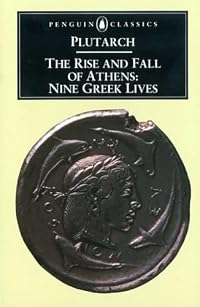
The Rise and Fall of Athens: Nine Greek Lives
by Plutarch
On This Page
Description
Nine Greek biographies illustrate the rise and fall of Athens, from Theseus through Solon, Themistocles, Aristides, Cimon, Pericles, Nicias, and Alcibiades, to the razing of its walls by Lysander. The nine lives follow Athen's history from the legendary times of Theseus, the city's founder, to its defeat at the hands of Lysander, its Spartan conqueror. Included are the biographies of Themistocles, a brilliant but heavy-handed naval commander, Aristedes 'the Just' and Pericles, who was show more responsible for the buildings on the Acropolis. Plutarch's real interest in these men is not in the greatness of their victories or achievemenets but in their moral strengths, and for him the responsibility for the eventual fall of Athens lay with the weakness and ambition of its great men. show lessTags
Recommendations







Member Reviews
The nines lives translated here start with Theseus the legendary hero, and end with Lysander, the Spartan General who pulled down the walls of Athens to the sound of flutes, to signify the end of the Peloponnesian War. Ian Scot-Kilverts wrinting flows well. The Penguin series of Plutarch's Lives does not contain all the Biographies, and doesn't have the essays explaining the chosen lives that one finds in the Dryden translation found in the "Great Books of the Western World Series. If you want completeness, go there. Use this smaller book for a themed read.
The nine lives translated here and arranged in chronical order follow the history of Athens.
Ratings
Members
- Recently Added By
Lists

Reading LIst
648 works; 1 member

Books Cited in Digging Up the Dead by Michael Kammen
183 works; 1 member

In Our Time books
4,934 works; 2 members
Author Information

1,618+ Works 25,876 Members
PLUTARCH. c.46--c.125 Considered by many to be the most important Greek writer of the early Roman period, Plutarch was a member of a well-to-do Greek family, a chief magistrate, a priest at Delphi, and an exceptionally well-read individual. His philosophical views were based on those of Plato and, although a Greek, he esteemed the achievements and show more attributes of the Romans. By the time Plutarch's works were published for the first time in the eleventh century, some had already been lost. He wrote innumerable essays on philosophical, historical, political, religious, and literary subjects, 78 of which survive today and are known collectively as the "Moralia." He is known primarily, however, for his Parallel Lives of Greeks and Romans, which consists of 50 biographies---23 of prominent Greeks, 23 of Roman leaders, and 4 separate lives---accompanied at intervals by short comparative essays. Although historical information is included in the work, Plutarch wrote it originally to inspire emulation in youth, so the emphasis is on character, moral choice, and anecdote. Sir Thomas North's 1579 translation into English of Parallel Lives became an important source for William Shakespeare which he used for three plays, Julius Caesar, Antony and Cleopatra, and Coriolanus. (Bowker Author Biography) show less
Some Editions
Series
Belongs to Publisher Series
Medallion Penguin Classics (L102)
Penguin Classics (L102)
Common Knowledge
- Canonical title
- The Rise and Fall of Athens: Nine Greek Lives
- Original title
- Βίοι Παράλληλοι
- Original publication date
- 1960; 2nd Century CE (early) (early)
- People/Characters
- Alcibiades; Aristides, 2nd century; Cimon; Lysander; Nicias; Pericles (show all 10); Soton; Themistocles; Theseus; Mapes
- Important places
- Anaphlystus; Athens, Greece; Greece (Ancient)
- Epigraph
- [None]
- Dedication
- [None]
- First words
- Sir Thomas North entitled his great translation of Plutarch The Lives of the Noble Grecians and Romans.
Introduction (Penguin Classics, Ian Scott-Kilvert transl., 1960).
You know, Sosius Senecio, how geographers, when they come to deal with those parts of the earth which know nothing about, crowd them into the margins of their maps with the explanation, 'Beyond this lie sandy waterless desert... (show all)s full of wild beasts,' or 'trackless swamps,' or 'Scythian snows,' or 'ice-locked sea.'
I. Theseus (Penguin Classics, Ian Scott-Kilvert transl., 1960). - Last words
- (Click to show. Warning: May contain spoilers.)This, then, is what we have found to tell about Lysander.
- Original language
- Greek (Ancient) (Ancient)
- Disambiguation notice
- The Penguin Classics edition comprises translations of nine of the original forty-eight Lives, those of Theseus, Solon, Themistocles, Aristides, Cimon, Pericles, Nicias, Alcibiades and Lysander.
Classifications
- Genres
- History, Nonfiction, General Nonfiction, Biography & Memoir
- DDC/MDS
- 938.00992 — History & geography History of ancient world (to ca. 499) Greece to 323 Greece to 323 Greek Stone & Bronze Age, Greek tribes (Ancient) Historiography
- LCC
- DE7 .P7 .S3 — History of Europe, Asia, Africa and Oceania Greco-Roman World History of the Greco-Roman world General
- BISAC
Statistics
- Members
- 1,439
- Popularity
- 16,224
- Reviews
- 2
- Rating
- (3.82)
- Languages
- English
- Media
- Paper, Ebook
- ISBNs
- 6
- UPCs
- 1
- ASINs
- 20