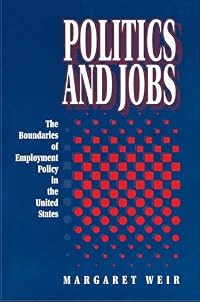
Politics and Jobs
by Margaret Weir
On This Page
Description
"Americans claim a strong attachment to the work ethic and regularly profess support for government policies to promote employment. Why, then, have employment policies gained only a tenuous foothold in the United States? To answer this question, Margaret Weir highlights two related elements: the power of ideas in policymaking and the politics of interest formation. Rather than seeing policy as a straightforward outcome of public preferences, she shows how ideas frame the problems and how show more interests form around possibilities created by the interplay of ideas and politics." "By examining Keynesian macroeconomic policy in the 1930s and 1940s, labor market policies in the 1960s and 1970s, and efforts to develop new planning mechanisms in the late 1970s, Weir shows how early decisions restricted the scope for later initiatives. As a result, policies in the 1960s emphasized racial differences and thus drew opposition for creating special interest measures for African-Americans. Highlighting the limited capacities of the American national state, employment policy also attracted charges of waste, fraud, and corruption. By the 1970s, antipathy to the federal government and racial antagonism dominated the politics in this field, and any ideas for new programs quickly became entangled with preexisting problems."--Jacket show lessTags
Members
- Recently Added By
Author Information
6 Works 168 Members
Classifications
- Genres
- Economics, Nonfiction, Politics and Government, Business
- DDC/MDS
- 339.5 — Social sciences Economics Macroeconomics and related topics Macroeconomic policy
- LCC
- HD5724 .W38 — Social sciences Industries. Land use. Labor Industries. Land use. Labor Labor. Work. Working class Labor market. Labor supply. Labor demand
- BISAC
Statistics
- Members
- 13
- Popularity
- 1,764,844
- Languages
- English
- Media
- Paper, Ebook
- ISBNs
- 3