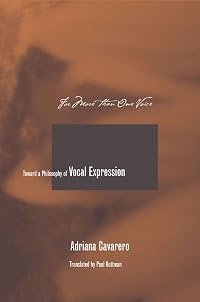
For More than One Voice: Toward a Philosophy of Vocal Expression
by Adriana Cavarero
On This Page
Description
The human voice does not deceive. The one who is speaking is inevitably revealed by the singular sound of her voice, no matter "what" she says. We take this fact for granted ?for example, every time someone asks, over the telephone, "Who is speaking?" and receives as a reply the familiar utterance, "It's me." Starting from the given uniqueness of every voice, Cavarero rereads the history of philosophy through its peculiar evasion of this embodied uniqueness. She shows how this history ?along show more with the fields it comprehends, such as linguistics, musicology, political theory, and studies in orality ?might be grasped as the "devocalization of Logos," as the invariable privileging of semantike over phone, mind over body. Female figures ?from the Sirens to the Muses, from Echo to opera singers ?provide a crucial counterhistory, one in which the embodied voice triumphs over the immaterial semantic. Reconstructing this counterhistory, Cavarero proposes a "politics of the voice" wherein the ancient bond between Logos and politics is reconfigured, and wherein what matters is not the communicative content of a given discourse, but rather who is speaking. show lessTags
Recommendations







































Member Reviews
Cavarero comincia con la lettura di un racconto di Calvino, Un re in ascolto tratto dalla sua ultima incompiuta raccolta di racconti, Sotto il sole giaguaro, che racconta di un re che attraverso l’ascolto della voce di una donna che non vede, scopre “il piacere che questa voce mette nell’esistere: nell’esistere come voce, ma questo piacere porta il re a immaginare il modo in cui la persona potrebbe essere diversa da ogni altra quanto è diversa la voce”.
Questo il punto di partenza di un percorso teorico che cerca di rileggere la metafisica occidentale, fondata da Platone, come un’operazione di devocalizzazione del logos che lo priva della unicità e dell’individualità per farlo accedere all’universalità.
“La macchina show more metafisica che nega metodologicamente il primato della voce sulla parola va smontata non solo trasformando tale primato in un’essenziale destinazione, ma tenendo sempre a mente che la strategia volta a neutralizzare la potenza della voce è anche una strategia nella quale il darsi a più voci, diverse una dall’altra del fenomeno della parola resta , per millenni, inascoltato” (22)
Un modo di riprendere dal punto di vista filosofico il lavoro della voce.
Da segnalare il capitolo intitolato L’armonia delle sfere ovvero il controllo politico della mousiké (p.168) sul controllo politico della musica in Platone show less
Questo il punto di partenza di un percorso teorico che cerca di rileggere la metafisica occidentale, fondata da Platone, come un’operazione di devocalizzazione del logos che lo priva della unicità e dell’individualità per farlo accedere all’universalità.
“La macchina show more metafisica che nega metodologicamente il primato della voce sulla parola va smontata non solo trasformando tale primato in un’essenziale destinazione, ma tenendo sempre a mente che la strategia volta a neutralizzare la potenza della voce è anche una strategia nella quale il darsi a più voci, diverse una dall’altra del fenomeno della parola resta , per millenni, inascoltato” (22)
Un modo di riprendere dal punto di vista filosofico il lavoro della voce.
Da segnalare il capitolo intitolato L’armonia delle sfere ovvero il controllo politico della mousiké (p.168) sul controllo politico della musica in Platone show less
Jun 16, 2008Italian
Ratings
Members
- Recently Added By
Author Information

20+ Works 301 Members
Adriana Cavarero is Professor of Political Philosophy at the University of Verona. Her books in English include For More than One Voice (Stanford, 2005) and Horrorism (2008).
Classifications
Statistics
- Members
- 53
- Popularity
- 572,673
- Reviews
- 1
- Rating
- (3.00)
- Languages
- English, Italian, Portuguese
- Media
- Paper, Ebook
- ISBNs
- 7