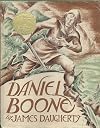
Daniel Boone
by James Daugherty
On This Page
Description
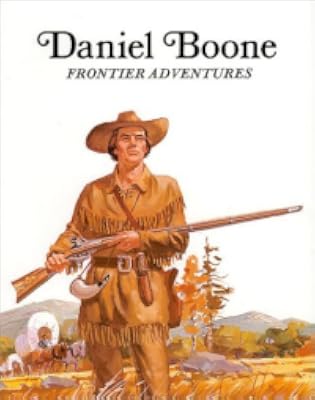
Tells the story of the life of the rugged frontiersman and pioneer leader who helped settle Kentucky.Tags
Recommendations













Member Reviews
Daugherty’s heroically illustrated biography of Boone is a paean to his subject’s resourcefulness, skill, and determination and to life of English pioneers and settlers as they became Americans and expanded the bounds of the United States westward beyond the Appalachian mountains. Or to put it in contemporary terms, a poetically phrased saga of settler colonialism, white supremacy, and genocide. The indigenous inhabitants of the land are portrayed as brutal enemies in both prose and portraiture, unless they are aiding an explorer, and as noble savages but only after they have been extinguished. In this book when Indians attack and butcher whites, it was barbaric, but when whites employ exactly the same tactics on Indians it is show more heroic.
Putting this book in its historical context, Daniel Boone was awarded the Newbery medal in 1940, a time when Americans feared a war with, ironically, some white skinned savages in the process of conquering large parts of Europe, and their oriental allies where doing much the same in Asia, and in a time when the ideology of racism and eugenics was a large part of white America’s ideaology. Not surprisingly, the book is currently out of print. show less
Putting this book in its historical context, Daniel Boone was awarded the Newbery medal in 1940, a time when Americans feared a war with, ironically, some white skinned savages in the process of conquering large parts of Europe, and their oriental allies where doing much the same in Asia, and in a time when the ideology of racism and eugenics was a large part of white America’s ideaology. Not surprisingly, the book is currently out of print. show less
It was an interesting read, but really brought home the fact that the winners write the history. Given the time it was written, the perspectives brought forth in the book about the settling of Kentucky and Ohio, with respect to Native Americans was understandable. Today a book written this way would (or should) never be published.
The whites were lauded as being civilized and the Native peoples as savages. The native warriors were criticized heavily for attempting to burn out the settlements of the white people, but the (let us be fair) white warriors were lauded for burning the villages of the native peoples.
The whites were lauded as being civilized and the Native peoples as savages. The native warriors were criticized heavily for attempting to burn out the settlements of the white people, but the (let us be fair) white warriors were lauded for burning the villages of the native peoples.
I'm sure this was intended to inspire children and get them interested in history. James Daugherty hero-worshipped Daniel Boone, and this is clearly intended to be a story of the legend, not the man. He describes Boone's burning of Indian towns and villages as if they are heroic actions. The description of an Indian woman with a bow and arrow trying to protect her loved ones in a long house was particularly disturbing. The white men shot her 20 times and set the building on fire, burning alive the 46 men inside. The burning child dragging himself through the street didn't seem to be a problem for him either. The nearly constant references to "red varmints,""red dogs," "savage demons," etc. made the book extremely difficult to read.
In show more 1940 this was deemed the best of the best of children's literature. Thank goodness times have changed. This does not belong in any children's classroom. show less
In show more 1940 this was deemed the best of the best of children's literature. Thank goodness times have changed. This does not belong in any children's classroom. show less
Completely unacceptable book today in its representation of Native Americans as savages in the way of American progress. Even Daniel Boone recognized that there were too many settlers pouring in and destroying the land into Kentucky after he made his way through the Cumberland Gap. Another reviewer said it best in describing this as hero worship of Boone as the great god of the American West who outsmarted or outweaponed the Native people to make room for more and more settlers. Truly, a tragic story of American terrorism, but I am sure this was a hit with the idealistic Northern boys of the 1940's, as the United States prepared to enter World War II and playing Cowboys and Indians - in which the Indians were always the bad guys - was show more seen as acceptable and common form of play. The story is also a slog, boring and confusing and is not the best choice for teaching children how the nation was settled. There are many other books about Daniel Boone and the settling of the Middle West, but this Newbery should not be on it. show less
And, at last, I dared to read Daniel Boone. It’s a story full of wicked Indians and good-guy white settlers, full of killing and attacking. You can almost see Daniel’s halo and the devil horns of the Indians as you read the story. It is told in the vernacular of Daugherty’s time and it is undoubtedly an interesting and exciting story. Must we pull it from our shelves simply because it is chockfull of opinions and prejudices? Can it not be read as a story without vilifying either the Indians or the white people of the book? What about reading it as a legend, a folk tale, which, of course, it is?
A good introductory biography of Daniel Boone. It's got more text than typical picture books, but it's not as long and detailed as a full-length biography. Some of the pictures could be a little scary or immodest. Recommended for upper-elementary or middle school.
Genre: Biography. 1940 Newbery Medal winner.
Genre: Biography. 1940 Newbery Medal winner.
The author illustrated this kid-friendly biography of Daniel Boone. The writing style is very flowery, which makes it somewhat dated (I'm not sure a kid of today would find the reading easy going). Also, Mr. Daugherty paints his Indians as a savage race, bent on blood shed, and best shot on sight. You'd have a hard time finding a book today with this take on the American Indians of the past. I would have liked more concrete stories from Mr. Boone's life - mostly Mr. Daugherty talks of what a courageous pioneer he was, striding off into the west. All very good and well, but it would have been more interesting with more stories. The only real stories are of his fights with the Indians.
Members
- Recently Added By
Lists

Best Newbery Medal Winners
94 works; 52 members

Honey For a Child's Heart
1,152 works; 25 members

CCE 1000 Good Books List
1,033 works; 12 members

Newbery Medal Winners - By Year
105 works; 7 members

Books Read in 2021
5,361 works; 114 members

Recommended Reading List
219 works; 1 member

HMS: Make Your Child a Lover of Books, Ages 9 & up
111 works; 2 members
Author Information

Awards and Honors
Common Knowledge
- Canonical title
- Daniel Boone
- Alternate titles
- Daniel Boone: With Original Lithographs in Color by the Author
- Original publication date
- 1939-01
- People/Characters
- Daniel Boone
- Important places
- Kentucky, USA
- First words
- Squire Boone was a blacksmith of Berks County, Pennsylvania, who owned a prosperous farm near the frontier village of Reading.
- Last words
- (Click to show. Warning: May contain spoilers.)So they took a day off for remembrance about humble, great-hearted men whose lives were a strong invisible substance for enduring corner-stones for these United States of America.
- Original language
- English
- Disambiguation notice
- Caution: James Daugherty was involved in two Daniel Boone books. For this 1939 book, he was both the writer and the illustrator. He only illustrated the 1922 book written by Stewart Edward White.
Classifications
Statistics
- Members
- 351
- Popularity
- 89,930
- Reviews
- 8
- Rating
- (2.57)
- Languages
- English
- Media
- Paper
- ISBNs
- 4
- ASINs
- 13