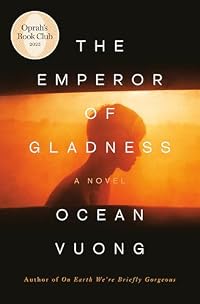
The Emperor of Gladness
by Ocean Vuong
On This Page
Description
Ocean Vuong returns with a bighearted novel about chosen family, unexpected friendship, and the stories we tell ourselves in order to survive. One late summer evening in the post-industrial town of East Gladness, Connecticut, nineteen-year-old Hai stands on the edge of a bridge in pelting rain, ready to jump, when he hears someone shout across the river. The voice belongs to Grazina, an elderly widow succumbing to dementia, who convinces him to take another path. Bereft and out of options, show more he quickly becomes her caretaker. Over the course of the year, the unlikely pair develops a life-altering bond, one built on empathy, spiritual reckoning, and heartbreak, with the power to alter Hai's relationship to himself, his family, and a community at the brink. Following the cycles of history, memory, and time, The Emperor of Gladness shows the profound ways in which love, labor, and loneliness form the bedrock of American life. At its heart is a brave epic about what it means to exist on the fringes of society and to reckon with the wounds that haunt our collective soul. Hallmarks of Ocean Vuong's writing--formal innovation, syntactic dexterity, and the ability to twin grit with grace through tenderness--are on full display in this story of loss, hope, and how far we would go to possess one of life's most fleeting mercies: a second chance. show lessTags
Recommendations













Member Reviews
Just so no one is even momentarily mislead by what I'm going to write next, I found The Emperor of Gladness to be an absolutely marvelous novel.
You know that sort of novel full of quirky, misfit characters who band together somehow, in a music group, say, or at a workplace, or in a bar. They are poor, probably, and/or otherwise outsiders. Their lives are hard, and they probably have some stronger outside force arrayed against them: an evil landlord or building developer, or a relative with power of attorney who just doesn't understand, or maybe the medical industry, but none of that matters in the end, because they have each other and their quirky humor and positive outlooks on life. There might be some good writing, but overall the show more novel provides a feel good cartoon of a story, even if the ending's not all that happy. Over the years, my patience for such novels has been worn down to a stubble.
The Emperor of Gladness could have been that, because what I've just described is the basic framework. But Ocean Vuong is such a good writer, his ability to infuse this archetype with depth and breadth so acute, that this novel instead becomes a moving and memorable testimony of friendship and continued struggle against the headwinds of poverty, diminished expectations and disappointment with one's own choices. In the first few pages, 19-year-old Hai, the son of Vietnamese immigrants, addicted to pharmaceuticals, stands on a bridge over a freezing river and prepares to jump. He has already dropped out of college in New York City and returned in abject embarrassment to his mother in East Gladness, Connecticut, a gray, shrinking industrial town several miles outside of Hartford. Now his mother thinks he is in Boston studying in a medical program, though in truth he has never left East Gladness, so although he misses her, he can only speak with her on the phone, pretending to be in another city. But while he is looking down at the water, he is hailed from the window of a house on the far shore by an old woman who somehow convinces not to jump but instead to finish crossing the bridge so that she can warm him up with a blanket and give him a meal. She is Drazina, an immigrant from Lithuania who ran from Stalin's army at the end of World War 2 with her husband, now dead, and who now lives alone in the family house at the end of what is now mostly an abandoned and crumbling block of houses that dead ends at the riverbank. She offers him a room and he essentially becomes her caretaker. Soon, he prevails upon his cousin, Sony, to help him get a job at a nearby HomeMarket, a chain restaurant that specializes in rotisserie chicken and mac and cheese. The staff of this restaurant, a band of misfits in one way or another, will become his surrogate family. Again, this is all within the first several pages, so no real spoilers.
Well, you can see, perhaps, the potential for preciousness here. But Vuong's extreme talent in accurately depicting the claustrophobic humiliations of poverty and restrictions of class, and the strength of human aspiration and hope in the face of these factors, renders his character portrayals intensely human and their setting entirely recognizable. Also, since we feel we're in the real world rather than a feel good comedy, we are never sure of happy or longterm outcomes. Here's an overlong (sorry 'bout that!) quote to give you an idea of Vuong's writing:
___________________________________
There's a way an old Connecticut town feels when you pass through it at night. Hollowed out, blasted yet styled into a potent aftermath, all of it touched by an inexplicable beauty, like the outside has suddenly become one huge living room. And you feel you can sit down underneath the sincere light of a streetlamp and no one would bother you, no one would tell you to leave, because they know you're staying for a reason. That you're bound by your debts, by blood or sweat and the cars sprayed silver with hoarfrost along streets named after white millionaires no one remembers. How boring, he thought, to be yet another boy wanting to rid himself of the hometown dust clinging to his clothes, setting out like a spark flung from his mother's cigarette. He floated through the empty streets, eyes watering from the icy wind. He passed houses filled with warm light and imagined the people inside, his head growing blurry with the thought of them huddled in their tiny parlors full of furniture and voices breaking through the raiment light of TV commercials, the news, its endless reel of abjection, their bodies kept, for now, from the intolerance of daylight and its procession of work and misgivings. He imagined all the boys he wanted to know lying sleepless in their cramped and cluttered rooms, the curling posters and chipped trophies, the endless cords to defunct video game consoles, all of it once the feeble altar of teenage triumphs, now the detritus of adolescence.
_________________________________________
This is a novel built much more strongly on character and setting than on plot. And yet, as we're pulled along by the writing, we relatively quickly come to care about these people, and to want to know what will become of them. And, to be clear, it is definitely not all as bleak as the excerpt I've provided above might suggest. There is, in fact, quite a bit of humor. This novel gets a rare five stars from me. show less
You know that sort of novel full of quirky, misfit characters who band together somehow, in a music group, say, or at a workplace, or in a bar. They are poor, probably, and/or otherwise outsiders. Their lives are hard, and they probably have some stronger outside force arrayed against them: an evil landlord or building developer, or a relative with power of attorney who just doesn't understand, or maybe the medical industry, but none of that matters in the end, because they have each other and their quirky humor and positive outlooks on life. There might be some good writing, but overall the show more novel provides a feel good cartoon of a story, even if the ending's not all that happy. Over the years, my patience for such novels has been worn down to a stubble.
The Emperor of Gladness could have been that, because what I've just described is the basic framework. But Ocean Vuong is such a good writer, his ability to infuse this archetype with depth and breadth so acute, that this novel instead becomes a moving and memorable testimony of friendship and continued struggle against the headwinds of poverty, diminished expectations and disappointment with one's own choices. In the first few pages, 19-year-old Hai, the son of Vietnamese immigrants, addicted to pharmaceuticals, stands on a bridge over a freezing river and prepares to jump. He has already dropped out of college in New York City and returned in abject embarrassment to his mother in East Gladness, Connecticut, a gray, shrinking industrial town several miles outside of Hartford. Now his mother thinks he is in Boston studying in a medical program, though in truth he has never left East Gladness, so although he misses her, he can only speak with her on the phone, pretending to be in another city. But while he is looking down at the water, he is hailed from the window of a house on the far shore by an old woman who somehow convinces not to jump but instead to finish crossing the bridge so that she can warm him up with a blanket and give him a meal. She is Drazina, an immigrant from Lithuania who ran from Stalin's army at the end of World War 2 with her husband, now dead, and who now lives alone in the family house at the end of what is now mostly an abandoned and crumbling block of houses that dead ends at the riverbank. She offers him a room and he essentially becomes her caretaker. Soon, he prevails upon his cousin, Sony, to help him get a job at a nearby HomeMarket, a chain restaurant that specializes in rotisserie chicken and mac and cheese. The staff of this restaurant, a band of misfits in one way or another, will become his surrogate family. Again, this is all within the first several pages, so no real spoilers.
Well, you can see, perhaps, the potential for preciousness here. But Vuong's extreme talent in accurately depicting the claustrophobic humiliations of poverty and restrictions of class, and the strength of human aspiration and hope in the face of these factors, renders his character portrayals intensely human and their setting entirely recognizable. Also, since we feel we're in the real world rather than a feel good comedy, we are never sure of happy or longterm outcomes. Here's an overlong (sorry 'bout that!) quote to give you an idea of Vuong's writing:
___________________________________
There's a way an old Connecticut town feels when you pass through it at night. Hollowed out, blasted yet styled into a potent aftermath, all of it touched by an inexplicable beauty, like the outside has suddenly become one huge living room. And you feel you can sit down underneath the sincere light of a streetlamp and no one would bother you, no one would tell you to leave, because they know you're staying for a reason. That you're bound by your debts, by blood or sweat and the cars sprayed silver with hoarfrost along streets named after white millionaires no one remembers. How boring, he thought, to be yet another boy wanting to rid himself of the hometown dust clinging to his clothes, setting out like a spark flung from his mother's cigarette. He floated through the empty streets, eyes watering from the icy wind. He passed houses filled with warm light and imagined the people inside, his head growing blurry with the thought of them huddled in their tiny parlors full of furniture and voices breaking through the raiment light of TV commercials, the news, its endless reel of abjection, their bodies kept, for now, from the intolerance of daylight and its procession of work and misgivings. He imagined all the boys he wanted to know lying sleepless in their cramped and cluttered rooms, the curling posters and chipped trophies, the endless cords to defunct video game consoles, all of it once the feeble altar of teenage triumphs, now the detritus of adolescence.
_________________________________________
This is a novel built much more strongly on character and setting than on plot. And yet, as we're pulled along by the writing, we relatively quickly come to care about these people, and to want to know what will become of them. And, to be clear, it is definitely not all as bleak as the excerpt I've provided above might suggest. There is, in fact, quite a bit of humor. This novel gets a rare five stars from me. show less
The Emperor of Gladness is a stunning meditation on memory, grief, and identity, woven together in Ocean Vuong’s unmistakably lyrical voice. With this collection, Vuong continues to expand the boundaries of poetry and narrative, delivering not just beautifully crafted lines but a deeply human story that unfolds gently, like a whispered confession.
Though written in verse, the book carries the momentum of a novel, with interconnected poems that trace the emotional terrain of a central speaker whose voice feels both autobiographical and mythic. This speaker, tender, observant, and wounded, navigates the complexities of being a queer son, a lover, a survivor of war's aftermath, and a seeker of joy in a world shaped by pain.
The supporting show more characters, though never overtly named in a traditional narrative sense, are deeply present: a mother whose quiet strength anchors the speaker, a father lost in silence or absence, lovers who flicker in and out like moments of tenderness and escape. Each relationship is painted with emotional precision, never relying on exposition, but revealed through gesture, memory, and metaphor.
Vuong's genius lies in how he builds an atmosphere more than a plot. There’s a sense of time folding in on itself, past and present coexisting in the speaker’s reckoning with family, war, intimacy, and the fragile pursuit of joy. The emotional arcs develop quietly, often achingly, and by the end, the reader feels as though they’ve traveled not just through someone’s life, but through their soul.
This is a book for readers who love language that sings but also cuts deep. It is at once intimate and expansive, specific and universal. The Emperor of Gladness is not only a masterclass in poetic form but also a deeply affecting, character-driven work that lingers in the heart and mind long after the final page.
Ocean Vuong has once again given us a collection that feels like a prayer for beauty, for healing, and for the quiet triumph of choosing tenderness in a world that so often demands hardness.
Thank you!
Nicole show less
Though written in verse, the book carries the momentum of a novel, with interconnected poems that trace the emotional terrain of a central speaker whose voice feels both autobiographical and mythic. This speaker, tender, observant, and wounded, navigates the complexities of being a queer son, a lover, a survivor of war's aftermath, and a seeker of joy in a world shaped by pain.
The supporting show more characters, though never overtly named in a traditional narrative sense, are deeply present: a mother whose quiet strength anchors the speaker, a father lost in silence or absence, lovers who flicker in and out like moments of tenderness and escape. Each relationship is painted with emotional precision, never relying on exposition, but revealed through gesture, memory, and metaphor.
Vuong's genius lies in how he builds an atmosphere more than a plot. There’s a sense of time folding in on itself, past and present coexisting in the speaker’s reckoning with family, war, intimacy, and the fragile pursuit of joy. The emotional arcs develop quietly, often achingly, and by the end, the reader feels as though they’ve traveled not just through someone’s life, but through their soul.
This is a book for readers who love language that sings but also cuts deep. It is at once intimate and expansive, specific and universal. The Emperor of Gladness is not only a masterclass in poetic form but also a deeply affecting, character-driven work that lingers in the heart and mind long after the final page.
Ocean Vuong has once again given us a collection that feels like a prayer for beauty, for healing, and for the quiet triumph of choosing tenderness in a world that so often demands hardness.
Thank you!
Nicole show less
This is a love story. Not a story of sexual liaison, but of two people decades and culturally apart in a country they were not born into. It is a book whose poignancy can break your heart.
It is a story about the American nightmare that is the American Dream.
It is about what happens to so many in America when they get feeble and older.
It is about the lies we tell people because we love them.
It is abou outcasts working in a fast-food joint in a decaying suburb.
It is about the global military machine.
It is by the talented Vietnamese American Ocean Vuong and I suspect that some of it is autobiographical.
It is about lost and the temporary nature of human life on Earth.
It is a book that can make you laugh and cry at the same time.
It’s about show more outcasts, fast-food workers in Home Market, who when push came to shove would do anything possible for each other.
These people, bound by nothing but toil in a tiny kitchen that was never truly a kitchen, paid just above minimum wage, their presence known to each other mostly through muscle memory. The shape of their bodies ingrained in the psyche from hours of periphery maneuvering through the narrow counters and back rooms of a fast food joint designed by a corporate architect, so that they would come to know the sound of each other’s coughs and exhale better than those of their kin and loved ones. They who owe each other nothing but time, the hours collectively shouldered into a shift so that they might finish on time, now brought to their knees in a forest to gather around a half-burnt headrest of a Nissan Maxima on a Tuesday in mid April, their bodies finally touching, a mass of labor cobbled together by a boy’s hollowed loss. On the clock.
The book is set in America in the early years of the 21st century. The central characters are a young Vietnamese boy Hai, and an elderly Lithuanian woman, Grazina a refugee from the Second World War, living in a decaying house in East Gladness, Connecticut. Grazina has end-stage dementia and takes a cocktail of medications which keep her semi-functional. She has lived alone for several years when she takes in Hai to help her in return for shelter and food.
Hai and Grazina come to love each other deeply. We know this from their actions rather than their words. As Grazina hallucinates she’s joined by Hai’s own highs - he’s been hooked on mind-altering drugs since he was 16. At times their hallucinations come together, entwined so that they stay in the one world, such as when they escape the Russian troops of World War II into a place called Gettysburg being the only battleground that Hai can think of as they make their hallucinogenic escape. Grazina calls s Hai “Labas” when he’s feeling normal, that Lithuanian for the greeting as in Hi. At times she calls him Sergeant Pepper when they are in military mode in their hallucinations.
Vuong’s cousin Sony is special needs and Hai helps him through his life. He is named after a TV set. We hear about other names given to Vietnamese children that are the names of American objects. Such as Mazda and Honda. The irony of these being Japanese products escapes them. The parents named them in post-war Vietnam where they hoped to find the American dream and to own these products of their imagination.
Sony is obsessed with the losing sides in wars. He’s particularly obsessed with the American Civil War, Gettysburg and with loser General Robert E. Lee. Sony see himself as a loser in life but feels like a winner when he takes on Lee’s persona and military paraphernalia that he has bought online.
Hai goes along with peoples’ lies and impossible solutions out of his innate kindness. He pretends to his mother that he’s going to med school, when in fact he lives his life addicted to hard drugs, and never even applied . He calls his mother who is proud of him, and goes along with his lie. To do other would destroy her. He pretends to believe a fellow worker in the fast food joint when she tells him about lizard people being descended from dinosaurs.
Hai’s and Grazina’s halluciagebic scenes of the most memorable. Two people sharing their own hallucinations combining their histories into creative fantasy.
I felt deeply about the main characters Hai, Grazina and Sony. Characters working in the fast food joint were also likable and quirky. But the most important thing about to book was the quality of the writing.; how the reader is brought into the novel, into the wasteland of suburban Connecticut, into the moral eyes of the underdogs of American society.
It is the first time for several years that I have literally sobbed during the last chapter of a book. But let me not put you off this book. It is a book I would encourage anyone with humanity in their soul to read. show less
It is a story about the American nightmare that is the American Dream.
It is about what happens to so many in America when they get feeble and older.
It is about the lies we tell people because we love them.
It is abou outcasts working in a fast-food joint in a decaying suburb.
It is about the global military machine.
It is by the talented Vietnamese American Ocean Vuong and I suspect that some of it is autobiographical.
It is about lost and the temporary nature of human life on Earth.
It is a book that can make you laugh and cry at the same time.
It’s about show more outcasts, fast-food workers in Home Market, who when push came to shove would do anything possible for each other.
These people, bound by nothing but toil in a tiny kitchen that was never truly a kitchen, paid just above minimum wage, their presence known to each other mostly through muscle memory. The shape of their bodies ingrained in the psyche from hours of periphery maneuvering through the narrow counters and back rooms of a fast food joint designed by a corporate architect, so that they would come to know the sound of each other’s coughs and exhale better than those of their kin and loved ones. They who owe each other nothing but time, the hours collectively shouldered into a shift so that they might finish on time, now brought to their knees in a forest to gather around a half-burnt headrest of a Nissan Maxima on a Tuesday in mid April, their bodies finally touching, a mass of labor cobbled together by a boy’s hollowed loss. On the clock.
The book is set in America in the early years of the 21st century. The central characters are a young Vietnamese boy Hai, and an elderly Lithuanian woman, Grazina a refugee from the Second World War, living in a decaying house in East Gladness, Connecticut. Grazina has end-stage dementia and takes a cocktail of medications which keep her semi-functional. She has lived alone for several years when she takes in Hai to help her in return for shelter and food.
Hai and Grazina come to love each other deeply. We know this from their actions rather than their words. As Grazina hallucinates she’s joined by Hai’s own highs - he’s been hooked on mind-altering drugs since he was 16. At times their hallucinations come together, entwined so that they stay in the one world, such as when they escape the Russian troops of World War II into a place called Gettysburg being the only battleground that Hai can think of as they make their hallucinogenic escape. Grazina calls s Hai “Labas” when he’s feeling normal, that Lithuanian for the greeting as in Hi. At times she calls him Sergeant Pepper when they are in military mode in their hallucinations.
Vuong’s cousin Sony is special needs and Hai helps him through his life. He is named after a TV set. We hear about other names given to Vietnamese children that are the names of American objects. Such as Mazda and Honda. The irony of these being Japanese products escapes them. The parents named them in post-war Vietnam where they hoped to find the American dream and to own these products of their imagination.
Sony is obsessed with the losing sides in wars. He’s particularly obsessed with the American Civil War, Gettysburg and with loser General Robert E. Lee. Sony see himself as a loser in life but feels like a winner when he takes on Lee’s persona and military paraphernalia that he has bought online.
Hai goes along with peoples’ lies and impossible solutions out of his innate kindness. He pretends to his mother that he’s going to med school, when in fact he lives his life addicted to hard drugs, and never even applied . He calls his mother who is proud of him, and goes along with his lie. To do other would destroy her. He pretends to believe a fellow worker in the fast food joint when she tells him about lizard people being descended from dinosaurs.
Hai’s and Grazina’s halluciagebic scenes of the most memorable. Two people sharing their own hallucinations combining their histories into creative fantasy.
I felt deeply about the main characters Hai, Grazina and Sony. Characters working in the fast food joint were also likable and quirky. But the most important thing about to book was the quality of the writing.; how the reader is brought into the novel, into the wasteland of suburban Connecticut, into the moral eyes of the underdogs of American society.
It is the first time for several years that I have literally sobbed during the last chapter of a book. But let me not put you off this book. It is a book I would encourage anyone with humanity in their soul to read. show less
A sad and sometimes uplifting book written in beautiful prose. We have Hai, age 20, who has lied to his mother and feels he cannot return home. He talks with her on the phone and makes up stories about what is happening in med school where she thinks he is. We have Grazina, an elderly woman living alone in a rundown house that she does not want to leave because of the memories contained within. She sees Hai on a bridge behind her home and believes he is about to jump. So, she yells at him and tells him to come to her home. They seem to adopt each other and try to fulfill each others needs. Grazina suffers from dementia that comes and goes and which is worsening. Hai has just been released from rehab for taking pills. Because she is on a show more fixed income, Hai gets a job to supplement their needs. He is hired on at Home Market where his autistic cousin Sony works. Everyone who works there have their own difficulties, but become a family of sorts. Life happens and before a year is over, Grazina is removed from her home and put into memory care. Sony loses his job, but Hai gives him all the money he has and the money given to him by Grazina. He will use this money to get his mom out of jail. Hai takes a handful of prescription pain pills and crawls into a dumpster behind Home Market and passes away while talking to his mom.
Kirkus starred review: young man’s path to redemption runs through a New England chain restaurant.
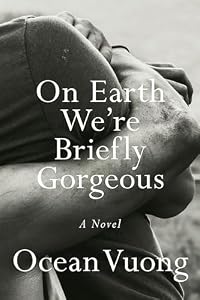
Hai, the hero of Vuong’s ambitious second novel—following On Earth We’re Briefly Gorgeous (2019)—is a 19-year-old college dropout and painkiller addict prepared to kill himself by leaping off a bridge in East Gladness, a rural Connecticut town. He’s coaxed to safety by Grazina, an 82-year-old woman with dementia, and soon he becomes her in-home support; with the help of a cousin, Sony, he lands a job at HomeMarket, a fast-casual joint. This is an unlikely milieu for a novel about the long consequences of violence, but that’s what Vuong strives for: In poetic, somber prose, he contemplates Grazina’s memories of escaping her native Lithuania under Stalin’s purges, the U.S. Civil War (Sony is obsessed with battles and the film Gettysburg), and his own family’s escape from Vietnam to America. The book is filled with some brilliant set pieces: A harrowing scene where Hai and his co-workers slaughter pigs for extra cash, his boss’s ill-fated attempt to launch a career as a pro wrestler, and moments where Hai soothes Grazina in the midst of her dementia by pretending to be a U.S. Army sergeant helping her escape Stalin’s clutches. And throughout, Hai serves as a sponge absorbing America’s worst elements: addiction, racism, and the urge to feign hollow successes. (He routinely lies to his mother, who believes he’s thriving in med school.) The references to Slaughterhouse-Five and The Brothers Karamazov underscore Vuong’s interest in exploring war and morality, but this is remarkable as a novel that tries to look at those themes outside of conventional realism or combat porn. It’s a messy but worthy exploration of how hurt and self-deception leaches into everyday life.
A sui generis take on the surprising and cruel ways violence is passed on across generations.
AP News- Donna Edwards: Hai is 19 and suicidal. Grazina is 81 and living alone with dementia. So when she strikes a deal to house him so they can keep each other company in exchange for his help as a kind of unofficial live-in nurse, this could spell their mutual salvation or destruction.
Ocean Vuong’s new novel follows Hai as he takes care of Grazina and works in a fast-casual restaurant to help support them. Told in moments, “The Emperor of Gladness” takes existentialism to a deeply intimate level, leaving the reader to contemplate what it is to live in a messy, complicated world of wars, addiction, class struggles and good people looking for second chances. The novel was immediately named Oprah Winfrey’s latest book club pick.
The author draws heavily on his own life — from Hai’s family fleeing the Vietnam War to their jobs in the service industry that allow them to scrape by — so “The Emperor of Gladness” is only a few degrees away from a memoir. And while it’s told in prose, Vuong’s penchant for poetry shows in patches of colorful, visceral language strewn with metaphors that run through the whole book, all the way back to its title.
The novel opens with a movie-like sweep through East Gladness, a tiny town outside of Hartford, Connecticut. The omniscient narrator zooms in on various scenes of decay and neglect until we land on Hai, at possibly his lowest point.
There’s not so much a plot as a gathering of people and experiences. We piece together the characters’ stories the way you would with real people in real life; through snippets that build atop each other until you can patch together a narrative of the relationships that left the biggest scars and the events that had profound impacts. Vuong achieves more by writing beside his characters than one would by writing a straightforward story about them.
True and gritty, “The Emperor of Gladness” is almost voyeuristic in how it looks into the most intimate and human moments of people’s lives, reflecting back on the reader and leaving plenty to ponder. show less
Kirkus starred review: young man’s path to redemption runs through a New England chain restaurant.
Hai, the hero of Vuong’s ambitious second novel—following On Earth We’re Briefly Gorgeous (2019)—is a 19-year-old college dropout and painkiller addict prepared to kill himself by leaping off a bridge in East Gladness, a rural Connecticut town. He’s coaxed to safety by Grazina, an 82-year-old woman with dementia, and soon he becomes her in-home support; with the help of a cousin, Sony, he lands a job at HomeMarket, a fast-casual joint. This is an unlikely milieu for a novel about the long consequences of violence, but that’s what Vuong strives for: In poetic, somber prose, he contemplates Grazina’s memories of escaping her native Lithuania under Stalin’s purges, the U.S. Civil War (Sony is obsessed with battles and the film Gettysburg), and his own family’s escape from Vietnam to America. The book is filled with some brilliant set pieces: A harrowing scene where Hai and his co-workers slaughter pigs for extra cash, his boss’s ill-fated attempt to launch a career as a pro wrestler, and moments where Hai soothes Grazina in the midst of her dementia by pretending to be a U.S. Army sergeant helping her escape Stalin’s clutches. And throughout, Hai serves as a sponge absorbing America’s worst elements: addiction, racism, and the urge to feign hollow successes. (He routinely lies to his mother, who believes he’s thriving in med school.) The references to Slaughterhouse-Five and The Brothers Karamazov underscore Vuong’s interest in exploring war and morality, but this is remarkable as a novel that tries to look at those themes outside of conventional realism or combat porn. It’s a messy but worthy exploration of how hurt and self-deception leaches into everyday life.
A sui generis take on the surprising and cruel ways violence is passed on across generations.
AP News- Donna Edwards: Hai is 19 and suicidal. Grazina is 81 and living alone with dementia. So when she strikes a deal to house him so they can keep each other company in exchange for his help as a kind of unofficial live-in nurse, this could spell their mutual salvation or destruction.
Ocean Vuong’s new novel follows Hai as he takes care of Grazina and works in a fast-casual restaurant to help support them. Told in moments, “The Emperor of Gladness” takes existentialism to a deeply intimate level, leaving the reader to contemplate what it is to live in a messy, complicated world of wars, addiction, class struggles and good people looking for second chances. The novel was immediately named Oprah Winfrey’s latest book club pick.
The author draws heavily on his own life — from Hai’s family fleeing the Vietnam War to their jobs in the service industry that allow them to scrape by — so “The Emperor of Gladness” is only a few degrees away from a memoir. And while it’s told in prose, Vuong’s penchant for poetry shows in patches of colorful, visceral language strewn with metaphors that run through the whole book, all the way back to its title.
The novel opens with a movie-like sweep through East Gladness, a tiny town outside of Hartford, Connecticut. The omniscient narrator zooms in on various scenes of decay and neglect until we land on Hai, at possibly his lowest point.
There’s not so much a plot as a gathering of people and experiences. We piece together the characters’ stories the way you would with real people in real life; through snippets that build atop each other until you can patch together a narrative of the relationships that left the biggest scars and the events that had profound impacts. Vuong achieves more by writing beside his characters than one would by writing a straightforward story about them.
True and gritty, “The Emperor of Gladness” is almost voyeuristic in how it looks into the most intimate and human moments of people’s lives, reflecting back on the reader and leaving plenty to ponder. show less
“Words cast spells. You should know this as a writer. That’s why it’s called spelling”
Ocean Vuong,’s new book The Emperor of Gladness is a beautiful description of families, including those blood related, those work related, and those you choose. The novel’s setting is a forgotten town of East Gladness : “It’s a town where high school kids, having nowhere to go on Friday nights, park their stepfathers’ trucks in the unlit edges of the Walmart parking lot, drinking Smirnoff out of Poland Spring bottles and blasting Weezer and Lil Wayne until they look down one night to find a baby in their arms and realize they’re thirtysomething and the Walmart hasn’t changed except for its logo, brighter now, lending a bluish glow show more to their time-gaunt faces.”
Seriously that sentence alone should get you to read this book.
The main character is a Vietnamese teenager named Hai who has lost a friend, flunked out of college, and rehab, and decides to throw himself off a bridge outside his local Connecticut town. Spotting him from below is an 82-year-old woman named Grazina, whose directness talks him off the ledge. Grazina is a refugee from Lithuania who’s currently without a home aid nurse and Hai takes on the role for free room and company. Their bonding is the heart of the novel as Hai role plays through her WWII hallucinations and tries to get her meds to help her to the right balance of reality. “The mind in dementia, Hai learned, can be like one of those Etch A Sketch things he had as a kid: a little shake and it vanishes to a grey and otherworldly blankness. “
When Hai shares his dream of being a writer, Grazina retorts, “You wanna be a writer and you want to jump off a bridge? That’s pretty much the same thing, no? A writer just takes longer to hit the water.”
Hai winds up seeking out his cousin, Sony, a slightly autistic Civil war buff and manages to land a job where he works at HomeMarket, where it’s Thanksgiving everyday. He starts as a dishwasher because as his cousin explains, “You gotta start at the asshole of things before you can get to the heart.”
The story revolves around his relationship with Grazina, his continued fantasy of convincing his mom he is in medical school, and his new interactions with an unusual bunch of coworkers. The story is tender and beautifully written. Vuong’s book was picked up by Oprah and their book club meeting is worth the watch. The author is a gentle, intelligent writer who nicely pulls from his own background to convey his message of community, dignity and family. His first book On Earth We’re Briefly Gorgeous is also beautiful. One of the best books I’ve read this year.
Lines:
Hartford, the capital built on insurance firms, firearms, and hospital equipment, bureaucracies of death and catastrophe, is only twelve minutes by car down the interstate, and everyone rushes past us, either on their way in or to get the hell out.
We are the blur in the windows of your trains and minivans, your Greyhounds, our faces mangled by wind and speed like castaway Munch paintings. The only things we share with the city are the ambulances, being close enough to Hartford for them to come fetch us when we’re near dead or rattling away on steel gurneys without next of kin. We live on the edges but die in the heart of the state. We pay taxes on every check to stand on the sinking banks of a river that becomes the morgue of our dreams.
Then the Nite-E-Nite Motel with its five babyshit yellow doors facing the Kahoots nightclub across the street, which promises New Girls Every Seven Months!
There was no shame, the boy thought, in losing yourself to something as natural as gravity—where one doesn’t jump but is pulled, blameless, toward the sea. If nothing else, this would hurt his mother least.
She was tall as his eyes, had a square jaw and a bulbous nose under wire-rimmed glasses that covered her entire face save for a chin that resembled the end of a dinner roll.
There was a twinkle in her eye that held without pause as they spoke, as if lit by an artificial source.
“You see, carrots become bright orange because it’s so dark in the ground. They make their own light because the sun never reaches that far—like those fish in the ocean who glow from nothing? So when you eat it, you take in the carrot’s will to go upward. To heaven.”
“You wanna be a writer and you want to jump off a bridge? That’s pretty much the same thing, no? A writer just takes longer to hit the water.”
“You gotta start at the asshole of things before you can get to the heart. That’s what BJ always says. And it’s true.”
He had no history because one was not required of him, and having no history also meant having no sadness. Instead, he was part of a workforce that fed people. He was America’s fuel. And he was burning to be used, to be useful.
Plus, they could feel the speed of the hot, acidic rush literally surging through their legs to the tip of their heads, some of them tracing the drug’s ascent with their fingers as if pointing to ruined cities on a map.
The thing about the pills was that he felt, once their magic seeped into him, like he was finally slipping naked into a warm, dry bed with thick wool sheets after days of walking soaked to the bone in rain.
They all wore purple scrubs (a color purported to lower blood pressure) and were somehow always cheery, but in a depressive, sentimental way, like Midwestern moms whose children just departed for college.
“No Catholicism, no Judaism for him. But he did convert to Alcoholism.”
Panetta was the place where rich girls from “the Heights,” wearing a uniform of Abercrombie sweatpants tucked into Ugg boots and puffer vests, would sit in a booth, look at you while sipping cantaloupe ice tea, then whisper to each other before erupting with toothy laughter.
“Words cast spells. You should know this as a writer. That’s why it’s called spelling,
He was around fifteen, scrawny and cursed with a face whose features were all pinched toward the center, as if molded out of clay by a toddler.
“To be alive and try to be a decent person, and not turn it into anything big or grand, that’s the hardest thing of all. You think being president is hard? Ha. Don’t you see that every president becomes a millionaire after he leaves office? If you can be nobody, and stand on your own two feet for as long as I have, that’s enough. Look at my girl, all that talent and for what, just to drown in Bud Light?” Water dripped from her nose. “People don’t know what’s enough, Labas. That’s their problem. They think they suffer, but they’re really just bored. They don’t eat enough carrots.”
Then he took medicine to make his wounds go away. He wanted too much of one feeling—and I guess his heart gave out because of it.
These people, bound by nothing but toil in a tiny kitchen that was never truly a kitchen, paid just above minimum wage, their presence known to each other mostly through muscle memory, the shape of their bodies ingrained in the psyche from hours of periphery maneuvering through the narrow counters and back rooms of a fast-food joint designed by a corporate architect, so that they would come to know the sound of each other’s coughs and exhales better than those of their kin and loved ones. They, who owe each other nothing but time, the hours collectively shouldered into a shift so that they might finish on time, now brought to their knees in a forest to gather around a half-burnt headrest of a Nissan Maxima on a Tuesday in mid-April, their bodies finally touching, a mass of labor cobbled together by a boy’s hallowed loss—on the clock. show less
Ocean Vuong,’s new book The Emperor of Gladness is a beautiful description of families, including those blood related, those work related, and those you choose. The novel’s setting is a forgotten town of East Gladness : “It’s a town where high school kids, having nowhere to go on Friday nights, park their stepfathers’ trucks in the unlit edges of the Walmart parking lot, drinking Smirnoff out of Poland Spring bottles and blasting Weezer and Lil Wayne until they look down one night to find a baby in their arms and realize they’re thirtysomething and the Walmart hasn’t changed except for its logo, brighter now, lending a bluish glow show more to their time-gaunt faces.”
Seriously that sentence alone should get you to read this book.
The main character is a Vietnamese teenager named Hai who has lost a friend, flunked out of college, and rehab, and decides to throw himself off a bridge outside his local Connecticut town. Spotting him from below is an 82-year-old woman named Grazina, whose directness talks him off the ledge. Grazina is a refugee from Lithuania who’s currently without a home aid nurse and Hai takes on the role for free room and company. Their bonding is the heart of the novel as Hai role plays through her WWII hallucinations and tries to get her meds to help her to the right balance of reality. “The mind in dementia, Hai learned, can be like one of those Etch A Sketch things he had as a kid: a little shake and it vanishes to a grey and otherworldly blankness. “
When Hai shares his dream of being a writer, Grazina retorts, “You wanna be a writer and you want to jump off a bridge? That’s pretty much the same thing, no? A writer just takes longer to hit the water.”
Hai winds up seeking out his cousin, Sony, a slightly autistic Civil war buff and manages to land a job where he works at HomeMarket, where it’s Thanksgiving everyday. He starts as a dishwasher because as his cousin explains, “You gotta start at the asshole of things before you can get to the heart.”
The story revolves around his relationship with Grazina, his continued fantasy of convincing his mom he is in medical school, and his new interactions with an unusual bunch of coworkers. The story is tender and beautifully written. Vuong’s book was picked up by Oprah and their book club meeting is worth the watch. The author is a gentle, intelligent writer who nicely pulls from his own background to convey his message of community, dignity and family. His first book On Earth We’re Briefly Gorgeous is also beautiful. One of the best books I’ve read this year.
Lines:
Hartford, the capital built on insurance firms, firearms, and hospital equipment, bureaucracies of death and catastrophe, is only twelve minutes by car down the interstate, and everyone rushes past us, either on their way in or to get the hell out.
We are the blur in the windows of your trains and minivans, your Greyhounds, our faces mangled by wind and speed like castaway Munch paintings. The only things we share with the city are the ambulances, being close enough to Hartford for them to come fetch us when we’re near dead or rattling away on steel gurneys without next of kin. We live on the edges but die in the heart of the state. We pay taxes on every check to stand on the sinking banks of a river that becomes the morgue of our dreams.
Then the Nite-E-Nite Motel with its five babyshit yellow doors facing the Kahoots nightclub across the street, which promises New Girls Every Seven Months!
There was no shame, the boy thought, in losing yourself to something as natural as gravity—where one doesn’t jump but is pulled, blameless, toward the sea. If nothing else, this would hurt his mother least.
She was tall as his eyes, had a square jaw and a bulbous nose under wire-rimmed glasses that covered her entire face save for a chin that resembled the end of a dinner roll.
There was a twinkle in her eye that held without pause as they spoke, as if lit by an artificial source.
“You see, carrots become bright orange because it’s so dark in the ground. They make their own light because the sun never reaches that far—like those fish in the ocean who glow from nothing? So when you eat it, you take in the carrot’s will to go upward. To heaven.”
“You wanna be a writer and you want to jump off a bridge? That’s pretty much the same thing, no? A writer just takes longer to hit the water.”
“You gotta start at the asshole of things before you can get to the heart. That’s what BJ always says. And it’s true.”
He had no history because one was not required of him, and having no history also meant having no sadness. Instead, he was part of a workforce that fed people. He was America’s fuel. And he was burning to be used, to be useful.
Plus, they could feel the speed of the hot, acidic rush literally surging through their legs to the tip of their heads, some of them tracing the drug’s ascent with their fingers as if pointing to ruined cities on a map.
The thing about the pills was that he felt, once their magic seeped into him, like he was finally slipping naked into a warm, dry bed with thick wool sheets after days of walking soaked to the bone in rain.
They all wore purple scrubs (a color purported to lower blood pressure) and were somehow always cheery, but in a depressive, sentimental way, like Midwestern moms whose children just departed for college.
“No Catholicism, no Judaism for him. But he did convert to Alcoholism.”
Panetta was the place where rich girls from “the Heights,” wearing a uniform of Abercrombie sweatpants tucked into Ugg boots and puffer vests, would sit in a booth, look at you while sipping cantaloupe ice tea, then whisper to each other before erupting with toothy laughter.
“Words cast spells. You should know this as a writer. That’s why it’s called spelling,
He was around fifteen, scrawny and cursed with a face whose features were all pinched toward the center, as if molded out of clay by a toddler.
“To be alive and try to be a decent person, and not turn it into anything big or grand, that’s the hardest thing of all. You think being president is hard? Ha. Don’t you see that every president becomes a millionaire after he leaves office? If you can be nobody, and stand on your own two feet for as long as I have, that’s enough. Look at my girl, all that talent and for what, just to drown in Bud Light?” Water dripped from her nose. “People don’t know what’s enough, Labas. That’s their problem. They think they suffer, but they’re really just bored. They don’t eat enough carrots.”
Then he took medicine to make his wounds go away. He wanted too much of one feeling—and I guess his heart gave out because of it.
These people, bound by nothing but toil in a tiny kitchen that was never truly a kitchen, paid just above minimum wage, their presence known to each other mostly through muscle memory, the shape of their bodies ingrained in the psyche from hours of periphery maneuvering through the narrow counters and back rooms of a fast-food joint designed by a corporate architect, so that they would come to know the sound of each other’s coughs and exhales better than those of their kin and loved ones. They, who owe each other nothing but time, the hours collectively shouldered into a shift so that they might finish on time, now brought to their knees in a forest to gather around a half-burnt headrest of a Nissan Maxima on a Tuesday in mid-April, their bodies finally touching, a mass of labor cobbled together by a boy’s hallowed loss—on the clock. show less
Ocean Vuong is the emperor of sad beauty. His novel is intensely heartfelt, and his protaganist, Hai, has a tremendously big heart while still feeling so lost in his own skin. Grazina is a wonderfully rich character, an often laugh-out-loud funny old woman who changes Hai's life. Vuong's word choice seems so exacting and intentional, it feels much like poetry at times. Although this novel left me feeling unsettled, I am richer for having read it.
In East Gladness, Hai contemplates dying by jumping off a bridge. He has dropped out of college, but is lying to his mother about it. His mother has worked in a salon for years to give him a better life. An elderly woman with dementia, Grozina, sees Hai, and tells him to choose another path. He moves in with her and helps with her daily needs.
Grozina's son wants her in a home, and Hai and Grozina go on an adventure. She hallucinates about the war, and Hai tells her tales. Hai uses drugs, and has tried to kick the habit, but relapses.
This is a very sad tale, about people who society ignores. I found it very difficult.
The writing is beautiful, but the story was too depressing for me.
Grozina's son wants her in a home, and Hai and Grozina go on an adventure. She hallucinates about the war, and Hai tells her tales. Hai uses drugs, and has tried to kick the habit, but relapses.
This is a very sad tale, about people who society ignores. I found it very difficult.
The writing is beautiful, but the story was too depressing for me.
Members
- Recently Added By
Lists

Sexuality & Gender
160 works; 3 members

2026 Tournament of Books Longlist
70 works; 2 members

The LonesomeReader Book Club
36 works; 1 member

Take Four Books
131 works; 1 member
Author Information

12+ Works 9,452 Members
Some Editions
Awards and Honors
Common Knowledge
- Canonical title
- The Emperor of Gladness
- Original publication date
- 2025
Classifications
Statistics
- Members
- 1,082
- Popularity
- 23,510
- Reviews
- 24
- Rating
- (3.82)
- Languages
- 8 — Catalan, Dutch, English, German, Italian, Portuguese, Spanish, Swedish
- Media
- Paper, Audiobook, Ebook
- ISBNs
- 21
- ASINs
- 11