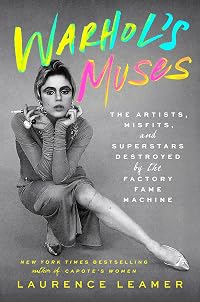
Warhol's Muses: The Artists, Misfits, and Superstars Destroyed by the Factory Fame Machine
by Laurence Leamer
On This Page
Description
"From the New York Times bestselling author of Capote's Women comes an astonishing account of the revolutionary artist Andy Warhol and his scandalous relationships with the ten women he deemed his "superstars," beginning in 1964 and culminating four years later when Warhol was shot and almost killed"--Tags
Recommendations














Member Reviews
In this intriguing book, veteran celebrity biographer Laurence Leamer turns his attention to Andy Warhol’s “superstars,” the loosely-knit collection of aspiring models and performers who starred in the pop artist’s scandalous underground films.
Warhol’s so-called superstars generally fit a certain mold. Hallmarks of the Warholian “Factory” style included striking beauty, an angular body, and a propensity towards wearing heavy makeup. Most of the denizens of Warhol’s world were lapsed Catholics from wealthy but highly dysfunctional families. All of them became addicted to amphetamines, heroin, or both. Only a few survived their phase in Warhol’s orbit.
The superstars were a pathetic lot, but Leamer’s portrait of Warhol show more himself is even more damning. The pop artist exploited his followers sexually, emotionally, and financially in ways that reminded me of how, during the same time period, Charles Manson manipulated the members of his “Family” to further his own ends. Moreover, Warhol’s callousness towards his superstars was legendary. Even the death of his favorite “Factory girl,” Edie Sedgwick, at the age of 28 left Warhol unmoved.
This book is engagingly written, but the underlying sadness of the milieu it depicts makes it tough to read. show less
Warhol’s so-called superstars generally fit a certain mold. Hallmarks of the Warholian “Factory” style included striking beauty, an angular body, and a propensity towards wearing heavy makeup. Most of the denizens of Warhol’s world were lapsed Catholics from wealthy but highly dysfunctional families. All of them became addicted to amphetamines, heroin, or both. Only a few survived their phase in Warhol’s orbit.
The superstars were a pathetic lot, but Leamer’s portrait of Warhol show more himself is even more damning. The pop artist exploited his followers sexually, emotionally, and financially in ways that reminded me of how, during the same time period, Charles Manson manipulated the members of his “Family” to further his own ends. Moreover, Warhol’s callousness towards his superstars was legendary. Even the death of his favorite “Factory girl,” Edie Sedgwick, at the age of 28 left Warhol unmoved.
This book is engagingly written, but the underlying sadness of the milieu it depicts makes it tough to read. show less
Ratings
Members
- Recently Added By
Lists

Art & Photography
50 works; 1 member
Author Information

22+ Works 2,360 Members
Laurence Leamer was born in Chicago on Ocober 30, 1941. He is the author of thirteen books, including The Kennedy Women, and Fantastic: The Life of Arnold Schwarzenegger. In 2015 his non-fiction book The Kennedy Men: 1901-1963, was listed on the Nrew York Times bestseller list. Leamer is a former Ford Fellow in International Development at the show more University of Oregon and a former International Fellow at Columbia University. He is regarded as an expert on the Kennedy family. Leamer was on the staff at Newsweek, and has written for The New York Times Magazine, Harper's, Playboy, and many other publications. (Bowker Author Biography) show less
Awards and Honors
Distinctions
Common Knowledge
- Original publication date
- 2025
Classifications
Statistics
- Members
- 41
- Popularity
- 714,361
- Reviews
- 1
- Rating
- (3.50)
- Languages
- English
- Media
- Paper, Audiobook, Ebook
- ISBNs
- 4
- ASINs
- 2