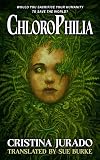
ChloroPhilia
by Cristina Jurado
On This Page
Description
Would you sacrifice your humanity to save the world?Kirmen is different from the other inhabitants of the Cloister, whose walls protect them all from the endless storm ravaging Earth. As a result of the Doctor's cruel experiments, his physical form is gradually evolving into something better fit for survival in the world outside.
Kirmen worries about becoming a pariah, an outcast among the other denizens of the domes. But his desire for affection and acceptance, and his humanity, fade a way show more as the Doctor's treatments progress. What will happen when the metamorphosis is complete ? What will be left of Kirmen and the group of survivors that he knows and loves?
In English for the first time (translated by Sue Burke), ChloroPhilia, an Ignotus Award-nominated novella by Cristina Jurado, is a strange coming–of-age story while addressing life after an environmental disaster, collective madness, and sacrifices made for the greater good.
. show less
Tags
Member Reviews
The climate is changing. As a species, we can fight against inexorable nature, or we can change. Either way, the struggle will leave something of us behind. This is the core conceit of Cristina Jurado’s Chlorophilia. The novella opens with the world swallowed by a constant storm of sand, shutting down society and driving the survivors to extremes that would fit right in to McCarthy’s The Road. In the first chapter (titled “Zero”, and in affect a second prologue – more on that later), an unnamed geneticist stumbles from horror to horror until chancing upon an invitation to a place of safety. We jump ahead a generation, where the last community of humans exists in an enclosed habitat called The Cloister. Kirmen is perhaps the show more last child born, undergoing a life-long medical experiment, becoming more and more tree-like with every passing year. He is brutally bullied for his appearance, and constantly overseen by the attending physician – presumably the doctor from the first chapter – who has become a deeply unpleasant misanthrope in his old age. Kirmen is told he is the last hope for humanity, but no one seems to care…
Conceptually, this book has great potential. I especially liked the first prologue, which actually encapsulates whole story – from the sandstorm’s point of view! Much of the rest of the book is Kirmen’s deeply unpleasant relationship with the doctor. His disillusionment with humanity made sense, especially when looked at through his grief – it becomes clear his life’s work is to reluctantly replace humans with something new, something vegetable. He is learning to love the green. A significant portion of the book is he and Kirmen walking through the habitat, and the doctor grieving for all the experiences of the world neither he, nor anyone else, will ever have again.
In retrospect, the themes all fit together perfectly. While reading it, though, I struggled with the tone of many of the characters – to believe that anyone would speak like that, in those situations. The cruelty was alienating, but then again, maybe it was supposed to be. These people are fighting against extinction by planning the same for themselves. And just like the arresting and abstract opening, the conclusion switches to an entirely new, alien point of view. I didn’t love Chlorophilia, but as a piece of cli-fi, it did well asking what it means to be human at the rate we’re going.
Thank you to Apex Publications for a copy to review. show less
Conceptually, this book has great potential. I especially liked the first prologue, which actually encapsulates whole story – from the sandstorm’s point of view! Much of the rest of the book is Kirmen’s deeply unpleasant relationship with the doctor. His disillusionment with humanity made sense, especially when looked at through his grief – it becomes clear his life’s work is to reluctantly replace humans with something new, something vegetable. He is learning to love the green. A significant portion of the book is he and Kirmen walking through the habitat, and the doctor grieving for all the experiences of the world neither he, nor anyone else, will ever have again.
In retrospect, the themes all fit together perfectly. While reading it, though, I struggled with the tone of many of the characters – to believe that anyone would speak like that, in those situations. The cruelty was alienating, but then again, maybe it was supposed to be. These people are fighting against extinction by planning the same for themselves. And just like the arresting and abstract opening, the conclusion switches to an entirely new, alien point of view. I didn’t love Chlorophilia, but as a piece of cli-fi, it did well asking what it means to be human at the rate we’re going.
Thank you to Apex Publications for a copy to review. show less
Members
- Recently Added By
Lists

Storybundle World of SF 2026
15 works; 1 member
Author Information
15+ Works 108 Members
Classifications
- Genres
- Fiction and Literature, Science Fiction
- BISAC
Statistics
- Members
- 9
- Popularity
- 2,306,230
- Reviews
- 1
- Languages
- English
- Media
- Paper, Ebook
- ISBNs
- 2
- ASINs
- 1