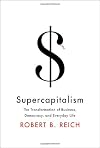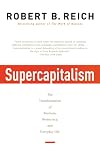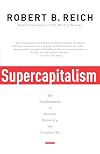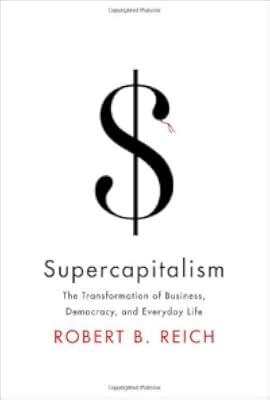
Supercapitalism: The Transformation of Business, Democracy, and Everyday Life
by Robert B. Reich
On This Page
Description
Since the 1970s, and notwithstanding three recessions, the U.S. economy has soared. Consumers have been treated to a vast array of new products, while the prices of standard goods and services have declined. Companies have also become far more efficient and the stock market has surged. In short, American capitalism has been a triumph, and it has spread throughout the world.At the same time, argues former secretary of labor Robert B. Reich, the effectiveness of democracy in America has show more declined. It has grown less responsive to the citizenry, and people are feeling more and more helpless as a result. In Supercapitalism, Reich discusses how capitalism has spilled over into politics, how it threatens democracy, and how citizens both benefit from and lose out because of supercapitalism. show lessTags
Recommendations






Member Reviews
Reich takes a nuanced view of economics which challenged my thinking and eventually won me over (although I wish he would have given more in the way of solutions than the final fifteen pages).
Although I disagree with him on several points, I am agreement with the thesis of his book: namely, that the citizen has been overwhelmed by the consumer and investor, and hence, democracy is in danger of being subordinated to the economy (more so than it already has). The end result is the monolithic supercapitalism we all toil under.
The accepted ways of dealing with corporations (lauding good corporate stewardship, boycotting bad actors, etc.) are provincial and myopic because the underlying structure of supercapitalism remains in place. If one show more villain falls, another will simply arise in its place. Yet his analysis seems obtuse at times; for instance, he ignores the role played by unions in forming the type of informed citizens he seems to desire that can hedge against corporate excess.
I believe the failure of unions to adapt to international corporatism is what has led to the unchecked capitalism that plagues us. If there are sweatshops in Timbuktu using child labor, why aren't American unions there, helping to build relationships with communities and promote reforms? Aside from the fact that they have been eviscerated, the unions are preoccupied with "American jobs," not understanding that they strengthen the long-term interests of the American worker by bringing his international cousin into the fold. (It reminds me of the early union efforts that neglected women and people of color -- divisions happily exploited by greedy industrialists.)
If economic exploitation doesn't honor national boundaries, neither should the instruments to fight it.
The rational market crowd -- among whose number Reich is counted -- tell us these sweatshops are necessary (and beneficial) to developing countries and therefore desirable. The truth is that transnational corporations own the political infrastructure of these economies (or, in the case of places like China, support the despotic regime in place), where labor activists are openly repressed because they threaten to upset shareholder returns. (For the record, I favor behavioral economics.)
The final third of the book shows a less nuanced Reich, wherein he ultimately (and rightly) rails against the legal fiction of corporate "personhood." He also proposes taxing returns earned from investments as personal income and removing corporate money from politics, both necessary and noble solutions if the Republic is to survive as a representation of citizen interests rather than investor and consumer interests. show less
Although I disagree with him on several points, I am agreement with the thesis of his book: namely, that the citizen has been overwhelmed by the consumer and investor, and hence, democracy is in danger of being subordinated to the economy (more so than it already has). The end result is the monolithic supercapitalism we all toil under.
The accepted ways of dealing with corporations (lauding good corporate stewardship, boycotting bad actors, etc.) are provincial and myopic because the underlying structure of supercapitalism remains in place. If one show more villain falls, another will simply arise in its place. Yet his analysis seems obtuse at times; for instance, he ignores the role played by unions in forming the type of informed citizens he seems to desire that can hedge against corporate excess.
I believe the failure of unions to adapt to international corporatism is what has led to the unchecked capitalism that plagues us. If there are sweatshops in Timbuktu using child labor, why aren't American unions there, helping to build relationships with communities and promote reforms? Aside from the fact that they have been eviscerated, the unions are preoccupied with "American jobs," not understanding that they strengthen the long-term interests of the American worker by bringing his international cousin into the fold. (It reminds me of the early union efforts that neglected women and people of color -- divisions happily exploited by greedy industrialists.)
If economic exploitation doesn't honor national boundaries, neither should the instruments to fight it.
The rational market crowd -- among whose number Reich is counted -- tell us these sweatshops are necessary (and beneficial) to developing countries and therefore desirable. The truth is that transnational corporations own the political infrastructure of these economies (or, in the case of places like China, support the despotic regime in place), where labor activists are openly repressed because they threaten to upset shareholder returns. (For the record, I favor behavioral economics.)
The final third of the book shows a less nuanced Reich, wherein he ultimately (and rightly) rails against the legal fiction of corporate "personhood." He also proposes taxing returns earned from investments as personal income and removing corporate money from politics, both necessary and noble solutions if the Republic is to survive as a representation of citizen interests rather than investor and consumer interests. show less
Not totally persuasive but an excellent view of corporations and how they behave and how they should behave. Reich offers a solution to our problems by dividing individuals into citizens and investors/consumers, arguing that the former are shafted by our pursuit of the best deals as the latter. Corporations would be untaxed entities which cannot sue and can only contribute to arts or political ends if their shareholders agreed. This is hard to credit, since corporations will continue to seek dominance in whatever way they can. Overall, I would recommend this book. JPH
Our daughter-in-law, Morra Aarons, got me interested in this book after she encountered Reich at a special presentation at the graduate school which she attends. I remembered Reich as the quirky economist in the Clinton cabinet, the guy who wrote "Locked in the Cabinet." The author of "Supercapitalism" is not so much quirky but very insightful, forthright and I would even say bold. He makes a very good case for all of us in the post-industrial economies, but especially in the United States, that the only way to empower citizens and come to grips with problems like global climate change is to stop hoping that corporations will act to promote the common good and reclaim the power of government to require action for the common good. If show more this sounds ominous in my simplified summary, read the book--I see no need to rewrite this excellent diagnosis of and common sense prescription for multiple disorders in our society. show less
i love this book. Long been a fan of Robert B. Reich. Don't always agree with him, but he always has an interesting take on things. In this case, Reich looks at the global economy and the stress it is creating for traditional businesses. Sounds like a hefty topic, but Reich does an excellent job of breaking things down and making a otherwise complicated topic easy to understand and interesting to read. What I enjoyed most is Reich's conclusions are not what you would expect from a Harvard professor who was served as Secretary of Labor in the Clinton White House. I won't say more than that - since it will spoil the book.
If you don't understand anymore the American way to democracy, this is the book you must read.
Extremely rational, well documented, well written and most important, illuminating.
This book should become a reference guide for political activists, environmentalists, and can generate a radical change in the way we interact with politicians and corporations.
Extremely rational, well documented, well written and most important, illuminating.
This book should become a reference guide for political activists, environmentalists, and can generate a radical change in the way we interact with politicians and corporations.
It's so easy today for us to rant about corporate greed or the sad fact that small independent businesses are being replaced by large superstores. And we are quick to blame heartless CEOs or big corporations. But in his book, Supercapitalism, Reich describes the forces in the US that are driving these changes and how we, as consumers, stock holders, and employees play a distinct and sometimes contrary role. Definitely some interesting points raised in this book - excellent in audio and a great book for a stimulating discussion.
This is a game-changer book for me. Can't quit thinking or talking about it. An easy-to-understand explanation of the way things are that helps me make sense of my world as a consumer, investor, employee, and citizen. Recommended!
Members
- Recently Added By
Lists

Books in the Bibliography of Humans: A Monstrous History by Surekha Davies
346 works; 1 member
Author Information

25+ Works 4,510 Members
Robert B. Reich was born in Scranton, Pennsylvania on June 24, 1946. He received a B.A. from Dartmouth College in 1968, a M.A. from Oxford University in 1970, and a J.D. from Yale University. Reich was an assistant to the Solicitor General in the U.S. Department of Justice from 1974 to 1976. He directed the policy planning staff of the Federal show more Trade Commission from 1976 to 1981 and taught on the faculty of Harvard University's John F. Kennedy School of Government from 1981 to 1992. He served as the 22nd Secretary of Labor from 1993 to 1997 under President Bill Clinton. He became the University Professor and the Maurice B. Hexter Professor of Social and Economic Policy at Brandies University in 1997. He is currently the Chancellor's Professor of Public Policy at the Goldman School of Public Policy at the University of California, Berkeley. Reich has written numerous books including Locked in the Cabinet; Reason: Why Liberals Will Win the Battle for America; Supercapitalism: The Transformation of Business, Democracy, and Everyday Life; Aftershock: The Next Economy and America's Future; Saving Capitalism: For the Many, Not the Few; and The Common Good. In 2003, he was awarded the Vaclev Havel Foundation Prize for his pioneering work in economic and social thought. (Bowker Author Biography) show less
Awards and Honors
Distinctions
Notable Lists
Common Knowledge
- Canonical title
- Supercapitalism: The Transformation of Business, Democracy, and Everyday Life
- Original publication date
- 2008
- Epigraph
- The imperatives of technology and organization, not the images of ideology, are what determine the shape of economic society. -John Kenneth Galbraith, The New Industrial State (1967)
The kind of economic organization that provides economic freedom directly, namely, competitive capitalism, also promotes political freedom because it separates economic power from political power and in this way enables the o... (show all)ne to offset the other. -Milton Friedman, Capitalism and Freedom (1962) - Dedication
- To the memory of Mildred Reich
- Canonical DDC/MDS
- 320.97301
- Canonical LCC
- JK275 .R45
Classifications
- Genres
- Economics, Politics and Government, Nonfiction, General Nonfiction, Business, History
- DDC/MDS
- 320.97301 — Society, government, & culture Political science Types of Government Political situation and conditions North America United States Theory And Instruction
- LCC
- JK275 .R45 — Political Science Political institutions and public administration (United States) Political institutions and public administration United States
- BISAC
Statistics
- Members
- 605
- Popularity
- 48,411
- Reviews
- 10
- Rating
- (3.91)
- Languages
- 6 — Dutch, English, French, German, Hungarian, Italian
- Media
- Paper, Audiobook, Ebook
- ISBNs
- 18
- ASINs
- 7