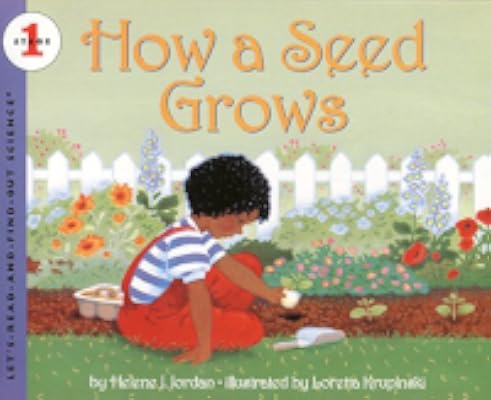
How a Seed Grows
by Helene J. Jordan
On This Page
Description
Uses observations of bean seeds planted in eggshells to demonstrate the growth of seeds into plants.Tags
Recommendations





Member Reviews
It is a science picture book and it is very cute. It is biological.The books introduce some kinds of seeds to us and tell us how them grow briefly. The illustrated is well done and sentences are simple for read. For instance, here is a flower seed, and someday it will be a flower like this. One part of the page is the seed and the other side is a beautiful sunflower. It is an easy and interest method to introduce something about plant and science. More over, the book use planting a bean seed for an example. It asks us use 12 eggshells to plant our bean seed and observe how they grow. Every detail of the growing process of bean seeds were described in the book. It remind me something happened when I was a child. Our 1st grade teacher show more asked us to plant a bean seed and bring it to the class once two weeks. Then we will discuss about how our seed growing. We enjoyed it so much and I even tried to plant some other kinds of seeds. It was funny and I knew I was learning by doing. Therefore, this science book is not boring at all because we can try to follow the instruction of the book.
To teachers, it is a nice picture science book that they can use it to teach students the information of seeds and how a seed grows. Meanwhile, teachers are able to use the book to let children try to do the planting work. It is a fun class after school.
To children, they will love this book because they may even can use the book for their painting exercise, they can try to draw a seed or a plant just like the pictures of the books. Further more, they can learn a lot about seed and plant by reading this science book. show less
To teachers, it is a nice picture science book that they can use it to teach students the information of seeds and how a seed grows. Meanwhile, teachers are able to use the book to let children try to do the planting work. It is a fun class after school.
To children, they will love this book because they may even can use the book for their painting exercise, they can try to draw a seed or a plant just like the pictures of the books. Further more, they can learn a lot about seed and plant by reading this science book. show less
I love this book for spring and summer coming up when plants are really growing and people are starting their gardens. Its not just a simple book on a seed sprouting, the end. This book covers all kinds of seeds and how they can be hard and become soft and the colors and sizes and what seed belongs to what plant and how they fall into the ground and create new plants. It is all simply put but amazing how much information is shared. I love this for a plant unit because kids may already know plants come from seeds but this expands their knowledge greatly.
Well, I didn't actually read this. My almost 5 year old daughter did! She just got it today, sat down on the couch, and read it aloud - cover to cover! Hardly need any help to boot! Her mother and I couldn't believe it! All 32 pages, one sitting, poof - done! By far the most she's read out loud to date! Thanks Ms. Jordan!
What this book is NOT, to be clear, is a good read-aloud. It's tedious if used that way.
What it *is* is a good, step-by-step instruction of a basic science project for little ones. If you use it that way, reading every step as you go through it and not before, it's wonderful.
I find the reading age suggested on this book (3-6) to be a little young. Try 6-8 instead.
What it *is* is a good, step-by-step instruction of a basic science project for little ones. If you use it that way, reading every step as you go through it and not before, it's wonderful.
I find the reading age suggested on this book (3-6) to be a little young. Try 6-8 instead.
This book talks about seeds growing. I like that it explains the cycle of a seed growing up and ties it to many different plants; it gives examples such as flower seeds, tree seeds, and more. I also like that it gives some different ideas of places to plant seeds. One thing I really like about this book is that it includes an experiment for kids to follow. If I were to use this book, I would first start with a read aloud. Then, I would use it as a loose model for planting seeds with my class. It would be really fun to read the book once as a read aloud and then to reread each part as we did each step the book lists.
How a Seed Grows by Helene J. Jordan is a non-fiction story book full of many different types of seeds. Each page is dedicated to a different seed , and the future plant it becomes along with how a seed works and fun interactive questions. The book is full of great illustrations that most children could see as their own backyards. Many of the characteristics of the different plants growth is compared to that of a human, making it very relatable to little ones. This is very informative story, told in a fun way that will keep children reading.
In this story a little boy watches as seeds grow and observes the changes that they go through in the process. It is informative but is on a younger reading level so that children in K, 1st or 2nd can understand. Children will love looking at the pictures along with planting their own seeds!
Members
- Recently Added By
Lists

Children's Books About Science and Math
461 works; 12 members
Author Information
6 Works 3,150 Members
Some Editions
Awards and Honors
Series
Belongs to Publisher Series
Let's-Read-and-Find-Out Science (Level 1)
Common Knowledge
- Canonical title
- How a Seed Grows
Classifications
Statistics
- Members
- 2,978
- Popularity
- 6,027
- Reviews
- 46
- Rating
- (4.14)
- Languages
- English, Spanish
- Media
- Paper, Ebook
- ISBNs
- 28
- UPCs
- 1
- ASINs
- 6
