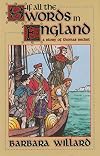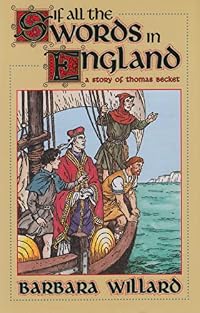
If All the Swords in England: A Story of Thomas Becket
by Barbara Willard
Clarion Books for Youth, Living History Library
On This Page
Description
In 1170, orphaned twin brothers, one in service to England's King Henry II and the to other Archbishop Thomas Becket, witness the climax of a long-standing battle of wills.Tags
Recommendations













Member Reviews
Young Simon, recently and tragically orphaned, becomes a scribe in the following of the exiled Archbishop of Canterbury, Thomas Becket. The uncertainty of the tumultuous years leading to the infamous cathedral slaying is heightened by Simon's separation from his twin Edmund, who is in the service of King Henry II. With an expert pen Barbara Willard deftly recounts events leading to the bishop's martyrdom in 1170.
The story of the martyrdom of Saint Thomas Becket (and the last six years of his life) is presented in an intelligent and interesting format by viewing these events through the eyes of twin boys, Simon and Edmund, who are (respectively) in the service of Thomas Becket and King Henry II ( Saint Thomas' friend-turned-enemy).
The story begins in the year 1164, while St. Thomas is in exile in France, avoiding the King's wrath for not cooperating with his wishes regarding the King's control over the Church. Edmund has just been admitted into the King's service, but Simon, because of his lame hand, is refused. Simon dreams of entering the Archbishop's service, but is temporarily taken in by some distant relatives of the Archbishop.
The King's show more own commands alter the course of events as Simon is caught up in the forced exile of all of St. Thomas' relatives to join him in France. The tensions and mysteries surrounding the struggles between these two men are well-explained and many truths and lessons are skillfully drawn out by the author. For example, the story provides a very clear lesson on the consequences of not controlling one's temper. This is easy even for young children to understand because the King literally acts like a two-year-old (with the exception of allowing himself further loss of control by the excessive use of alcohol) - allowing himself to get so angry that he yells and screams, falls to the floor and eventually passes out. His temper tantrums lead directly to the death of the Archbishop. Also, the way the story is presented through the eyes of a child gives a sense of the awe of going to confession to and serving Mass for a living saint.
Although it is clear from early in the book (even if the reader doesn't know otherwise) that Saint Thomas will be martyred, the subject is handled very thoughtfully and helps children to realize the "sweetness" present in the bitterness of martyrdom.
I read this aloud to my children and only found one sentence too much for their ages (my oldest is seven). "He drew his sword and struck at the skull of the dead man, scattering brains and blood on the pavement." (pg. 173). My children and I also found the parallels between St. Thomas' final years and Our Lord's final days rather interesting. (There are parallels to the triumphal entry into Jerusalem, the scattering of his followers before his death, and even one faithful follower who stuck with him to the end.) show less
The story begins in the year 1164, while St. Thomas is in exile in France, avoiding the King's wrath for not cooperating with his wishes regarding the King's control over the Church. Edmund has just been admitted into the King's service, but Simon, because of his lame hand, is refused. Simon dreams of entering the Archbishop's service, but is temporarily taken in by some distant relatives of the Archbishop.
The King's show more own commands alter the course of events as Simon is caught up in the forced exile of all of St. Thomas' relatives to join him in France. The tensions and mysteries surrounding the struggles between these two men are well-explained and many truths and lessons are skillfully drawn out by the author. For example, the story provides a very clear lesson on the consequences of not controlling one's temper. This is easy even for young children to understand because the King literally acts like a two-year-old (with the exception of allowing himself further loss of control by the excessive use of alcohol) - allowing himself to get so angry that he yells and screams, falls to the floor and eventually passes out. His temper tantrums lead directly to the death of the Archbishop. Also, the way the story is presented through the eyes of a child gives a sense of the awe of going to confession to and serving Mass for a living saint.
Although it is clear from early in the book (even if the reader doesn't know otherwise) that Saint Thomas will be martyred, the subject is handled very thoughtfully and helps children to realize the "sweetness" present in the bitterness of martyrdom.
I read this aloud to my children and only found one sentence too much for their ages (my oldest is seven). "He drew his sword and struck at the skull of the dead man, scattering brains and blood on the pavement." (pg. 173). My children and I also found the parallels between St. Thomas' final years and Our Lord's final days rather interesting. (There are parallels to the triumphal entry into Jerusalem, the scattering of his followers before his death, and even one faithful follower who stuck with him to the end.) show less
Young Simon, recently and tragically orphaned, becomes a scribe in the following of the exiled Archbishop of Canterbury, Thomas Becket. The uncertainty of the tumultuous years leading to the infamous cathedral slaying is heightened by Simon's separation from his twin Edmund, who is in the service of King Henry II.
Ratings
Members
- Recently Added By
Author Information

66+ Works 3,477 Members
Some Editions
Series


Common Knowledge
- Canonical title
- If All the Swords in England: A Story of Thomas Becket
- Original publication date
- 1961
- People/Characters
- Thomas Becket; Henry II, King of England
- Important places
- England, UK (as England); Kent, England, UK (as Kent, England); Canterbury, Kent, England, UK (as Canterbury, Kent, England); Canterbury Cathedral, Canterbury, Kent, England, UK
- Important events
- Reign of Henry II (1154-12-19 | 1189-07-06); Murder of Thomas Becket (1170)
- First words
- "The taller lad will do very well," said the steward, "but I cannot offer the other a place."
Classifications
Statistics
- Members
- 452
- Popularity
- 67,360
- Reviews
- 4
- Rating
- (4.08)
- Languages
- English
- Media
- Paper, Ebook
- ISBNs
- 1
- ASINs
- 5