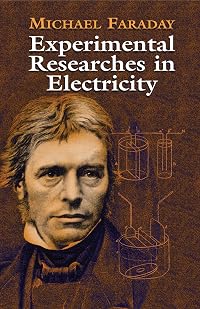
Experimental Researches in Electricity
by Michael Faraday
91 Members (3.25)
On This Page
Description
First published in three volumes from 1839 to 1855, this landmark work clearly discusses the inquiries that led to the author's development of the first dynamo and his establishment of the foundations of classical field theory. "The writing is interesting and the expositions are impressive." -- Florida Scientist. 1914 edition.Tags
Recommendations








Member Reviews
Members
- Recently Added By
Lists

Books that changed the world
67 works; 64 members

Trinity College Booklist (1951): Class One, Natural Science
98 works; 2 members

How to Read a Book's Recommended Reading List
309 works; 10 members
Author Information

23+ Works 1,143 Members
Michael Faraday, a British physicist and chemist, was one of the greatest experimentalists of the nineteenth century. The son of a blacksmith, Faraday received a minimal education, which did not include much training in mathematics. Nevertheless, in 1812 his innate intelligence attracted the attention of Sir Humphry Davy at the Royal Institution. show more Davy hired Faraday as a laboratory assistant in the institution; Faraday remained until his retirement in 1862. Here, he made his contributions to the study of electricity by formulating the laws of electrolysis in 1834. Faraday also discovered that the circular lines of magnetic force produced by the flow of current through a wire deflect a nearby compass needle. By demonstrating this conversion of electrical energy into motive force, Faraday identified the basic principles governing the application of the electric motor. Simultaneously with Joseph Henry, Faraday discovered electromagnetic induction and then successfully built the first electric generator based on a suggestion from Scottish mathematician and physicist Lord William Thomson Kelvin. After a series of experiments using polarized light, Faraday proposed an electromagnetic theory of light. This theory was later developed by James Clerk Maxwell and was fundamental to the later development of physics. Faraday was widely known as a popularizer of science, regularly lecturing to lay audiences from 1825 to 1862. Faraday was an extremely modest person. For example, he declined honors bestowed in recognition of his accomplishments, such as a knighthood and the presidency of the Royal Society. (Bowker Author Biography) show less
Series
Belongs to Publisher Series
Work Relationships
Has as a study
Common Knowledge
- Original publication date
- 1844
- First words
- The power which electricity of tension possesses of causing an opposite electrical state in its vicinity has been expressed by the general term Induction; which, as it has been received into scientific language, may also, wit... (show all)h propriety, be used in the same general sense to express the power which electrical currents may possess of inducing any particular state upon matter in their immediate neighbourhood, otherwise indifferent. It is with this meaning that I purpose using it in the present paper.
Classifications
Statistics
- Members
- 91
- Popularity
- 352,777
- Rating
- (3.25)
- Languages
- English, Portuguese
- Media
- Paper
- ISBNs
- 9
- UPCs
- 1
- ASINs
- 1