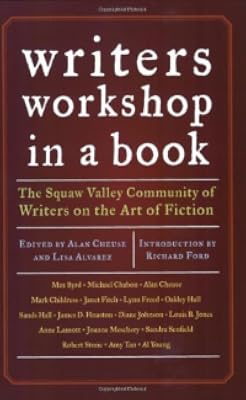
Writer's Workshop in a Book: The Squaw Valley Community of Writers on the Art of Fiction
by Alan Cheuse
On This Page
Description
Since 1969, the prestigious Squaw Valley Community of Writers has helped develop the art and craft of many who are now household names. Instructors such as Michael Chabon, Mark Childress, Diane Johnson, Anne Lamott, Robert Stone, and Amy Tan have distilled their advice and wisdom from seminars and lectures, and the result is a book that captures the workshop experience of completesubmersion in the writing process. With an introduction by novelist and short story master Richard Ford, himself show more a conference attendee in the 1970s, this volume gives the writer and dedicated reader a jolt of inspiration, sharp insight into matters of technique, and a feeling of camaraderie with a writing community. show lessTags
Recommendations



Member Reviews
This is not a particularly good collection of writing advice. Yes, there are big names. Yes it comes from a relatively prestigious writers’ workshop. No, it doesn’t add much to what you probably already know. In fact, if this is what the contents of this particular workshop are like, then the success is in spite of the content.
Writing advice is only as useful as the personal serendipity you get from it. Someone may say to you, “just start writing gooder sentences”, and it may be your road to Damascus moment. But that doesn’t mean everyone else wants (or needs) to hear it. I have come across books that do a decent job of sharing ideas on how to write without becoming too mundane (and, in the process, be very entertaining.) Just show more to mention a couple – Thomas Mallon’s In Fact, Essays on Writing and Writers; Robin Wilson’s Paragons: Twelve Master Science Fiction Writers Ply Their Craft; and my absolute favorite, Kate Willhelm’s Storyteller Writing Lessons and More from 27 Years of the Clarion Writers Workshop. None are perfect, but each managed to evoke in me the desire to do more writing.
Such is not the case with this book. The advice feels as if it has come from a high school creative writing class, and there are too many self-evaluative moments from the writers. (For example, why did I have to read two different people’s versions of moving from a first novel mega-success to struggling to write a second novel, and two other descriptions of writing novels that went nowhere?) There are a couple of interesting anecdotes and, since they are all successful writers, they all do a decent job of writing their own piece. But there is really not enough here to warrant the time. (Particularly if the time spent could have been spent working on your writing. You will have learned more from writing badly than from reading these essays.) show less
Writing advice is only as useful as the personal serendipity you get from it. Someone may say to you, “just start writing gooder sentences”, and it may be your road to Damascus moment. But that doesn’t mean everyone else wants (or needs) to hear it. I have come across books that do a decent job of sharing ideas on how to write without becoming too mundane (and, in the process, be very entertaining.) Just show more to mention a couple – Thomas Mallon’s In Fact, Essays on Writing and Writers; Robin Wilson’s Paragons: Twelve Master Science Fiction Writers Ply Their Craft; and my absolute favorite, Kate Willhelm’s Storyteller Writing Lessons and More from 27 Years of the Clarion Writers Workshop. None are perfect, but each managed to evoke in me the desire to do more writing.
Such is not the case with this book. The advice feels as if it has come from a high school creative writing class, and there are too many self-evaluative moments from the writers. (For example, why did I have to read two different people’s versions of moving from a first novel mega-success to struggling to write a second novel, and two other descriptions of writing novels that went nowhere?) There are a couple of interesting anecdotes and, since they are all successful writers, they all do a decent job of writing their own piece. But there is really not enough here to warrant the time. (Particularly if the time spent could have been spent working on your writing. You will have learned more from writing badly than from reading these essays.) show less
I photocopied the essay from Janet Fitch, called "Coming to Your Senses." That one really stood out to me, but all in all, the other essays were worth the read as well. Some I skipped over because they really didn't speak to me, but not everything does or will.
Ratings
Members
- Recently Added By
Author Information

22+ Works 569 Members
Alan Cheuse was born in Perth Amboy, New Jersey on January 23, 1940. He graduated from Rutgers University and returned to receive a doctorate in 1974 after traveling abroad. He taught creative writing and literature at George Mason University from 1987 until his death. He also led fiction workshops at the Squaw Valley Community of Writers in show more California. During his lifetime, he published 12 books and delivered thousands of commentaries on NPR. His books included The Bohemians: John Reed and His Friends Who Shook the World, The Light Possessed, To Catch Lightning, and Prayers for the Living. He spent more than 25 years with NPR, contributing book reviews, profiles, and commentary to All Things Considered. Beginning in 1981, he reviewed an estimated 1,600 books and provided annual recommendations of summer and Christmas reading, as well as commentary on notable writers. He was known for championing the work of younger writers and independent publishers. He died from injuries sustained in a car accident on July 31, 2015 at the age of 75. (Bowker Author Biography) show less
Classifications
Statistics
- Members
- 83
- Popularity
- 383,559
- Reviews
- 2
- Rating
- (3.28)
- Languages
- English
- Media
- Paper
- ISBNs
- 2
- ASINs
- 1