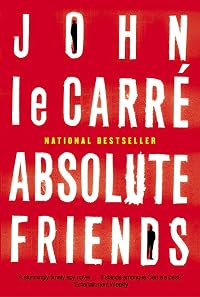
Absolute Friends
by John le Carré
On This Page
Description
A ferocious new novel from the master: when a man's good heart is his worst enemy ... By chance and not by choice, Ted Mundy, eternal striver, failed writer, and expatriate son of a British Army officer, used to be a spy. But that was in the good old Cold War days, when a cinder-block wall divided Berlin and the enemy was easy to recognize. Today, Mundy is a down-at-the-heels tour guide in southern Germany, dodging creditors, supporting a new family, and keeping an eye out for trouble while show more in spare moments vigorously questioning the actions of the country he once bravely served. And trouble finds him, as it has before, in the shape of an old German student friend, radical, and onetime fellow spy, the crippled Sasha, seeker after absolutes, dreamer, and chaos addict. After years of trawling the Middle East and Asia as an itinerant university lecturer, Sasha has yet again discovered the true, the only, answer to life-this time in the form of a mysterious billionaire philanthropist named Dimitri. Thanks to Dimitri, both Mundy and Sasha will find a path out of poverty, and with it their chance to change a world that both believe is going to the devil. Or will they? Who is Dimitri? Why does Dimitri's gold pour in from mysterious Middle Eastern bank accounts? And why does his apparently noble venture reek less of starry idealism than of treachery and fear? Some gifts are too expensive to accept. Could this be one of them? With a cooler head than Sasha's, Mundy is inclined to think it could. In Absolute Friends, John le Carre delivers the masterpiece he has been building to since the fall of communism: an epic tale of loyalty and betrayal that spans the lives of two friends from the riot-torn West Berlin of the 1960s to the grimy looking-glass of Cold War Europe to the present day of terrorism and new alliances. This is the novel le Carre fans have been waiting for, a brilliant, ferocious, heartbreaking work for the ages. show lessTags
Recommendations















Member Reviews
It's a mark of Le Carré's talent, and what places him at the top of the four great British spy writers, that this is a fairly long novel (400+ pages paperback) and yet nothing happens to the plot for the first three quarters of it. Everything is devoted to Le Carré's great skill, that of building characters with a huge, if hidden, interior depth. Two novellas and a short story are spent on building backstory of the two characters, and what is for once in Le Carré a friendly relationship, rather than as adversaries of history.
The final denouement is brief, brutal and as other reviewers have said, angry. It's set in a post 9/11 context, but it's even more convincing now a few years later. Perhaps the spooks hadn't reached such a show more level of cynical double-dealing back when this was written, although it's no surprise now. It's still an unexpected outcome, although it's not so much foreshadowed a few pages earlier, as we're given the whole script for it. But we're no more likely to take the hint than our hero was. Now that's Le Carré being truly angry at the whole edifice of Western hypocrisy and writing himself into a role as the postscript chorus.
Not an accessible book or a light read, but Le Carré at his very best. show less
The final denouement is brief, brutal and as other reviewers have said, angry. It's set in a post 9/11 context, but it's even more convincing now a few years later. Perhaps the spooks hadn't reached such a show more level of cynical double-dealing back when this was written, although it's no surprise now. It's still an unexpected outcome, although it's not so much foreshadowed a few pages earlier, as we're given the whole script for it. But we're no more likely to take the hint than our hero was. Now that's Le Carré being truly angry at the whole edifice of Western hypocrisy and writing himself into a role as the postscript chorus.
Not an accessible book or a light read, but Le Carré at his very best. show less
Read: Absolute Friends, John le Carré
This is an angry book. It was published in 2003, after the US/UK invasion of Iraq, something le Carré plainly did not support (who did, other than right-wingers, greedy industrialists and venal politicians?). The two friends of the title are Edward Mundy and Sasha (cannot remember if his surname is mentioned, it probably is). Mundy was born in Lahore just before it became part of Pakistan. His father was a disgraced officer in the Indian army, his mother was aristocracy but died in childbirth. After Partition, Mundy and his father returned to the UK, where Mundy attended public school, then Cambridge, then moved to Berlin and became caught up in the anarchist movement there. Which is where he met show more Sasha. Mundy was booted out of Berlin after being arrested at a demo. He joined the British Council, where he acted as escort and factotum for various UK artistic troupes touring East Europe, And so was consequently recruited by MI6. And also ran into Sasha, in East Berlin, where he was now a Stasi officer. Sasha recruits Mundy as a Stasi asset, but is really himself a MI6 asset using Mundy as the go-between. The Berlin Wall falls some time later and their careers come to an end. In the present day, Mundy is pulled out of “retirement” by Sasha, who wants to recruit him to a scheme run by a philanthropic oligarch (2024 readers will immediately be suspicious here, with good reason). Nothing, of course, is as it seems, and nothing ends well. Le Carré’s views on Bush and Blair are clear, even if neither is mentioned in the novel. The plot leaps about chronologically but is never confusing. If the book has a flaw, it’s that its story implies redemption but finally offers the opposite. It’s a good novel, well-written and impressively researched; and it’ll make you as angry as le Carré was when he wrote it. show less
This is an angry book. It was published in 2003, after the US/UK invasion of Iraq, something le Carré plainly did not support (who did, other than right-wingers, greedy industrialists and venal politicians?). The two friends of the title are Edward Mundy and Sasha (cannot remember if his surname is mentioned, it probably is). Mundy was born in Lahore just before it became part of Pakistan. His father was a disgraced officer in the Indian army, his mother was aristocracy but died in childbirth. After Partition, Mundy and his father returned to the UK, where Mundy attended public school, then Cambridge, then moved to Berlin and became caught up in the anarchist movement there. Which is where he met show more Sasha. Mundy was booted out of Berlin after being arrested at a demo. He joined the British Council, where he acted as escort and factotum for various UK artistic troupes touring East Europe, And so was consequently recruited by MI6. And also ran into Sasha, in East Berlin, where he was now a Stasi officer. Sasha recruits Mundy as a Stasi asset, but is really himself a MI6 asset using Mundy as the go-between. The Berlin Wall falls some time later and their careers come to an end. In the present day, Mundy is pulled out of “retirement” by Sasha, who wants to recruit him to a scheme run by a philanthropic oligarch (2024 readers will immediately be suspicious here, with good reason). Nothing, of course, is as it seems, and nothing ends well. Le Carré’s views on Bush and Blair are clear, even if neither is mentioned in the novel. The plot leaps about chronologically but is never confusing. If the book has a flaw, it’s that its story implies redemption but finally offers the opposite. It’s a good novel, well-written and impressively researched; and it’ll make you as angry as le Carré was when he wrote it. show less
I'm of two minds on this. Mostly, I really loved it. It is powerfully written and the main characters are interesting. They are very real and flawed and so much more interesting because I want them to have something good happen to them, despite all thier flaws. That is where I am mixed. I expected something like the ending but it still left me feeling like I was listening to the news; depressed and helpless. Oh, and bitter. LeCarre is always good at the moral universe inhabited by spies but here he really extends the cynical outlook and makes a much more worldly statement about ulterior motives and double dealings, etc. I agree with him more than I can state but it does make me feel very sad and down when the novel ends. I can't say show more that is a bad thing but I think I'm going to read something more cheerful next. show less
The next book off my shelf was John Le Carré's Absolute Friends published in 2003 and so one of his later novels. We meet Ted Munday as a tour guide in Heidelberg, Germany: struggling to make a living and to cement a relationship with Zara his muslim common law wife. After a days work he is troubled and seeks the aid of his mysterious friend Sacha. From this point on in typical Le Carré mode the backstory of Ted Munday and his friend Sacha is filled in, which takes up the majority of the book. Being le Carré it is no surprise to discover Ted's links with the British secret service and the interest is in how he finds himself now in a desperate position. Who is Sacha and what is Ted doing seemingly cast adrift and working in show more Germany.
There are few better authors at filling in the back story of characters in an espionage novel and Le Carré is in fine form with Bundy and Sacha. Bundy however is a man who seems to let things happen to him rather than chasing after them and so his work as a spy stretches credence a little. Perhaps this is why Absolute Friends is not very highly ranked in Le Carre's oeuvre. Le Carré's later novels also seem world weary and the intelligence services come in for much criticism, he has also become more and more anti-American and it is no surprise who are the villains in this book. Having said all this I found Absolute Friends superb entertainment and Le Carré's somewhat jaundiced view of the world's situation chimed particularly with the way that I feel. 4.5 stars show less
There are few better authors at filling in the back story of characters in an espionage novel and Le Carré is in fine form with Bundy and Sacha. Bundy however is a man who seems to let things happen to him rather than chasing after them and so his work as a spy stretches credence a little. Perhaps this is why Absolute Friends is not very highly ranked in Le Carre's oeuvre. Le Carré's later novels also seem world weary and the intelligence services come in for much criticism, he has also become more and more anti-American and it is no surprise who are the villains in this book. Having said all this I found Absolute Friends superb entertainment and Le Carré's somewhat jaundiced view of the world's situation chimed particularly with the way that I feel. 4.5 stars show less
The story unfolds somewhat slowly, built around a vivid depiction of the intense and unlikely friendship that develops between Pakistani-born Brit Ted Mundy and German left-wing radical Sasha, who meet in the turbulent environment of student dissent in 1960s West Berlin. The trust that develops between them is hard won and hard tested through their involvement in radical left politics of the 1960s, then cold war intrigue as both come to serve for decades as highly effective double agents working for the downfall of the soviet Eastern bloc and especially the hated Stasi of East Germany, and finally as pawns in a deadly scheme in the 21st century war on terror.
The dramatization of Mundy and Sasha’s relationship is brilliant. Though show more personal trust is the linchpin of their relationship, this is not simpleminded story that politics is superficial, unworthy of our attention – the province of mere fanatics who ware not to be trusted on any account. Indeed, it is their commitment in different ways to a politics of freedom and human decency that draws them together, and is bound up in their relationship as it evolves.
.
**Spoiler alert**
My one misgiving in the novel concerns the paranoid conclusion, in which it turns out that Sasha’s political passions, and Mundy’s commitment to Sasha as hope perhaps for a decent world, are manipulated by agents provocateurs committed to the hegemony of the US corporate state, and gunned down in a sham raid staged to silence European critics and dissenters in of the war on terrorism.
Is such a thing plausible? One would like to think that it is not. But since the novel’s publication some aspects of this kind of plot have been borne out by events – e.g. “terrorists” recruited by US intelligence operatives only to have their plans, which were really only ever the machinations of the US agents who manipulated them, foiled in highly public operations calculated to prove the need and efficacy of US intelligence operations, and the targeted assassination of US citizens deemed by US administration officials to be enemy combatants. Given those developments, and recent revelations of spying, one really does not have terribly firm grounds for dismissing the plot climax as paranoid delusion.
But in the end, the plausibility of the novel’s concluding plot device is far less important than the plausibility of the two main characters commitment to a politics of resistance to injustice and oppression in the face of profound uncertainties, and their related commitment to each other as friends. This is the thread of integrity which le Carre offers in a world in which truth of any kind is virtually impossible to find. show less
The dramatization of Mundy and Sasha’s relationship is brilliant. Though show more personal trust is the linchpin of their relationship, this is not simpleminded story that politics is superficial, unworthy of our attention – the province of mere fanatics who ware not to be trusted on any account. Indeed, it is their commitment in different ways to a politics of freedom and human decency that draws them together, and is bound up in their relationship as it evolves.
.
**Spoiler alert**
My one misgiving in the novel concerns the paranoid conclusion, in which it turns out that Sasha’s political passions, and Mundy’s commitment to Sasha as hope perhaps for a decent world, are manipulated by agents provocateurs committed to the hegemony of the US corporate state, and gunned down in a sham raid staged to silence European critics and dissenters in of the war on terrorism.
Is such a thing plausible? One would like to think that it is not. But since the novel’s publication some aspects of this kind of plot have been borne out by events – e.g. “terrorists” recruited by US intelligence operatives only to have their plans, which were really only ever the machinations of the US agents who manipulated them, foiled in highly public operations calculated to prove the need and efficacy of US intelligence operations, and the targeted assassination of US citizens deemed by US administration officials to be enemy combatants. Given those developments, and recent revelations of spying, one really does not have terribly firm grounds for dismissing the plot climax as paranoid delusion.
But in the end, the plausibility of the novel’s concluding plot device is far less important than the plausibility of the two main characters commitment to a politics of resistance to injustice and oppression in the face of profound uncertainties, and their related commitment to each other as friends. This is the thread of integrity which le Carre offers in a world in which truth of any kind is virtually impossible to find. show less
"Leaving the envelope to mature for a week or two, therefore, he waits until the right number of tequilas has brought him to the right level of insouciance, and rips it open."
Ted Mundy, Pakistan-born English major's son, Germanophile and student rebel, has just about settled into mediocrity at the British Council when a trip in his guise as head of Overseas Drama and Arts (particular responsibility: Youth) becomes an exercise in secret police evasion. A figure from his past appears and he is recruited into double agency.
I got to page 260 out of 400 of this. The first 200 pages were really promising - fascinating character development, a cold open that leaves us desperate to get back to it, great student riot atmosphere... and then we show more get into the spying proper and it bored me to anger. Seriously, I got so angry with the dull plot, dire characters and chronically self-indulgent writing ("redux" 4 times in 2 pages??) that I decided I would rather play Bubble Shooter on my phone than continue reading it. Scathing criticism indeed.
The writing is exceptional and so consistent that I struggled to find a quote for the top of this review and shan't waste more time trying to find any more - rather than good writing with exceptional one-liners, this is excellent writing with an unfortunate dollop of smug. The page that finally made me lose my temper was one in which Ted was named "Mundy redux" 5 times over a double page. I don't know what redux was supposed to mean, given that we are already so hopelessly entrenched in Ted's multiple personalities, but it struck me as so pompous, so "I require my readers to have advanced degrees, otherwise they're not good enough", that I was genuinely angry.
The characters are impossible to relate to - Ted is dull, mediocre, apathetic; no wonder his wife finds someone else. Sasha is fiery and contrary, but implausibly so. And no one else gets much of a look-in, as this is about the two absolute friends and not anyone else. So character development for the support cast is woeful.
And as for the plot - Ted's childhood: fascinating. Student days: engrossing. Berlin riot participation: page-turning. Settling into middle-class mediocrity in Britain/spying: urgh. Bubble Shooter was more exciting. show less
Ted Mundy, Pakistan-born English major's son, Germanophile and student rebel, has just about settled into mediocrity at the British Council when a trip in his guise as head of Overseas Drama and Arts (particular responsibility: Youth) becomes an exercise in secret police evasion. A figure from his past appears and he is recruited into double agency.
I got to page 260 out of 400 of this. The first 200 pages were really promising - fascinating character development, a cold open that leaves us desperate to get back to it, great student riot atmosphere... and then we show more get into the spying proper and it bored me to anger. Seriously, I got so angry with the dull plot, dire characters and chronically self-indulgent writing ("redux" 4 times in 2 pages??) that I decided I would rather play Bubble Shooter on my phone than continue reading it. Scathing criticism indeed.
The writing is exceptional and so consistent that I struggled to find a quote for the top of this review and shan't waste more time trying to find any more - rather than good writing with exceptional one-liners, this is excellent writing with an unfortunate dollop of smug. The page that finally made me lose my temper was one in which Ted was named "Mundy redux" 5 times over a double page. I don't know what redux was supposed to mean, given that we are already so hopelessly entrenched in Ted's multiple personalities, but it struck me as so pompous, so "I require my readers to have advanced degrees, otherwise they're not good enough", that I was genuinely angry.
The characters are impossible to relate to - Ted is dull, mediocre, apathetic; no wonder his wife finds someone else. Sasha is fiery and contrary, but implausibly so. And no one else gets much of a look-in, as this is about the two absolute friends and not anyone else. So character development for the support cast is woeful.
And as for the plot - Ted's childhood: fascinating. Student days: engrossing. Berlin riot participation: page-turning. Settling into middle-class mediocrity in Britain/spying: urgh. Bubble Shooter was more exciting. show less
Angry book about betrayal and two friends one joins MI6 the other becomes a Stasi officer, they reunite in Berlin and each are trying to turn the other.
Members
- Recently Added By
Published Reviews
In this book John le Carré, the pro's pro, seems determined to resume his own apprenticeship as a writer, to shuck off the last stubborn vestiges of public-school cleverness. The rant at the end of the book is the proof. He does the most un-English thing imaginable: he loses his head while all about him are keeping theirs.
added by John_Vaughan
Una nueva muestra del mejor le Carré, en forma de salvaje fábula sobre la hipocresía de la política, aunque no exenta de ternura, y a la vez un canto a la amistad que sobrevive en un mundo despersonalizado y sin rumbo. Con su habitual maestría, le Carré relata la historia de dos amigos a lo largo de cincuenta y seis años: Ted Mundy, hijo de un militar británico, y Sasha, hijo de un show more pastor luterano proveniente de la Alemania del Este. Ambos estudian en Berlín Oeste y se reencontrarán primero en la guerra fría y años más tarde en un mundo amenazado por el terrorismo y sojuzgado por la política americana de la guerra global. show less
added by Pakoniet
Lists

Best Espionage (Fiction)
55 works; 20 members
Best Spy Fiction
153 works; 102 members
Author Information

218+ Works 99,208 Members
David John Moore Cornwell was born in Poole, Dorsetshire, England in 1931. He attended Bern University in Switzerland from 1948-49 and later completed a B.A. at Lincoln College, Oxford. He taught at Eton from 1956-58 and was a member of the British Foreign Service from 1959 to 1964. He writes espionage thrillers under the pseudonym John le Carré. show more The pseudonym was necessary when he began writing, in the early 1960s because, at that time, he held a diplomatic position with the British Foreign Office and was not allowed to publish under his own name. When his third book, The Spy Who Came in from the Cold, became a worldwide bestseller in 1964, he left the foreign service to write full time. His other works include Call for the Dead; A Murder of Quality; Tinker, Tailor, Soldier, Spy; The Honourable Schoolboy; and Smiley's People. He has received numerous awards for his writing, including the Grand Master Award from the Mystery Writers of America in 1986 and the Diamond Dagger from the Crime Writers Association in 1988. In 2011 he accepted the Goethe Medal. And in 2020, he accepted the Olof Palme Prize. Ten of his books have been adapted for television and motion pictures including The Spy Who Came in from the Cold, The Russia House, The Constant Gardener, A Most Wanted Man, and Our Kind of Traitor. Le Carré's memoir, The Pigeon Tunnel: Stories from my Life, became a New York Times bestseller in 2016. In 2019, he published a spy thriller, Agent Running in the Field. John Le Carré died on December 12, 2020 from pneumonia at the age of 89. (Bowker Author Biography) John le Carre was born in 1931. After attending the univesities of Berne and Oxford, he spent five years in the British Foreign Service. He's the author of eighteen novels, translated into twenty-five languages. He lives in England. (Publisher Provided) show less
Awards and Honors
Common Knowledge
- Canonical title*
- Absolute Friends
- Original title
- Absolute Friends
- Original publication date
- 2003
- People/Characters
- Ted Mundy; Zara; Mustafa; Sasha; Nick Amory; Jay Rourke
- Important places
- West Berlin, Federal Republic of Germany; Baden-Württemberg, Germany; Heidelberg, Baden-Württemberg, Germany; Berlin, Germany
- Epigraph
- [None]
- Dedication
- [None]
- First words
- On the day his destiny returned to claim him, Ted Mundy was sporting a bowler hat and balancing on a soapbox in one of Mad King Ludwig's castles in Bavaria.
- Last words
- (Click to show. Warning: May contain spoilers.)The mist, she reported, never quite lifts, but the broken Christian masonry makes it a popular place for children to stage their mock battles.
*Some information comes from Common Knowledge in other languages. Click "Edit" for more information.
Classifications
Statistics
- Members
- 3,351
- Popularity
- 5,055
- Reviews
- 64
- Rating
- (3.48)
- Languages
- 19 — Catalan, Chinese, Danish, Dutch, English, Estonian, Finnish, French, German, Greek, Hebrew, Hungarian, Italian, Norwegian (Bokmål), Polish, Portuguese, Romanian, Spanish, Swedish
- Media
- Paper, Audiobook, Ebook
- ISBNs
- 109
- ASINs
- 26