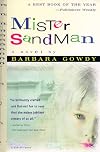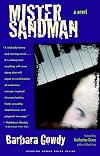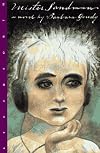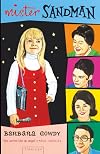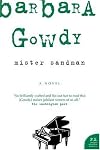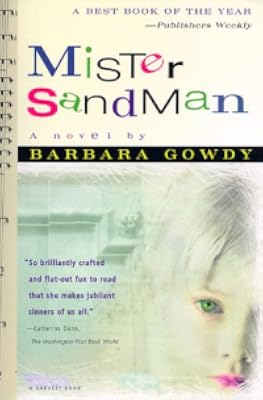
Mister Sandman
by Barbara Gowdy
On This Page
Description
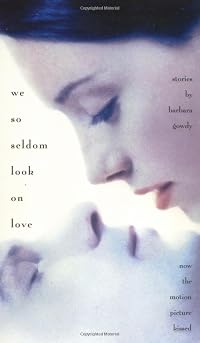
A zany novel on Joan, dropped on her head at birth. Joan grows to be a dwarf unable to speak, but able to mimic sound to the point of even playing the piano. The novel describes the impact she has on her family: Joan's 15-year-old mother, Joan's lesbian grandmother, her homosexual grandfather, and the grandfather's male lover, none other than Joan's father. By the author of We So Seldom Look on Love.Tags
Recommendations

















Member Reviews
This book is a marvelously written tale about a family so dysfunctional that their actual functioning comes across as completely normal (think Geek Love). It's difficult to put into words, because Gowdy does a fine job by herself. Her characters are robust, a little pathetic , delusional at times, and very much alive. The plot is unbelievably scandalous, yet, at the center of it all, is the Canary family - very strange yet completely devoted to one another. The youngest, Joan, is unforgettable. This is a very odd (I like odd) but compelling novel.
Rating: 3.5* of five (for this re-read)
The Publisher Says: Barbara Gowdy's outrageous, hilarious, disturbing, and compassionate novel is about the Canary family, their immoderate passions and eccentricities, and their secret lives and histories. The deepest secret of all is harbored in the silence of the youngest daughter, Joan, who doesn't grow, who doesn't speak, but who can play the piano like Mozart though she's never had a lesson.
Joan is a mystery, and in the novel's stunning climax her family comes to understand that each of them is a mystery, as marvelous as Joan, as irreducible as the mystery of life itself.
In its compassionate investigation of moral truths and its bold embrace of the fractured nature of every one of its show more characters, Mister Sandman attains the heightened quality of a modern-day parable.
I GOT THIS BOOK DECADES AGO, AND HAVE NO MEMORY OF HOW.
My Review: I read it in 1996 or so, loved it, and felt a re-read would be a fun thing. Queer representation has come a long way in thirty years.
I'm not as excited and delighted as I was in my 30s, and got more and more uneasy with the characters' poor communication skills, so I pulled thr ripcord at 50%. It's pretty well-written so I'm not warning you off. I'm just not that guy anymore.
It's out of print; there's an AI-generated audio version, should you wish to participate in the theft of authorial work. show less
The Publisher Says: Barbara Gowdy's outrageous, hilarious, disturbing, and compassionate novel is about the Canary family, their immoderate passions and eccentricities, and their secret lives and histories. The deepest secret of all is harbored in the silence of the youngest daughter, Joan, who doesn't grow, who doesn't speak, but who can play the piano like Mozart though she's never had a lesson.
Joan is a mystery, and in the novel's stunning climax her family comes to understand that each of them is a mystery, as marvelous as Joan, as irreducible as the mystery of life itself.
In its compassionate investigation of moral truths and its bold embrace of the fractured nature of every one of its show more characters, Mister Sandman attains the heightened quality of a modern-day parable.
I GOT THIS BOOK DECADES AGO, AND HAVE NO MEMORY OF HOW.
My Review: I read it in 1996 or so, loved it, and felt a re-read would be a fun thing. Queer representation has come a long way in thirty years.
I'm not as excited and delighted as I was in my 30s, and got more and more uneasy with the characters' poor communication skills, so I pulled thr ripcord at 50%. It's pretty well-written so I'm not warning you off. I'm just not that guy anymore.
It's out of print; there's an AI-generated audio version, should you wish to participate in the theft of authorial work. show less
Woah! An unusual, imaginative and probably controversial-at-the-time novel from the early days of Barbara Gowdy. A story about a family in which both parents are trying to work out their sexual identity - and other identity issues. The first daughter has a baby from a one-night stand and the parents pretend the baby is theirs, even keeping this secret from their second daughter. The three children are, not surprisingly, confused about who they are. And the baby apparently has an unusual form of brain damage. Normally I would prefer a story which seemed closer to the reality of the world as I know it, but this novel had enough reality and complexity to keep me reading, and I enjoyed it in the end. I have more Gowdy on my TBR pile and I'm show more looking forward to them. show less
The story of a queer little family - encompassing both meanings of that word - and the secrets they've built their lives around. The style of this book really grew on me -- kind of rambly, lots of tangents and seemingly unimportant information sprinkled everywhere. Messy. But the mess starts to cohere, and flow, and take what you were expecting into another direction entirely (over and over again). I liked that, a lot. There's a feeling of inevitability to the ending, which is strange because it really was so unexpected right until it happened and then it fit perfectly. Someone's said it better than I could: "Gowdy surprises and delights; she also - which is rare - gives us moments which are at the same time preposterous and strangely show more moving." -Margaret Atwood show less
“’The truth is only aversion.’” – Sonja Canary
In this beautifully written novel, the reader is introduced to each member of the Canary family. Early on it becomes clear that a great deal of how this unconventional family functions is through deceit. At first, it seems like this is a family doomed to destruction and angst. Afterall, the truth can only be buried so long. And, don’t most contemporary novels featuring highly dysfunctional families end sadly?
Happily, in “Mister Sandman”, what ultimately shines through each character’s obvious flaws is a genuine love, protection and devotion to each other that is endearing and comical. Joan, the family’s ethereal and mute youngest member, becomes the sounding board to whom show more the rest of the family divulges their secrets. She is a silent observer, a gravitational force that pulls the family inward and keeps it together. Later, she is also the catalyst for moving everyone together towards greater honesty with themselves and each other.
In Nancy Pearl’s “BookLust”, “Mister Sandman” is recommended as a “Coming Out” novel. Gowdy’s story is indeed frankly sexual. But whatever a reader’s comfort level with honest sexuality, I have seldom read a book with stronger characterizations, whose every sentence – nee, every word – is purposeful, thoughtful, and necessary to the story.
Though this is a family inherently averse to truth, it is their duplicity that gives them authentic dimensionality. While their dishonesty is never overtly approved of, neither is it the means to the Canary’s destruction.
“Mister Sandman” reminds me of John Irving’s early books minus the angst. I definitely want to read more of Gowdy’s books. I recently purchased “The White Bone”, a story told from the perspective of an elephant. With such far-reaching literary abilities, Gowdy deserves to become better-known in the United States.
“Mister Sandman” was an absolute pleasure to read. Despite such a vastly odd cast of characters and strange family mix, this is an uplifting story of a family whose devotion to each other rises above everything else.
“They could be a family spending a day at the beach together. If they were on a beach. If it was day.” show less
In this beautifully written novel, the reader is introduced to each member of the Canary family. Early on it becomes clear that a great deal of how this unconventional family functions is through deceit. At first, it seems like this is a family doomed to destruction and angst. Afterall, the truth can only be buried so long. And, don’t most contemporary novels featuring highly dysfunctional families end sadly?
Happily, in “Mister Sandman”, what ultimately shines through each character’s obvious flaws is a genuine love, protection and devotion to each other that is endearing and comical. Joan, the family’s ethereal and mute youngest member, becomes the sounding board to whom show more the rest of the family divulges their secrets. She is a silent observer, a gravitational force that pulls the family inward and keeps it together. Later, she is also the catalyst for moving everyone together towards greater honesty with themselves and each other.
In Nancy Pearl’s “BookLust”, “Mister Sandman” is recommended as a “Coming Out” novel. Gowdy’s story is indeed frankly sexual. But whatever a reader’s comfort level with honest sexuality, I have seldom read a book with stronger characterizations, whose every sentence – nee, every word – is purposeful, thoughtful, and necessary to the story.
Though this is a family inherently averse to truth, it is their duplicity that gives them authentic dimensionality. While their dishonesty is never overtly approved of, neither is it the means to the Canary’s destruction.
“Mister Sandman” reminds me of John Irving’s early books minus the angst. I definitely want to read more of Gowdy’s books. I recently purchased “The White Bone”, a story told from the perspective of an elephant. With such far-reaching literary abilities, Gowdy deserves to become better-known in the United States.
“Mister Sandman” was an absolute pleasure to read. Despite such a vastly odd cast of characters and strange family mix, this is an uplifting story of a family whose devotion to each other rises above everything else.
“They could be a family spending a day at the beach together. If they were on a beach. If it was day.” show less
 This review was written for LibraryThing Early Reviewers.
I knew I was in for a treat when I opened my copy of the new edition of Barbara Gowdy's 1995 novel Mister Sandman, and saw that the foreword was written by Katherine Dunn, author of the weird and wonderful Geek Love. I wasn't disappointed.
Set in Toronto in the late fifties through the early seventies, Mister Sandman is the story of the Canarys, a most unusual family. Father Gordon works at a publishing house, editing potboilers. He's quiet and deep, and he--like everyone in the novel--has a secret. A very big secret. Mother Doris is an habitual liar ("the truth is just a version" she famously says) who's built a past as an actress and now raises three children. She has a secret, too. Sonja is the eldest of the three girls, and her show more secret is that the youngest of the three is her daughter. Marcy is the middle girl, smart and aware. And then there's Joan.
The eternally innocent Sonja is seduced--or raped?--by a man we later discover to be extremely important to others in the family. Doris immediately determines that they must go to her great aunt in Vancouver, where Sonja can have the baby and no one will be the wiser. There is never any thought of not keeping the baby and raising her as Doris and Gordon's third daughter.
Joan is lovely: tiny, delicate, and pale, she is physically an eternal child . She doesn't talk or write, but she has the gifts of music and insight. Joan is the literary descendant of Gunter Grass's Oskar, who at the age of three wills himself not to grow any bigger, and of Irving's Lily Berry, who just stops growing; like them, despite her tiny stature she has emotional, spiritual, and intellectual capacities far beyond her apparent years--and far beyond those of everyone around her as well.
Joan is, for most of the book, the secret keeper of the family. All are drawn to her and each feels the need to confide in her. She knows all of the lies and the deceptions, she knows the joys, the pleasures (both conventional and illicit), she knows what everybody wants. In the end, it seems, she knows what they need, too, although they don't know it themselves. And, as almost always happens, the secrets will be told.
Words and language are very important in Mister Sandman. Joan speaks a language of soft clicks and hisses and moos and meows, perfect imitations of the noises she hears around her and mostly intelligible to her family. Sonja hears her mother's declaration that "the truth is just a version" as "the truth is just aversion." The words pour out of Gordon and Doris and Marcy and even the dull Sonja, and Joanie absorbs them all. What she does with them in the end is her gift to her "darlings," her family.
Mister Sandman is magical--dreams are prophetic, transformative, sometimes shared by more than one person. It's tragic, full of betrayal, despair, revelation. It's funny. It's excruciatingly erotic, often at the most awkward of times. Occasionally the novel verges on being cloyingly quirky, but there's always just enough nastiness lurking at the edges to pull it back into the realm of the weird and the wonderful. show less
Set in Toronto in the late fifties through the early seventies, Mister Sandman is the story of the Canarys, a most unusual family. Father Gordon works at a publishing house, editing potboilers. He's quiet and deep, and he--like everyone in the novel--has a secret. A very big secret. Mother Doris is an habitual liar ("the truth is just a version" she famously says) who's built a past as an actress and now raises three children. She has a secret, too. Sonja is the eldest of the three girls, and her show more secret is that the youngest of the three is her daughter. Marcy is the middle girl, smart and aware. And then there's Joan.
The eternally innocent Sonja is seduced--or raped?--by a man we later discover to be extremely important to others in the family. Doris immediately determines that they must go to her great aunt in Vancouver, where Sonja can have the baby and no one will be the wiser. There is never any thought of not keeping the baby and raising her as Doris and Gordon's third daughter.
Joan is lovely: tiny, delicate, and pale, she is physically an eternal child . She doesn't talk or write, but she has the gifts of music and insight. Joan is the literary descendant of Gunter Grass's Oskar, who at the age of three wills himself not to grow any bigger, and of Irving's Lily Berry, who just stops growing; like them, despite her tiny stature she has emotional, spiritual, and intellectual capacities far beyond her apparent years--and far beyond those of everyone around her as well.
Joan is, for most of the book, the secret keeper of the family. All are drawn to her and each feels the need to confide in her. She knows all of the lies and the deceptions, she knows the joys, the pleasures (both conventional and illicit), she knows what everybody wants. In the end, it seems, she knows what they need, too, although they don't know it themselves. And, as almost always happens, the secrets will be told.
Words and language are very important in Mister Sandman. Joan speaks a language of soft clicks and hisses and moos and meows, perfect imitations of the noises she hears around her and mostly intelligible to her family. Sonja hears her mother's declaration that "the truth is just a version" as "the truth is just aversion." The words pour out of Gordon and Doris and Marcy and even the dull Sonja, and Joanie absorbs them all. What she does with them in the end is her gift to her "darlings," her family.
Mister Sandman is magical--dreams are prophetic, transformative, sometimes shared by more than one person. It's tragic, full of betrayal, despair, revelation. It's funny. It's excruciatingly erotic, often at the most awkward of times. Occasionally the novel verges on being cloyingly quirky, but there's always just enough nastiness lurking at the edges to pull it back into the realm of the weird and the wonderful. show less
This review was written for LibraryThing Early Reviewers.I was surprised to see this as an Early Reviewer book on LibraryThing because I knew it had been published in 1995. I also knew it was one of Nancy Pearl's Booklust 'must reads'. This is a re-issue, now with an introduction by Katherine Dunn, author of Geek Love. Barbara Gowdy is a consisently good writer and here again we find strong characterization, this time with dark humour and frank sexuality. The Canary family are unconventional to say the least. Gordon and Doris Canary are emotionally dishonest with themselves as well as others. Their habit of lies and wildly exaggerated histories spills over into the lives of their daughters, Sonja and Marcy. We laugh at some of the ridiculous things they say but with a tinge of sadness because show more they resort to such self-deceptions to get through life. Gowdy's characters seem almost preposterous, although she is non-judgemental and compassionate towards them and we come to understand them better once we get to know them. The story is set in the 50's and 60's during which a third child is born into their midst. A mute but musically gifted and insightful creature, little Joan becomes the unwitting keeper of all the family secrets and ultimately its saving grace. We do care about the characters after all because they protect and care for each other. But I found the sexual bits disturbing. I've heard Mister Sandman compared to both Geek Love and Arrested Development but I have read neither myself so you will have to judge for yourselves. show less
This review was written for LibraryThing Early Reviewers.Members
- Recently Added By
Published Reviews
ThingScore 75
Das Lied "Mister Sandman" begleitet das Leben der Familie Canary als ein wiederkehrendes Motiv. Eine eigenwillige Komposition dieses "Ohrwurms" von Joan, aus Melodien und zusammengeschnittenen Sätzen der Familienmitglieder erstellt, ist es schließlich, die den Geheimnissen ein Ende macht. Musikalisch und irgendwie leicht wirkt die Geschichte auf den Leser, obwohl die Probleme aller show more Beteiligten - außer vielleicht der von Joan, die unendlich zufrieden in sich zu ruhen scheint - schwer genug wiegen. Schwarzer Humor, Sex, komische und brilliant groteske Szenen sorgen immer wieder für Überraschungen. Ein Buch, das auch dank der hervorragenden Übersetzung alles andere als langweilig ist und auf weitere Werke von Barbara Gowdy neugierig macht. show less
added by Indy133
Her language is unpretentious, relentless, but full of sympathy for her characters...We can't get enough of Barbara Gowdy's intelligent, familiar, and yet bizarre characters.
added by GYKM
Mister Sandman kidnapped me, enveloped me in a dreamlike haze, and dropped me back to reality breathless...an amazing achievement.
added by GYKM
Lists

Most Depressing Books
69 works; 16 members
Author Information

16+ Works 2,644 Members
Barbara Gowdy was born in Windsor in 1950 but grew up in the Toronto suburb of Don Mills, after having moved there with her family in 1954. After graduating from high school in the late 1960s, she studied at York University and the Royal Conservatory of Music. In the early 1980s, Gowdy became an editor for the publisher Lester and Orpen Dennys. show more She has also taught creative writing at Ryerson and the University of Toronto and has worked as an interviewer for the TVOntario program, Imprint. Gowdy has been a finalist for several prominent literary awards, including the Trillium Award for We So Seldom Look on Love and the Trillium Award, the Giller Prize, and the Governor General's Award for Mr. Sandman. The White Bone has also been nominated for the Giller Prize. (Bowker Author Biography) show less
Awards and Honors
Common Knowledge
- Canonical title
- Mister Sandman
- Original title
- Mister Sandman
- Original publication date
- 1995
- Important places
- Canada
- Blurbers
- Dunn, Katherine
Classifications
Statistics
- Members
- 421
- Popularity
- 73,569
- Reviews
- 20
- Rating
- (3.70)
- Languages
- Dutch, English, German, Norwegian (Bokmål)
- Media
- Paper, Audiobook, Ebook
- ISBNs
- 18
- ASINs
- 5