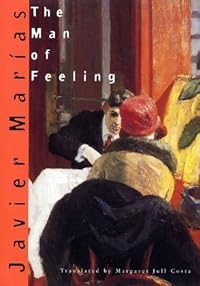
The Man of Feeling
by Javier Marías
On This Page
Description
A story of love and memory from "the most subtle and gifted writer in contemporary Spanish literature" (The Boston Globe) and the award-winning, international bestselling author of The Infatuations. On a train journey from Paris to Madrid a young opera singer becomes fascinated by those in his compartment: a middle-aged businessman, his alluring wife, and their male traveling companion.Soon his life of constant travel, luxury hotels, rehearsal and performance will become entangled with show more these three people, and the singer will find himself fatefully consumed by Natalia's beauty.
The Man of Feeling is the haunting story of the birth and death of a passion, told in retrospect. Intricately interweaving desire and memory, it explores the nature of love, and asks whether we can ever truly recall something that no longer exists. Literature. Fiction. Romance. show less
Tags
Recommendations

































Member Reviews
Premetto: parlando di M. non sono persona obiettiva.
---
Non è un libro immortale, ma è *solo* affascinante, intenso, delicato, colto, ricco. Non sarà ai livelli di "Domani nella battaglia..." ma non possono essere tutte opere indimenticabili, quelle di M. Anche se mi vien da pensare che questa ha una, una pagina sola, buttata li' in mezzo alle altre, che rimane brillante di un amore, di un dolore, di una potenza evocativa tale che basta questa a giustificare la lettura di tutto il libro. Solo per arrivare li' è rimanere impietriti.
---
Non è un libro immortale, ma è *solo* affascinante, intenso, delicato, colto, ricco. Non sarà ai livelli di "Domani nella battaglia..." ma non possono essere tutte opere indimenticabili, quelle di M. Anche se mi vien da pensare che questa ha una, una pagina sola, buttata li' in mezzo alle altre, che rimane brillante di un amore, di un dolore, di una potenza evocativa tale che basta questa a giustificare la lettura di tutto il libro. Solo per arrivare li' è rimanere impietriti.
Early Marías, but already with most of the characteristic features of his style clearly visible. The classic narrative rhythm, the subversive parentheses, the loops and digressions, the literary sidetracks: all there as we would expect, but on a slightly less monumental scale than in his more recent books.
The narrator is an opera singer, a tenor, who is telling us about a dream he's just had relating to an incident some four years ago when he was in Madrid, appearing as Cassio in Verdi's Otello, and got involved with a woman called Natalia Manur, wife of an important Flemish banker. We soon lose track of how much of what he's telling us is dream and how much really happened, and he doesn't seem to be very clear about it himself, but show more obviously that shouldn't make any difference to us as readers of a piece of fiction anyway...
As we might expect, there's a female character who has to die prematurely for no good reason other than to advance the plot. But despite the obvious Othello parallels in the plot, it isn't the Desdemona character who gets the chop this time. Moreover, Marías being nothing if not self-aware, it turns out that the narrator has an interesting obsession with the character Liù in Turandot, who has to kill herself so that it's possible for the story to resolve itself.
There are passing mentions of Flaubert, Nabokov, Shakespeare and other usual suspects, as well as "an Austrian writer" (Thomas Bernhard? Robert Musil?). But mostly Marías sticks to the idea that the narrator is not a particularly bookish person, more interested in the oddities of the opera world than in odd corners of world literature. And there are some good opera anecdotes, including the one about the singer who becomes so obsessive about not singing to a house that is less than 100% full that he ends up sitting in an overlooked empty seat himself and having to be removed forcibly by the men in white coats.
Good claustrophobic fun! show less
The narrator is an opera singer, a tenor, who is telling us about a dream he's just had relating to an incident some four years ago when he was in Madrid, appearing as Cassio in Verdi's Otello, and got involved with a woman called Natalia Manur, wife of an important Flemish banker. We soon lose track of how much of what he's telling us is dream and how much really happened, and he doesn't seem to be very clear about it himself, but show more obviously that shouldn't make any difference to us as readers of a piece of fiction anyway...
As we might expect, there's a female character who has to die prematurely for no good reason other than to advance the plot. But despite the obvious Othello parallels in the plot, it isn't the Desdemona character who gets the chop this time. Moreover, Marías being nothing if not self-aware, it turns out that the narrator has an interesting obsession with the character Liù in Turandot, who has to kill herself so that it's possible for the story to resolve itself.
There are passing mentions of Flaubert, Nabokov, Shakespeare and other usual suspects, as well as "an Austrian writer" (Thomas Bernhard? Robert Musil?). But mostly Marías sticks to the idea that the narrator is not a particularly bookish person, more interested in the oddities of the opera world than in odd corners of world literature. And there are some good opera anecdotes, including the one about the singer who becomes so obsessive about not singing to a house that is less than 100% full that he ends up sitting in an overlooked empty seat himself and having to be removed forcibly by the men in white coats.
Good claustrophobic fun! show less
This short meditative book is narrated from the perspective of a young opera singer who travels across Europe for performances. On one of his journeys he shares a train cabin with an attractive woman, her husband, and a man who works as their handler (for lack of a better word). It seems painfully obvious that the narrator will lust after the woman, that the power-hungry husband won't like that, and the handler will play both sides against one another, because that is exactly what happens. Marias narrator is not a sympathetic character, even as he details the reprehensible behavior of the others in this quartet, he still comes off as the worst. The saving grace is that Marias - and his translator - makes good use of lyric writing with a show more few turns of the flowery word and a narrative built on a dreamlike quality. This is not a book to read for the plot or the characters, just the well-crafted prose. Marias describes his work accurately in the epilogue as 'a love story in which love is neither seen nor experienced, but announced and remembered.'' show less
A tale of cosmopolitan love, The Man of Feeling is a novel of recollection. A memory of love remembered ala Proust, but with a shortened span of memory as if the dream is fleeting as the love. A ghost story in the sense that memory is ghost-like and this memory, while filled with desire, is haunting with fragments of what happened or may have happened. For an opera-love like myself it had just enough passion to suggest the music of love. It had the libretto, if not the music.
The Man of Feeling is a reinvention of Othello, one both wicked and wicked-smart. An opera singer reflects on a visit to Madrid to perform in Verdi's Otello. He encounters three people: a married couple and their (paid) companion. The Shakespearean roles are all twisted and dislocated. The matters are more mercenary here than the Bard's tale. Madrid is both home to the itinerant singer as well as some blurred noir, teeming with after-hour temptations and the ubiquity of garbage trucks. Marias offers a duality in the afterward: there are those who accept a fictive purpose and those who aspire to a reality, even if that tangibility destroys. Marias finds favor with the latter, especially those who are consequently consigned to memory's show more lens.
I fled through this novel, inhaling each sentence and marveling. An entire afternoon slipped between the pages. I find the Marias of this and [b:Tomorrow in the Battle Think on Me|60030|Tomorrow in the Battle Think on Me|Javier Marías|http://d202m5krfqbpi5.cloudfront.net/books/1348254165s/60030.jpg|1281855] to be narcotic. The long form Javier of the trilogy doesn't have quite the same effect. show less
I fled through this novel, inhaling each sentence and marveling. An entire afternoon slipped between the pages. I find the Marias of this and [b:Tomorrow in the Battle Think on Me|60030|Tomorrow in the Battle Think on Me|Javier Marías|http://d202m5krfqbpi5.cloudfront.net/books/1348254165s/60030.jpg|1281855] to be narcotic. The long form Javier of the trilogy doesn't have quite the same effect. show less
It's taken me awhile to write this review. Because I'm trying to get a handle on my thoughts.
I really liked the structure of the book. It turned a simple story into a suspenseful one too. Marquez-like, Marías blends past, present, future, memory and dream, but he adds something else to the mix: imagination -- that is, the narrator imagines what other characters might be doing or thinking. Like he needs to create a story beyond his own story.
Marías himself says, in an epilogue, that this is a love story where love is neither seen nor lived, but is announced and remembered.
I was going to give this 3 stars and complain: but I don't see love, not even remembered. I see selfishness masquerading as love ("I don't want to die like an show more imbecile")... infatuation masquerading as love (the mysterious, melancholic elegant still-beautiful wife of a banker)... and now I realize, maybe that's the point? That's how we think about love, imagine love, remember love.
But unless we live it, it's only a dream. show less
I really liked the structure of the book. It turned a simple story into a suspenseful one too. Marquez-like, Marías blends past, present, future, memory and dream, but he adds something else to the mix: imagination -- that is, the narrator imagines what other characters might be doing or thinking. Like he needs to create a story beyond his own story.
Marías himself says, in an epilogue, that this is a love story where love is neither seen nor lived, but is announced and remembered.
I was going to give this 3 stars and complain: but I don't see love, not even remembered. I see selfishness masquerading as love ("I don't want to die like an show more imbecile")... infatuation masquerading as love (the mysterious, melancholic elegant still-beautiful wife of a banker)... and now I realize, maybe that's the point? That's how we think about love, imagine love, remember love.
But unless we live it, it's only a dream. show less
This is yet another brilliant novel by Javier Marías. I'm not going to pretend to any kind of objectivity; he has become one of my favorite writers in a very short time. In this short, intricately crafted novel, Marías explores the intersection between love and dreams. Is the true experience of love something a person experiences actively and with intention, or is its essence made up of recollection and imagination? And what happens when a person's best chance of happiness seems to come while dreaming?
In this early novel, the protagonist is a rising young tenor who is traveling to Madrid to sing the role of Cassio in Verdi's Otello. With scenes of the landscape rushing by the train windows, he observes a trio of fellow travelers, two show more men and a mysterious and melancholy sleeping woman. As the protagonist becomes acquainted with Natalia Manur, her controlling husband, and her paid companion Dato, he quickly falls under Natalia's spell. Throughout the rest of the novel, he explores the depth of his feelings, wrestles with the gap between anticipation and reality, and struggles with a series of memories, sometimes of dreams, that he hopes will lead him to love.
At the beginning of the novel, the protagonist expresses some ambivalence about his focus on his dreams, "I don't know whether I should tell you my dreams.... They are dreams that become somewhat tedious after a while because the person dreaming them always wakes before the end, as if the dream impulse had worn itself out in the representations of all those details and lost interest in the final result, as if dreaming were the only true ideal and aimless activity left." In spite of these concerns, he moves back and forth between dreams and lived experience, between imagination and memory.
The world of opera provides the perfect setting for these explorations, and not only because of the resonances between the young tenor's dilemma and Otello. Marías provides some funny, and sometimes poignant, descriptions of the follies and foibles of opera stars. The many different roles they play on and off stage, and the projection of feeling during performances, raise some of Marías's questions regarding the relationships among recollection, anticipation, and any true feelings, especially love. The characterization of Natalia also bears some resemblance to female protagonists in opera, as Marías admits in his Afterword. She seems ethereal throughout, more an imagined ideal than a flesh and blood character. This representation works perfectly, given Marías's themes of interest in the novel.
Highly recommended for Marías's beautiful, dreamlike writing style, his masterful exploration of his key themes, and the surprises he threads into his narrative along the way. show less
In this early novel, the protagonist is a rising young tenor who is traveling to Madrid to sing the role of Cassio in Verdi's Otello. With scenes of the landscape rushing by the train windows, he observes a trio of fellow travelers, two show more men and a mysterious and melancholy sleeping woman. As the protagonist becomes acquainted with Natalia Manur, her controlling husband, and her paid companion Dato, he quickly falls under Natalia's spell. Throughout the rest of the novel, he explores the depth of his feelings, wrestles with the gap between anticipation and reality, and struggles with a series of memories, sometimes of dreams, that he hopes will lead him to love.
At the beginning of the novel, the protagonist expresses some ambivalence about his focus on his dreams, "I don't know whether I should tell you my dreams.... They are dreams that become somewhat tedious after a while because the person dreaming them always wakes before the end, as if the dream impulse had worn itself out in the representations of all those details and lost interest in the final result, as if dreaming were the only true ideal and aimless activity left." In spite of these concerns, he moves back and forth between dreams and lived experience, between imagination and memory.
The world of opera provides the perfect setting for these explorations, and not only because of the resonances between the young tenor's dilemma and Otello. Marías provides some funny, and sometimes poignant, descriptions of the follies and foibles of opera stars. The many different roles they play on and off stage, and the projection of feeling during performances, raise some of Marías's questions regarding the relationships among recollection, anticipation, and any true feelings, especially love. The characterization of Natalia also bears some resemblance to female protagonists in opera, as Marías admits in his Afterword. She seems ethereal throughout, more an imagined ideal than a flesh and blood character. This representation works perfectly, given Marías's themes of interest in the novel.
Highly recommended for Marías's beautiful, dreamlike writing style, his masterful exploration of his key themes, and the surprises he threads into his narrative along the way. show less
Members
- Recently Added By
Author Information

Javier Marias, a literary phenomenon worldwide, is still in the process of being discovered in America. Among his awards are the Premio Ciudad de Barcelona, The Spanish Critics' Award, the Prix L'Oeil et la Lettre, the Premio Mondello, the Premio Internacional de Novela Romulo Gallegos, the Prix Femina Etranger, the Nelly-Sachs Prize, and the show more Dublin International IMPAC Award. He is also King Xavier I of Redonda. show less
Some Editions
Awards and Honors
Awards
Notable Lists
Torchlight List (#166d)
Series
Belongs to Publisher Series
Common Knowledge
- Canonical title
- The Man of Feeling
- Original title
- El hombre sentimental
- Alternate titles*
- Een man van gevoel : roman
- Original publication date
- 1986
- Important places*
- Madrid, Spanje
- Epigraph
- I think myself into love,
And dream myself out of it.
William Hazlitt - Dedication
- For Daniella Pittarello
che magari still exists - First words
- I don't know whether I should tell you my dreams.
The Man of Feeling has its origins in two images: the first could well belong not so much to the real world as to an illustrated edition of Wuthering Heights or to one of the film versions made of Emily Bronte's... (show all) novel. (Epilogue: Something unfulfilled) - Last words
- (Click to show. Warning: May contain spoilers.)But don't worry; I would be incapable of following his example.
(Click to show. Warning: May contain spoilers.)One wonders if the narrator meant to add, "or on something unfulfilled." (Epilogue: Something unfulfilled) - Blurbers
- Coetzee, J.M.; Warner, Marina
- Original language
- Spanish
*Some information comes from Common Knowledge in other languages. Click "Edit" for more information.
Classifications
Statistics
- Members
- 497
- Popularity
- 60,406
- Reviews
- 20
- Rating
- (3.69)
- Languages
- 8 — Dutch, English, French, German, Italian, Polish, Portuguese, Spanish
- Media
- Paper, Ebook
- ISBNs
- 37
- ASINs
- 6