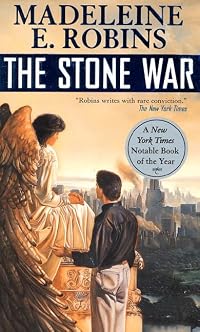
The Stone War
by Madeleine E. Robins
On This Page
Description
John Tietjen loves New York City like life itself. But while he's out of town at a conference, confused reports come out of the city. Millions of refugees are streaming out, each bearing contradictory tales of fire, earthquake, explosions, collapse. Making his perilous way back, he gathers a few survivors and establishes a shelter. But the full nature of the catastrophe is still unclear.Tags
Recommendations























Member Reviews
While away on a business trip, New Yorker John Tietjen learns that something has happened to his city. Fleeing survivors tell a garbled story of widespread destruction and violence, but it's not until Tietjen fights his way into the city that he gains some sense of New York City's apocalyptic fate -- and what he can do to stand against it.
The Stone War was excellent and unflinching. Every time the possibility for a pat or cliched resolution arises, the novel resolutely turns away and pushes deeper into the dark and unpredictable. And what's marvelous is that, despite the horror and the misery, the novel itself isn't grim. Instead, it's a glowing examination about the need for community against the threat of brutality and estrangement. show more I'm not sure I accept the denouement, in which the novel attempts to assign its phantasmagorical terrors to a concrete agent, but I'll agree that the conclusion is consistent with the rest of the book. show less
The Stone War was excellent and unflinching. Every time the possibility for a pat or cliched resolution arises, the novel resolutely turns away and pushes deeper into the dark and unpredictable. And what's marvelous is that, despite the horror and the misery, the novel itself isn't grim. Instead, it's a glowing examination about the need for community against the threat of brutality and estrangement. show more I'm not sure I accept the denouement, in which the novel attempts to assign its phantasmagorical terrors to a concrete agent, but I'll agree that the conclusion is consistent with the rest of the book. show less
This may be one of the most unusual fantasy novels I've ever read. I loved it. It's somewhat-contemporary, and set in a city, and the city is central to the story. Think "Wizard of the Pigeons", or "The City, Not Long After". I'm calling it somewhat contemporary because it's in no way the common fantasy novel setting, with vaguely medieval social and economic qualities. Nor is it what's now called urban fantasy, with a hot babe battling elves, witches or whatever.
It's set in a future New York where crime has driven anyone with any money to live behind guards and gates. Whole blocks are gated to keep the homeless off of the sidewalks. The main character is an architect who loves the city, and who chooses to live without all the show more protections, and is managing. He's out of town on a project when something happens. Refugees pour out of the city, but their reports of what happened are wild and unbelievable. He walks in, and finds things twisted, damaged and changed in ways that are clearly impossible -- yet are. The city is almost empty of people. He hunts for his children, who were with his ex-wife, and then ends up trying to survive in the ruins of the city and help others. It becomes clear that there's no way for rescuers to come into the city, and they also can't leave. The explanation of the city's state gradually emerges.
This is a character-driven novel. The group of people that comes together around him are interesting, and they change and grow as they struggle with the situation. I particularly like the woman who is the other leader of the group. show less
It's set in a future New York where crime has driven anyone with any money to live behind guards and gates. Whole blocks are gated to keep the homeless off of the sidewalks. The main character is an architect who loves the city, and who chooses to live without all the show more protections, and is managing. He's out of town on a project when something happens. Refugees pour out of the city, but their reports of what happened are wild and unbelievable. He walks in, and finds things twisted, damaged and changed in ways that are clearly impossible -- yet are. The city is almost empty of people. He hunts for his children, who were with his ex-wife, and then ends up trying to survive in the ruins of the city and help others. It becomes clear that there's no way for rescuers to come into the city, and they also can't leave. The explanation of the city's state gradually emerges.
This is a character-driven novel. The group of people that comes together around him are interesting, and they change and grow as they struggle with the situation. I particularly like the woman who is the other leader of the group. show less
John loves New York City, which has grown so dangerous that all but the poorest residents hire armed guards and build gates around their neighborhoods. No one, not even his beloved sons, understands his affection for a place everyone else wants to escape. While he is away on business, earthquakes and fires abruptly raze the city. John heads against the tide of refugees (this part of the book is probably the most effective) toward the city, to find his family and discover what happened. He finds the place almost completely abandoned and destroyed, but perseveres in creating a small haven for the few others who did not abandon the city. Unfortunately, the humans are no longer alone in New York City—something monstrous stalks its show more streets. I really liked much of this book, about creating a new community on the bones of the old, but once the monsters (and the psychic boy at the heart of the whole mess) become a major plot point instead of atmosphere, I got frustrated. show less
(Amy) This was an odd choice to read in the week before coming to New York City, set as it is in the aftermath of a series of inexplicable and utterly weird disasters in said locale. So far I haven't actually seen in person any of the things mentioned as having been distorted by bizarre happenings, but I'm sure I'll run across one or two before we leave.
As that implies, the book is about a distaster-ridden Manhattan. It was published in 1999, which gives it a bit of an odd twist - our protagonist, an engineer back when the world was normal, muses at one point that the Trade Center Towers could not have fallen over as they did in this story, which is a little jarring. (Probably true, though - melt and then fall over, that they could do, show more but just plain fall over sideways, that most likely couldn't have happened.)
It's a decent story, though, if a bit awkwardly told. The pre-disaster setting is a Manhattan so overrun by crime and assorted dangers that virtually everyone lives in security-grilled buildings with armed security guards and never leave the patrolled areas of subway platforms. Then, in an interesting twist, the city's repressed hatred and so on explodes into chaos, warping reality in myriad ways. John Tietjen, the aforementioned protagonist, is off the island at the time, and fights his way back in, hoping to save his family, or failing that, his city.
The base that is set up to attract survivors and rebuild (for except John, no one else seems able to get in, not even the National Guard) soon comes under attack from those who were themselves changed when the city changed, into things bizarre and terrifying. And soon after that, John meets the one responsible for what happened to his city, but finds that he, as so many things, is not what he seems.
( http://weblog.siliconcerebrate.com/zenos-library/2008/03/the-stone-war-madeleine... ) show less
As that implies, the book is about a distaster-ridden Manhattan. It was published in 1999, which gives it a bit of an odd twist - our protagonist, an engineer back when the world was normal, muses at one point that the Trade Center Towers could not have fallen over as they did in this story, which is a little jarring. (Probably true, though - melt and then fall over, that they could do, show more but just plain fall over sideways, that most likely couldn't have happened.)
It's a decent story, though, if a bit awkwardly told. The pre-disaster setting is a Manhattan so overrun by crime and assorted dangers that virtually everyone lives in security-grilled buildings with armed security guards and never leave the patrolled areas of subway platforms. Then, in an interesting twist, the city's repressed hatred and so on explodes into chaos, warping reality in myriad ways. John Tietjen, the aforementioned protagonist, is off the island at the time, and fights his way back in, hoping to save his family, or failing that, his city.
The base that is set up to attract survivors and rebuild (for except John, no one else seems able to get in, not even the National Guard) soon comes under attack from those who were themselves changed when the city changed, into things bizarre and terrifying. And soon after that, John meets the one responsible for what happened to his city, but finds that he, as so many things, is not what he seems.
( http://weblog.siliconcerebrate.com/zenos-library/2008/03/the-stone-war-madeleine... ) show less
In a alternative future close to when this story is written New York has a resurgence of creatures of myth and legend and a collapse of some buildings and normal. John Tietjen is out of the city when it happens but returns to try to find his family. Instead he finds creatures of myth and a very changed world.
It's an interesting story with some interesting moments but there were times I had to re-read bits to try to see what had gone on. It had potential that really didn't seem to be fully realised.
It's an interesting story with some interesting moments but there were times I had to re-read bits to try to see what had gone on. It had potential that really didn't seem to be fully realised.
Ratings
Members
- Recently Added By
Author Information

30+ Works 1,305 Members
All Editions
Common Knowledge
- People/Characters
- John Tietjen ; Barbara McGrath
- Important places
- New York, New York, USA
- Dedication
- For Juliana and Rebecca, my very own citykids.
- First words
- The air was soft and warm; a light breeze belled out at the corners of the block and whisked bits of paper, dust, and cellophane from the trash cans.
- Last words
- (Click to show. Warning: May contain spoilers.)They started back across the Park, empty of shadows.
- Publisher's editor
- Nielsen Hayden, Patrick
- Blurbers
- Palwick, Susan; Sherman, Delia; Lynn, Elizabeth A.; Friesner, Esther M.; Shwartz, Susan
Classifications
- Genres
- Fiction and Literature, Fantasy, General Fiction, Science Fiction
- DDC/MDS
- 813.54 — Literature & rhetoric American literature in English American fiction in English 1900-1999 1945-1999
- LCC
- PS3568 .O2774 .S75 — Language and Literature American literature American literature Individual authors 1961-
- BISAC
Statistics
- Members
- 135
- Popularity
- 241,368
- Reviews
- 6
- Rating
- (3.59)
- Languages
- English
- Media
- Paper, Ebook
- ISBNs
- 4
- ASINs
- 1