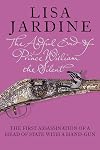
The Awful End of Prince William the Silent: The First Assassination of a Head of State with a Handgun (Making History)
by Lisa Jardine
On This Page
Description
"The assassination of Prince William of Orange by a French Catholic in 1584 had immediate political consequences and a profound effect on the course of history. It was a serious setback for Protestants in the Netherlands, who were struggling for independence from the Catholic rule of the Hapsburg Empire. But the crime's ramifications were even more earth-shattering, for it heralded the arrival of a new threat to the safety of world leaders and the security of nations: a pistol that could show more easily be concealed on one's person and employed to lethal effect at point-blank range. In this provocative, fascinating, and enormously engaging work, noted author and historian Lisa Jardine brilliantly recounts the brazen act of religious terrorism that changed everything--and explores its long and bloody legacy, from the murder of Abraham Lincoln in 1865 to the slaying of Archduke Ferdinand in 1914, to the plague of terror and violent zealotry that infects our world today."--Publisher's website. An account of the 1584 shooting of the Protestant Prince William of Orange by a French Catholic, assessing the struggle of the Netherlands to overthrow Catholic rule, and its implications for other heads-of-state fearful of assassination. show lessTags
Recommendations

























Member Reviews
An interesting short history of a significant event in Dutch (and European) history of which I doubt many Americans are aware -- the first assassination of a head of state by a handgun. Religion (the Protestant states of Holland seeking independence from Spanish Roman Catholicism) plays a large role here. While Jardine explicates the actual event and its direct consequences expertly, and her musings on assassinations, guns, and fear are interesting, the book is not "big" enough to fully support some of her attempts to bring in public interest through comparisons to the Palestinian statehood effort and the post-9/11 security/fear/propaganda matrix. Nonetheless an excellent guide to an event which is worthy of some thought, particularly show more in light of recent shootings. show less
http://nhw.livejournal.com/960271.html
Got a battered second-hand copy of this cheap off the internets after reading Veronica Wedgwood's biography of William (which is not cited even once by Jardine). I think this is much the better book; it's also about a third the length. Where Wedgwood breathlessly tells of the exploits of her hero, Jardine analyses how events were reported and used in the wider geopolitical context. She makes much of the use of the new pistol technology for William's assassination, though I'm not totally convinced by her stress on the novelty of the murder method: in fact it was the second such attempt on William's life in just over two years, and it was more than two decades since the Duc de Guise had been shot by a show more pistol-wielding assassin.
What surely is unusual is the economic aspect to the crime - the fact that Philip II of Spain had put a massive price on William's head, and indeed paid out to the family of the assassin (who was himself put to death in a gruesome public execution in Delft lasting several days). Even then, a policy of decapitation of unfriendly regimes by physical attack on their leaders was regarded as particularly controversial, and the murder clearly damaged Philip II's already poor reputation still further. (The more modern parallels are obvious.)
Jardine concentrates a lot more than Wedgwood on the English aspects of the killing, though she goes in circles a bit (especially about the death of Sir Philip Sidney) and pulls in contemporary references in a way that will make this book feel rather dated before many years have passed. On the whole, though, I found her presentation of the historical details more lucid and interesting than Wedgwood's.
Anyway, a good quick read about an interesting part of European history. show less
Got a battered second-hand copy of this cheap off the internets after reading Veronica Wedgwood's biography of William (which is not cited even once by Jardine). I think this is much the better book; it's also about a third the length. Where Wedgwood breathlessly tells of the exploits of her hero, Jardine analyses how events were reported and used in the wider geopolitical context. She makes much of the use of the new pistol technology for William's assassination, though I'm not totally convinced by her stress on the novelty of the murder method: in fact it was the second such attempt on William's life in just over two years, and it was more than two decades since the Duc de Guise had been shot by a show more pistol-wielding assassin.
What surely is unusual is the economic aspect to the crime - the fact that Philip II of Spain had put a massive price on William's head, and indeed paid out to the family of the assassin (who was himself put to death in a gruesome public execution in Delft lasting several days). Even then, a policy of decapitation of unfriendly regimes by physical attack on their leaders was regarded as particularly controversial, and the murder clearly damaged Philip II's already poor reputation still further. (The more modern parallels are obvious.)
Jardine concentrates a lot more than Wedgwood on the English aspects of the killing, though she goes in circles a bit (especially about the death of Sir Philip Sidney) and pulls in contemporary references in a way that will make this book feel rather dated before many years have passed. On the whole, though, I found her presentation of the historical details more lucid and interesting than Wedgwood's.
Anyway, a good quick read about an interesting part of European history. show less
An entertaining appetizer about a shot heard across a continent. Lisa Jardine, as always, does not disappoint and introduces her readers to the time of the Dutch revolution, its leaders and opponents and the new weapons technology. Given the limited number of pages, the book can only glance at William's life and the topic of renaissance political assassinations. She devotes two out of six chapters to the English repercussions - too much for my taste. The space might have been better used to discuss other political assassinations from John the Fearless to Henry I, Duke of Guise, to Wallenstein. Instead she compares the murder of William to today's terrorist attacks, which is a major category error both in motive, weapon and target. show more William the Silent was killed by a Catholic infiltrator (like an original Assassin) most probably for monetary reasons. Ultimately, the assassination was counterproductive, as William was, on the verge of losing influence, turned into a martyr and topic of the Dutch anthem "Het Wilhelmus". show less
An interesting short microhistory about the first assassination of a head of state by handgun. Readable and well researched.
In some ways this is less about the actual assassination of William the Silent than about the context of his death, including the means (the relatively new wheel-lock pistol), the political climate, and the religious conflicts of 16th-century Europe. The assassination itself occupies a very small portion of this volume.
Those who did not take a survey course on European or British history or the Rennaisance, or those who had trouble understanding the political machinations that preceded those fictionalized in Neal Stephenson's Baroque Cycle, will find the first chapter useful; it provides a not-too-dry overview of the Protestant/Catholic conflicts, particularly in relation to the Low Countries. Chapter 2 treats the murder itself. After show more that, the order of the book is puzzling. It backtracks to discuss a previous attempt on William's life, then a discourse on the history and characteristics of the wheel-lock pistol, then two chapters with non-linear chronologies on Elizabeth I, followed by primary sources in the appendices (most notably, the fatwa against William issued by Phillip II).
The chapters that actually narrate daily events are more interesting than the chapters that present a broader historical portrait; the latter suffer as all surveys do from being a blur of names and policies. That the text is not chronological adds some confusion and difficulty orienting oneself. The author's comparisons of the events to contemporary political conflicts, while interesting, might better have been served up as a final chapter that emphasized both the historical import of the assassination and its contemporary relevance. Still and all, this was an enjoyable book, and I'll watch for more from Lisa Jardine in the future. show less
Those who did not take a survey course on European or British history or the Rennaisance, or those who had trouble understanding the political machinations that preceded those fictionalized in Neal Stephenson's Baroque Cycle, will find the first chapter useful; it provides a not-too-dry overview of the Protestant/Catholic conflicts, particularly in relation to the Low Countries. Chapter 2 treats the murder itself. After show more that, the order of the book is puzzling. It backtracks to discuss a previous attempt on William's life, then a discourse on the history and characteristics of the wheel-lock pistol, then two chapters with non-linear chronologies on Elizabeth I, followed by primary sources in the appendices (most notably, the fatwa against William issued by Phillip II).
The chapters that actually narrate daily events are more interesting than the chapters that present a broader historical portrait; the latter suffer as all surveys do from being a blur of names and policies. That the text is not chronological adds some confusion and difficulty orienting oneself. The author's comparisons of the events to contemporary political conflicts, while interesting, might better have been served up as a final chapter that emphasized both the historical import of the assassination and its contemporary relevance. Still and all, this was an enjoyable book, and I'll watch for more from Lisa Jardine in the future. show less
Interesting take on how modern handguns changed politics and head of state security measures. The assassination of William of Orange is described in great detail, though not with the greatest precision (many a reader will walk away thinking Antwerp is a Dutch city). The perspective is unabashedly Anglo-centric, and it did feel odd to be informed almost exclusively about the repercussions on English politics of a fact that impacted millions of people on the Continent. Generally it felt like a university paper that was turned into a short book because it couldn't decide whether it was going to have the assassination of William of Orange as its topic, or the invention, mechanics and impact of modern handguns.
Cheap at best. No ideas. Nothing. It says that William tried to keep the rebels side unified. What were the conflicts among the rebels. She says almost nothing about this and hence leaves one of his contributions in the dark. William's military efforts ended in failure .Yet the rebels were able to keep Holland and Zeeland as a stable homeland. How? No answer at all. What was the role of Calvinism in all this. She does not say. She does not mention that the Dutch themselves played a significant role in the rebellion but this is barely mentioned.
Over and over again she talks about how a pistol can be hidden. I got that the first time.
Over and over again she talks about how a pistol can be hidden. I got that the first time.
Members
- Recently Added By
Author Information

24+ Works 3,340 Members
Lisa Jardine was born in Oxford, England on April 12, 1944. She studied mathematics and English at university receiving a MA in the literary theory of translation from the University of Essex and a PhD from the University of Cambridge with a thesis on the scientific genius of Francis Bacon. She taught English at Warburg Institute, the University show more of Essex, Cornell University, Cambridge University, and Queen Mary and Westfield College. She wrote several books during her lifetime including Francis Bacon: Discovery and the Art of Discourse, Ingenious Pursuits, Worldly Goods, Global Interests: Renaissance Art Between East and West, and Temptation in the Archives: Essays in Golden Age Dutch Culture. Going Dutch: How England Plundered Holland's Glory won the $75,000 Cundill International Prize in History in 2009. She received a Royal Society medal for popularizing science and was appointed CBE in 2005 for her contribution and commitment to state education. She died of cancer on October 25, 2015 at the age of 71. (Bowker Author Biography) show less
Common Knowledge
- People/Characters
- William I, Prince of Orange (William the Silent)
Classifications
- Genres
- History, Nonfiction, General Nonfiction, Biography & Memoir
- DDC/MDS
- 364.152 — Society, government, & culture Social problems and social services Crime Criminal offenses Offenses against the person Homicide
- LCC
- DH188 .W7 .J37 — History of Europe, Asia, Africa and Oceania Low Countries – Benelux Countries History of Low Countries. Benelux Countries History By period Wars of Independence, 1555-1648
- BISAC
Statistics
- Members
- 230
- Popularity
- 141,099
- Reviews
- 9
- Rating
- (3.32)
- Languages
- Dutch, English, Spanish
- Media
- Paper, Ebook
- ISBNs
- 8
- ASINs
- 4