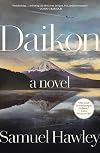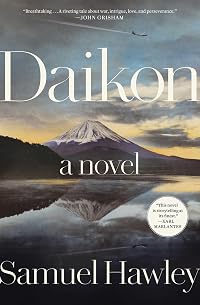
Daikon: A Novel
by Samuel Hawley 
On This Page
Description
"A sweeping and suspenseful novel of love and war, set in Japan during the final days of World War II, with a shocking historical premise: three atomic bombs were actually delivered to the Pacific-not two-and when one of them falls into the hands of the Japanese, the fate of a couple that has been separated from one another becomes entangled with the fate of this strange new device"--Tags
Recommendations































Member Reviews
The premise of this intriguing piece of speculative fiction holds that the Americans actually may have possessed more than two atomic bombs and intended to use all of them to bring Japan to its knees. Hawley suggests that this was indeed plausible. The fiction takes off from there. While on its mission to deliver one of those bombs to a target, the fictitious “Wicked Intent” has engine trouble and is brought down by a suicide attack. The Japanese then retrieve the bomb.
Fortunately, Hawley chose to tell his story from the Japanese perspective. This provides him with a platform to explore the complex human dynamics at play in Japan during the final days of World War II. Its infrastructure had almost totally collapsed. The people were show more starving and desperate. The Navy had no ships. The government was divided on whether to continue or surrender. The Army remained patriotic yet faced overwhelming odds with few options short of providing its soldiers with methamphetamines and increasing reliance on suicide missions. If a Japanese scientist could understand it, however, the recovered American atomic bomb could be used as a tool to protect the homeland, raise morale and maybe even continue the fight to its inevitable and dark conclusion.
The level of detail Hawley provides in his novel is indeed impressive. He explains how the early bombs worked, describes the unknown side effects of radiation poisoning, covers the tension within the military, the longstanding racism in Japanese culture, the brutal thought police and the moral ambiguity surrounding the use of nuclear weapons on civilian populations. In places, the narrative reads more like investigative journalism or detective fiction than a thriller. Unfortunately, these digressions slow the narrative pace and present with characters who often seem emotionally reserved and distant. Notwithstanding these shortcomings, the novel slowly builds tension to a highly satisfying, if outlandish, climax. show less
Fortunately, Hawley chose to tell his story from the Japanese perspective. This provides him with a platform to explore the complex human dynamics at play in Japan during the final days of World War II. Its infrastructure had almost totally collapsed. The people were show more starving and desperate. The Navy had no ships. The government was divided on whether to continue or surrender. The Army remained patriotic yet faced overwhelming odds with few options short of providing its soldiers with methamphetamines and increasing reliance on suicide missions. If a Japanese scientist could understand it, however, the recovered American atomic bomb could be used as a tool to protect the homeland, raise morale and maybe even continue the fight to its inevitable and dark conclusion.
The level of detail Hawley provides in his novel is indeed impressive. He explains how the early bombs worked, describes the unknown side effects of radiation poisoning, covers the tension within the military, the longstanding racism in Japanese culture, the brutal thought police and the moral ambiguity surrounding the use of nuclear weapons on civilian populations. In places, the narrative reads more like investigative journalism or detective fiction than a thriller. Unfortunately, these digressions slow the narrative pace and present with characters who often seem emotionally reserved and distant. Notwithstanding these shortcomings, the novel slowly builds tension to a highly satisfying, if outlandish, climax. show less
What might have happened had the Enola Gay not made it to Hiroshima, but instead an American B-29 carrying an atomic bomb crash landed in Japanese territory in 1945? In "Daikon," Samuel Hawley imagines a scenario in which Keizo Kan, a Japanese physicist, is ordered to examine a device found in the aforementioned plane's wreckage. Keizo had previously worked in a laboratory where he and his colleagues tried and failed to enrich uranium. He is stunned when he sees what the Americans have accomplished. It takes him a while to understand how this bomb was designed to cause maximum devastation.
"Daikon" is a well-researched novel that describes in harrowing detail the destruction of Hiroshima and Nagasaki. However, it also focuses on the show more third unexploded bomb that some Japanese leaders are eager to use against their adversaries. The author delves into the mindset of a nation governed by men who are obsessed with conquest and are willing to sacrifice countless Japanese lives rather than suffer the humiliation of defeat. One of the most loathsome characters is an Imperial Army Officer, Colonel Shingen Sagara, a meth addict and sadist who is descending into madness. He bullies Keizo into doing his will and, with the help of Korean-born Petty Officer Ryohei Yagi, Keizo attempts to configure the third bomb into a weapon against those who created it.
The dialogue is often stilted and some of the events in the book are implausible, but Hawley's thought-provoking tale is compelling and filled with fascinating scientific details. In addition to its emphasis on the war between Japan and America, "Daikon" is a story of romantic love, friendship, and moral predicaments. Should Keizo obey Colonel Sagara's orders or find a way to undermine them? The plot is riveting, the finale is suspenseful, and Hawley evocatively portrays the terrible consequences of murderous hatred. This theme, alas, is all too timely today. show less
"Daikon" is a well-researched novel that describes in harrowing detail the destruction of Hiroshima and Nagasaki. However, it also focuses on the show more third unexploded bomb that some Japanese leaders are eager to use against their adversaries. The author delves into the mindset of a nation governed by men who are obsessed with conquest and are willing to sacrifice countless Japanese lives rather than suffer the humiliation of defeat. One of the most loathsome characters is an Imperial Army Officer, Colonel Shingen Sagara, a meth addict and sadist who is descending into madness. He bullies Keizo into doing his will and, with the help of Korean-born Petty Officer Ryohei Yagi, Keizo attempts to configure the third bomb into a weapon against those who created it.
The dialogue is often stilted and some of the events in the book are implausible, but Hawley's thought-provoking tale is compelling and filled with fascinating scientific details. In addition to its emphasis on the war between Japan and America, "Daikon" is a story of romantic love, friendship, and moral predicaments. Should Keizo obey Colonel Sagara's orders or find a way to undermine them? The plot is riveting, the finale is suspenseful, and Hawley evocatively portrays the terrible consequences of murderous hatred. This theme, alas, is all too timely today. show less
What if the United States had a third nuclear bomb, dropped before Hiroshima, which didn't explode? This well-researched alternate history has enough details to make you wonder if it really could have happened. It begins with the specially-trained crew of the bomber, detailing all their preparations for the drop. The bulk of the book puts us in Japanese culture in 1946, where civilians are on short rations and questioning why their government hasn't accepted the terms of surrender. Some top Japanese Army officers, fanatical patriots, recover the bomb and put their scientists to work on figuring out how to use it against the US.The novel’s main character, Keizo Kan, a scientist who worked on Japan's failed attempts at nuclear weapons, show more is more concerned about the fate of his family who were living in an area destroyed by US incendiary bombs. His wife was part of the Japanese propaganda (á la Tokyo Rose). show less
In Daikon, author Samuel Hawley imagines an alternate WWII where three atomic bombs were created and brought to Japan instead of two, and one of them falls into Japanese hands after an accident. The novel’s main character, Keizo Kan, is a scientist who worked on Japan's failed attempts at nuclear weapons, who gets coerced into helping use the discovered bomb. Hawley’s background in nonfiction is apparent in the copious details and descriptions, but he also brings the thrills while creating a multi-dimensional character in Kan. Daikon should be added to the TBR lists of readers of historical fiction, war stories, and thrillers.
What if the US planned to drop a 3rd bomb on Japan during WWII, yet the mission failed and the Japanese recovered the bomb? Daikon imagines this scenario and the Japanese who championed a return to Japanese imperialism. Within the war story is also a love story.
I didn't know what to expect from this novel, and I was pleasantly surprised at how much I enjoyed it.
I didn't know what to expect from this novel, and I was pleasantly surprised at how much I enjoyed it.
Detailed picture of wartime Japan and insights into construction of the bomb. It is clear that Japan was devastated by wars end. It is the setting for a love story. I found the book interesting and thought provoking.
Plot-based - Interesting and engaging storyline. The writing isn't pretty, but the story of a third atomic bomb is imaginative and seems historically accurate in many ways. The characters are a bit flat. I appreciated the notes at the end about the author's resources.
Members
- Recently Added By
Author Information

11 Works 348 Members
Samuel Hawley is a LibraryThing Author, an author who lists their personal library on LibraryThing.
Awards and Honors
Distinctions
Classifications
Statistics
- Members
- 102
- Popularity
- 316,148
- Reviews
- 8
- Rating
- (4.07)
- Languages
- English
- Media
- Paper, Audiobook, Ebook
- ISBNs
- 6
- ASINs
- 2