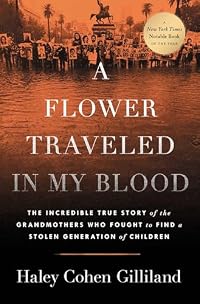
A Flower Traveled in My Blood: The Incredible True Story of the Grandmothers Who Fought to Find a Stolen Generation of Children
by Haley Cohen Gilliland
On This Page
Description
"The epic, true story of the Abuelas de Plaza de Mayo, grandmothers who fought to find their stolen grandchildren during Argentina's brutal dictatorship"-- Provided by publisher.Tags
Recommendations





















Member Reviews
Rating: 4.5* of five
The Publisher Says: For readers of Say Nothing and The Immortal Life of Henrietta Lacks, the epic, true story of the Abuelas de Plaza de Mayo, grandmothers who fought to find their stolen grandchildren during Argentina’s brutal dictatorship.
In the early hours of March 24th, 1976, the streets of Buenos Aires rumbled with tanks as soldiers seized the presidential palace, overthrowing Argentina’s leader. To many, it seemed like just another coup in a continent troubled by them, amid political violence and Cold War tensions. But there was something darker about this new regime. Quietly supported by the United States and much of Argentina itself, which was sick of constant bombings and gunfights, the junta quickly show more launched the “National Reorganization Process” or El Proceso—a bland name masking their ruthless campaign to crush the political left and instill the country with “Western, Christian” values. The dictatorship, which continued until 1983, decimated a generation.
One of the military’s most diabolical acts was the disappearance of hundreds of pregnant women. Patricia Roisinblit was among them, a mother and leftist revolutionary labeled “subversive” and abducted while eight months pregnant with her second child. Patricia gave birth in captivity, making one last call to her mother, Rosa, before vanishing. Her newborn son was also taken, one of hundreds given to police, military families, and dictatorship supporters, while their biological parents were secretly executed and their bodies disposed of. For Rosa and the other mothers in her same situation, the loss was unimaginable; their only solace was the hope that their grandchildren were still alive. United by this faith, a group of fierce grandmothers formed the Abuelas de Plaza de Mayo, dedicated to finding the stolen children and seeking justice from a nation that betrayed them.
A Flower Traveled in My Blood is Rosa and the Abuelas’ extraordinary story, told by a journalist with unique access. With authority and compassion, Haley Cohen Gilliland brings this tale to life, tracing the lives of Patricia, Rosa, and her stolen grandson, Guillermo. As the Abuelas transform into detectives, they confront military officers, sift through government documents, assume aliases to see suspected grandchildren, and even pioneer a groundbreaking genetics test with an American scientist.
A compelling mystery and deeply researched account of a pivotal era in world history, A Flower Traveled in My Blood takes readers on a journey of love, resilience, and redemption, revealing new truths about memory, identity, and family.
I RECEIVED A DRC FROM THE PUBLISHER VIA NETGALLEY. THANK YOU.
My Review: It took me almost three months to read this book. Yes, it's over five hundred pages; I can do that much reading in a day; the reason it's taken me so long is purely emotional.
This horror is another example of why the Global Right is really the international fascist front. There is no hiding from the fact the US government is riddled with people who supported the perpetrators of the heinous, nauseating crimes Author Cohen Gilliland details. And no, the argument that they did not know what was happening is not true...I refer you to the astonishingly and damningly complete endnotes. Not one thing in this book is unsourced. The perpetrators' voices are unheard, though not for lack of trying on her part. Had I done any of these things, I don't know I'd've been willing to talk on the record about them.
Anyone who heard about "Alligator Alcatraz" and did not instantly go into resistance mode needs to read this book. This is what happens when fascist scum grab power. If you can read this and NOT think "I've got to do something, anything, to oppose this publicly", I'm ashamed for and of you. Not reading it is cowardly.
If that sounds like I'm judging you, you're right. I am.
It's long past time to coddle yourself. I assure you, if you think you and yours are safe, they are not. No one's "guilt" matters to people like this.
I was clear about why Author Cohen Gilliland chose to refer to the Madres and the Abuelas by first names, both her stated one of not having confusingly common last names on the page and her unstated one of creating greater intimate connection with them, but it felt more confusing for me. A reporter for The Economist is not going to be so inexperienced as to not think of that; it actually works to increase my readerly investment because it hammers into my brain the Everywoman who went on the Plaza to hold up signs, photographs, and stand there utterly exposed to the unpredictable actions of the gun-wielders was each of these enraged grieving mothers and grandmothers.
Read this story, then resist actively the actions of ICEstapo. show less
The Publisher Says: For readers of Say Nothing and The Immortal Life of Henrietta Lacks, the epic, true story of the Abuelas de Plaza de Mayo, grandmothers who fought to find their stolen grandchildren during Argentina’s brutal dictatorship.
In the early hours of March 24th, 1976, the streets of Buenos Aires rumbled with tanks as soldiers seized the presidential palace, overthrowing Argentina’s leader. To many, it seemed like just another coup in a continent troubled by them, amid political violence and Cold War tensions. But there was something darker about this new regime. Quietly supported by the United States and much of Argentina itself, which was sick of constant bombings and gunfights, the junta quickly show more launched the “National Reorganization Process” or El Proceso—a bland name masking their ruthless campaign to crush the political left and instill the country with “Western, Christian” values. The dictatorship, which continued until 1983, decimated a generation.
One of the military’s most diabolical acts was the disappearance of hundreds of pregnant women. Patricia Roisinblit was among them, a mother and leftist revolutionary labeled “subversive” and abducted while eight months pregnant with her second child. Patricia gave birth in captivity, making one last call to her mother, Rosa, before vanishing. Her newborn son was also taken, one of hundreds given to police, military families, and dictatorship supporters, while their biological parents were secretly executed and their bodies disposed of. For Rosa and the other mothers in her same situation, the loss was unimaginable; their only solace was the hope that their grandchildren were still alive. United by this faith, a group of fierce grandmothers formed the Abuelas de Plaza de Mayo, dedicated to finding the stolen children and seeking justice from a nation that betrayed them.
A Flower Traveled in My Blood is Rosa and the Abuelas’ extraordinary story, told by a journalist with unique access. With authority and compassion, Haley Cohen Gilliland brings this tale to life, tracing the lives of Patricia, Rosa, and her stolen grandson, Guillermo. As the Abuelas transform into detectives, they confront military officers, sift through government documents, assume aliases to see suspected grandchildren, and even pioneer a groundbreaking genetics test with an American scientist.
A compelling mystery and deeply researched account of a pivotal era in world history, A Flower Traveled in My Blood takes readers on a journey of love, resilience, and redemption, revealing new truths about memory, identity, and family.
I RECEIVED A DRC FROM THE PUBLISHER VIA NETGALLEY. THANK YOU.
My Review: It took me almost three months to read this book. Yes, it's over five hundred pages; I can do that much reading in a day; the reason it's taken me so long is purely emotional.
This horror is another example of why the Global Right is really the international fascist front. There is no hiding from the fact the US government is riddled with people who supported the perpetrators of the heinous, nauseating crimes Author Cohen Gilliland details. And no, the argument that they did not know what was happening is not true...I refer you to the astonishingly and damningly complete endnotes. Not one thing in this book is unsourced. The perpetrators' voices are unheard, though not for lack of trying on her part. Had I done any of these things, I don't know I'd've been willing to talk on the record about them.
Anyone who heard about "Alligator Alcatraz" and did not instantly go into resistance mode needs to read this book. This is what happens when fascist scum grab power. If you can read this and NOT think "I've got to do something, anything, to oppose this publicly", I'm ashamed for and of you. Not reading it is cowardly.
If that sounds like I'm judging you, you're right. I am.
It's long past time to coddle yourself. I assure you, if you think you and yours are safe, they are not. No one's "guilt" matters to people like this.
I was clear about why Author Cohen Gilliland chose to refer to the Madres and the Abuelas by first names, both her stated one of not having confusingly common last names on the page and her unstated one of creating greater intimate connection with them, but it felt more confusing for me. A reporter for The Economist is not going to be so inexperienced as to not think of that; it actually works to increase my readerly investment because it hammers into my brain the Everywoman who went on the Plaza to hold up signs, photographs, and stand there utterly exposed to the unpredictable actions of the gun-wielders was each of these enraged grieving mothers and grandmothers.
Read this story, then resist actively the actions of ICEstapo. show less
An extraordinary and important book that looks at the story of Argentina's Disappeared through the lens of a group of mothers whose children were stolen and executed by the government and who dedicated their lives to locating the children of those children, brought to term and handed out like prizes at which point their mothers were tortured and killed. This is a big story, with 20,000 or more people murdered by the regime during the Dirty War. Thousands of those people were pregnant women whose babies were taken. So Cohen Gilliland focused predominantly on one family, with references to some others. There is also a focus on the American doctor who found a way to use genetic tests to identify children where the parents were not show more available (and who also discovered the BRCA gene, god I love scientists!) It was a smart choice. This story is painful at all points, but it is also a story of unshakable love and of service. Cohen Gilliland does not shy away from hard topics here. These identifications were painful for the children who had mostly been raised with love and care and whose identities were shattered. The abuealas also fought to force genetic testing on the children once they were adults, even if they did not want to know, saying that the identities belonged to all of Argentina. This is as thorny as matters of privacy and independence can get, and the author lets the reader feel that, to see this from all sides.
I read this and listened to the audio. I thought Alejandra Reynoso's narration was extraordinary. I did like having the book because there were parts I chose to go back and reread, and it is hard to do that with the audio, but overall if I had to pick I would go with the audio. show less
I read this and listened to the audio. I thought Alejandra Reynoso's narration was extraordinary. I did like having the book because there were parts I chose to go back and reread, and it is hard to do that with the audio, but overall if I had to pick I would go with the audio. show less
A Flower Traveled in My Blood by Haley Cohen Gilliland is an incredibly well-researched and written story about a lost generation of Argentinians. Starting in the mid-1970s, Gilliland follows Rosa's journey as her pregnant daughter is abducted, tortured, and killed by Argentina’s military. Rosa then spends years searching for her missing grandson. The book mixes in the political history of different regimes, stories of other families who faced similar tragedies, the rise of a protest movement, the development of genetic testing and forensic genetics, and the impact of trauma passed down through generations.
The amazing thing about this book is how the author effortlessly combines decades of history, personal stories, and ethical show more questions into something that's so readable and engaging. It's not a dry political science piece, though it does raise important questions about what justice looks like, who identity belongs to, and whether the past should be remembered or forgotten. The book looks at big events while also focusing on individual struggles and emotions, without ever getting confusing or boring.
Even though I knew a bit about the desaparecidos (those kidnapped and killed by the government) and their stolen children, I learned so much more about the systematic plan that extended beyond Argentina. I also didn't realize that scientists made major developments in tests specifically to reconnect families, which are now the basis for today's ancestry service kits.
I enjoy this sort of narrative journalism, and this is one of the best examples that I have read. Highly recommended.
Thank you to NetGalley and Avid Reader Press for the eARC. show less
The amazing thing about this book is how the author effortlessly combines decades of history, personal stories, and ethical show more questions into something that's so readable and engaging. It's not a dry political science piece, though it does raise important questions about what justice looks like, who identity belongs to, and whether the past should be remembered or forgotten. The book looks at big events while also focusing on individual struggles and emotions, without ever getting confusing or boring.
Even though I knew a bit about the desaparecidos (those kidnapped and killed by the government) and their stolen children, I learned so much more about the systematic plan that extended beyond Argentina. I also didn't realize that scientists made major developments in tests specifically to reconnect families, which are now the basis for today's ancestry service kits.
I enjoy this sort of narrative journalism, and this is one of the best examples that I have read. Highly recommended.
Thank you to NetGalley and Avid Reader Press for the eARC. show less
I received this book for free, this does not affect my opinion of the book or the content of my review
A group of fierce grandmothers formed the Abuelas de Plaza de Mayo, dedicated to finding the stolen infants and seeking justice from a nation that betrayed them.
A Flower Traveled in my Blood is an historical and emotional account of how the dictatorships, juntas, and upheavals in 1970s Argentina lead to forty years of searching for disappeared family members and fighting for justice. Written by journalist Haley Cohen Gilliland, it takes into account historical documents and first hand accounting from people who lived it. When I started this, I thought the focus was going on to be solely on the group Abuelas de Plaza de Mayo, but so show more that the reader gets a full understanding, Gilliland gives a full accounting and goes through the timeline of political events that lead to the forming of the Abuelas and the political atmosphere affecting their lives. It gives a fuller picture but also felt too scattered at times, it seemed like the story didn't know what it wanted to focus on. If you know nothing of the history of Argentina at this time, you might appreciate the context but others not looking for a full complete history lesson and more of a singular focus on the Abuelas, may get lost in all the historical players.
The armed men who now roved the city as agents of the dictatorship were at once secretive— driving cars without license plates and obscuring their faces with women’s stockings— and brazen, abducting people off the street in broad daylight.
While the story lays out the historical events and details about the Abuelas, it also has a solid backbone taking the reader through the timeline by following the Roisinblit family. Rosa was one of the founders of the Abuelas and came into it by searching for her daughter, Patricia. Patricia was earlier on politically active with her partner, Jose, but then had a daughter and was pregnant again, trying to stay off the radar. She was taken, her young daughter left, Rosa ends up taking care of her, and thus begins Rosa's search for her. With the government unstable, and others searching for the desaparecidos, we see how out of necessity Rosa and the other older women, join together to try and find their children. So, while we travel through the timeline of historical events starting in the 1970s, El Proceso (National Reorganization Process), Argentine Anticommunist Alliance, Noche de los Lápices (Night of the Pencils), Operation Condor, etc, we also follow the forming of the Abuelas and some of Patricia's, her children, and Rosa's journey.
While the armed forces claimed to be targeting “terrorists,” they employed a conveniently loose definition of what that meant. In their crosshairs were not only militants but those on the further peripheries of the left. Students. Artists. Journalists. Union leaders. Lawyers who defended unions. Musicians. Poets. Priests who ministered to the poor. Nuns who helped desperate families looking for their missing relatives. In the eyes of the dictatorship, they were all “subversives.”
The small beginning of the Abuelas to the organization it grew to was emotional and inspiring. There were the bonds of grief, the infighting from growing pains, the danger from the government and their infiltrators, and their sheer determination to never forget their children. When they start to get help from outside organizations, like the Delegación de Asociaciones Israelitas Argentinas, CLAMOR (Committee for the Defense of Human Rights in the Countries of the Southern Cone), and eventually an American scientist Mary-Claire King, you'll start to feel the power and achievement of collective power.
The junta had tried to make thousands of people disappear, and to erase the identities of their children. But mtDNA was like an indelible ID tag that every mother seals in her children’s cells. What the Abuelas needed to find their grandchildren was already within them. In their blood, just as in Gelman’s poem, traveled a hardy flower, the mitochondrial DNA that contained the story of every mother that had come before them, and every child they had borne—no matter where in the world they had been taken.
The later second half focused on the search for the grandchildren of the missing Abuela's children and how DNA research was the hope they were looking for. An important aspect I liked being touched on was how this didn't just devastate the Abuela's lives but the easy answer of finding DNA matches wasn't easy at all. The grandchildren ranks were full of children who had no idea about their origins, sometimes not wanting to know and others feeling torn up about feeling like they were betraying their adoptive parents by getting to know their biological families. Rosa's family thread continues as they find Patricia's child she was pregnant with when she was taken and he talks about how learning his true origins shredded his life. Injustices like this never happen in a vacuum and I'm glad the generational reverberations were shown.
“It was an honor to scream when everybody else held silence,”
There were at times I thought the organization of the storytelling felt too scattered but if you don't mind a pretty thorough relaying of the political historical events of the time, the eye-opening and emotional journey is worth it. The Roisinblit family doesn't get a full happy ending, no such thing exists in circumstances like this, but you'll learn some of what happened to Patricia. As the story takes us all the way up to present day, you'll learn about some of the court cases trying to get justice for these families forty years later, how the ESMA (Escuela de Mecánica de la Armada) prison is now a museum to try and tell some of the desaparecidos stories and serve as a warning when eyes turn away, and how many grandchildren have been found and how many are still missing. It's a time in history we shouldn't look away from and hopefully, learn from, and this covered the emotional toll of living through such time and standing up to it pretty well. show less
A group of fierce grandmothers formed the Abuelas de Plaza de Mayo, dedicated to finding the stolen infants and seeking justice from a nation that betrayed them.
A Flower Traveled in my Blood is an historical and emotional account of how the dictatorships, juntas, and upheavals in 1970s Argentina lead to forty years of searching for disappeared family members and fighting for justice. Written by journalist Haley Cohen Gilliland, it takes into account historical documents and first hand accounting from people who lived it. When I started this, I thought the focus was going on to be solely on the group Abuelas de Plaza de Mayo, but so show more that the reader gets a full understanding, Gilliland gives a full accounting and goes through the timeline of political events that lead to the forming of the Abuelas and the political atmosphere affecting their lives. It gives a fuller picture but also felt too scattered at times, it seemed like the story didn't know what it wanted to focus on. If you know nothing of the history of Argentina at this time, you might appreciate the context but others not looking for a full complete history lesson and more of a singular focus on the Abuelas, may get lost in all the historical players.
The armed men who now roved the city as agents of the dictatorship were at once secretive— driving cars without license plates and obscuring their faces with women’s stockings— and brazen, abducting people off the street in broad daylight.
While the story lays out the historical events and details about the Abuelas, it also has a solid backbone taking the reader through the timeline by following the Roisinblit family. Rosa was one of the founders of the Abuelas and came into it by searching for her daughter, Patricia. Patricia was earlier on politically active with her partner, Jose, but then had a daughter and was pregnant again, trying to stay off the radar. She was taken, her young daughter left, Rosa ends up taking care of her, and thus begins Rosa's search for her. With the government unstable, and others searching for the desaparecidos, we see how out of necessity Rosa and the other older women, join together to try and find their children. So, while we travel through the timeline of historical events starting in the 1970s, El Proceso (National Reorganization Process), Argentine Anticommunist Alliance, Noche de los Lápices (Night of the Pencils), Operation Condor, etc, we also follow the forming of the Abuelas and some of Patricia's, her children, and Rosa's journey.
While the armed forces claimed to be targeting “terrorists,” they employed a conveniently loose definition of what that meant. In their crosshairs were not only militants but those on the further peripheries of the left. Students. Artists. Journalists. Union leaders. Lawyers who defended unions. Musicians. Poets. Priests who ministered to the poor. Nuns who helped desperate families looking for their missing relatives. In the eyes of the dictatorship, they were all “subversives.”
The small beginning of the Abuelas to the organization it grew to was emotional and inspiring. There were the bonds of grief, the infighting from growing pains, the danger from the government and their infiltrators, and their sheer determination to never forget their children. When they start to get help from outside organizations, like the Delegación de Asociaciones Israelitas Argentinas, CLAMOR (Committee for the Defense of Human Rights in the Countries of the Southern Cone), and eventually an American scientist Mary-Claire King, you'll start to feel the power and achievement of collective power.
The junta had tried to make thousands of people disappear, and to erase the identities of their children. But mtDNA was like an indelible ID tag that every mother seals in her children’s cells. What the Abuelas needed to find their grandchildren was already within them. In their blood, just as in Gelman’s poem, traveled a hardy flower, the mitochondrial DNA that contained the story of every mother that had come before them, and every child they had borne—no matter where in the world they had been taken.
The later second half focused on the search for the grandchildren of the missing Abuela's children and how DNA research was the hope they were looking for. An important aspect I liked being touched on was how this didn't just devastate the Abuela's lives but the easy answer of finding DNA matches wasn't easy at all. The grandchildren ranks were full of children who had no idea about their origins, sometimes not wanting to know and others feeling torn up about feeling like they were betraying their adoptive parents by getting to know their biological families. Rosa's family thread continues as they find Patricia's child she was pregnant with when she was taken and he talks about how learning his true origins shredded his life. Injustices like this never happen in a vacuum and I'm glad the generational reverberations were shown.
“It was an honor to scream when everybody else held silence,”
There were at times I thought the organization of the storytelling felt too scattered but if you don't mind a pretty thorough relaying of the political historical events of the time, the eye-opening and emotional journey is worth it. The Roisinblit family doesn't get a full happy ending, no such thing exists in circumstances like this, but you'll learn some of what happened to Patricia. As the story takes us all the way up to present day, you'll learn about some of the court cases trying to get justice for these families forty years later, how the ESMA (Escuela de Mecánica de la Armada) prison is now a museum to try and tell some of the desaparecidos stories and serve as a warning when eyes turn away, and how many grandchildren have been found and how many are still missing. It's a time in history we shouldn't look away from and hopefully, learn from, and this covered the emotional toll of living through such time and standing up to it pretty well. show less
A Flower Traveled In My Blood, Haley Cohen Gilliland, author; Alejandra Reynoso, narrator
At times, the book is more about the history of Argentina than about the missing victims of the Dirty War. At times it is repetitive, disjointed, and a bit woke, but at no time is it disappointing. This author presents an incredibly detailed history of Argentina’s political landscape, concentrating on the years beginning with the rule of Juan Peron until the present day, but also harkening back further in history to give a thorough overview of the development of its political leadership. She traces the progress of conservative policies as they slowly replaced left-wing policies and led to the changes that took place in the country bringing show more turmoil and tragedy.
By the mid 1970’s, Argentina’s government was growing chaotic. Ruler after ruler was unable to restore the country’s economy and social principles. After Peron was overthrown, for the second time, a military government gained power. With Jorge Rafaél Videla, in 1976, came a regime of terror that began for any and all who opposed him or was deemed a left-wing subversive. He was responsible for the Guerra Sucia, the “Dirty War” in which thousands of those who opposed him were kidnapped, tortured and murdered in the most violent ways. Their whereabouts were unknown and they became the desaparecidos, a growing community of the disappeared. Once taken, they were never seen again. No information was provided for the families as to their whereabouts. Thousands simply disappeared.
Many of the women suffering the monumental loss of family members sought, indefatigably, to find the missing, but to no avail. Finally, they formed a group called the Mothers of the Plaza de Mayo, (Madres de Plaza de Mayo). They staged marches and protests as they sought to bring attention to their cause, which was simply to know the whereabouts and condition of their loved ones. Soon, they realized that not only their children were missing, but so were many grandchildren that had been taken or born in captivity. These women became known as the Associacion Abuelas de Plaza de Mayo, (the grandmothers, worked tirelessly for decades to recover the children).
The barbaric tactics of the military government continued largely until the end of the regime of Reynaldo Bignone and the beginning of Raúl Alfonsin’s term in 1983. He reinstated a more democratic government and as the truth began to be exposed, although those guilty continued to hide their sadistic deeds from the public, the times began to change and justice for the grandmothers began. However, it was not without controversy, since years had passed. The grandmothers and the children’s memories were faulty and many did not want to leave their families, even if they had been obtained by ill-gotten means.
Early on, in an effort to be able to identify and positively find the children or bodies of their relatives, the grandmothers had reached out to Mary-Claire King, a scientist from California whose work on mitochondrial DNA might be able to help them definitively pinpoint their relatives. This woman, an accomplished genetic scientist, was eager to help them. Her work allowed the isolation of genes that could, with nearly 100% success, positively identify their missing children and relatives, if and when they were found. Today she is also known for her discovery and naming of the breast cancer gene, BRCA1, that proved a genetic connection in victims. Her brilliance and accomplishments are well known. She actively works on human rights investigations in many countries. It was the work of Mary-Claire King that allowed the teeth, bones and bodies of the murdered disappeared to be found and identified.
During the time of the Dirty War, those deemed to be subversive were abducted and judged to be guilty, without so much as a trial. Many Jews were the victims of the kidnappings and lootings because antisemitism was wide-spread, although the author did not really make mention of that or dwell on it in the book, except to emphasize that the organization of madres had as one of its founding members, Rosa Tarlovsky de Roisinblit, a Jewish woman whose activist efforts are actually the beginning and major focus of the book. Her daughter and son-in-law were both kidnapped and never seen again. At the time of the kidnapping, her daughter was eight months pregnant. In addition, Jacobo Timerman is briefly mentioned, and he too is a Jewish journalist who exposed the atrocities of the government and was kidnapped and tortured for more than a year. He was fortunate to be released and not thrown, alive, from airplanes to drown in the river below. He was exiled to Israel, eventually.
Because the narrator used a Spanish accent to be authentic, I did not recognize many of the names or words she used, however, after finishing the book, I did some research to identify what I was unable to understand. I think a print book is more advisable, therefore, than an audio, for someone unfamiliar with the Spanish language. The history of Argentina is fascinating, the scientific discoveries that helped uncover the “disappeared” was really interesting, the conflicts of the victims of this terrible time were intense and sometimes had tragic results. Not all the disappeared wanted to be found. Although they realized if they were indeed stolen children, given to others to raise to prevent the spread of subversion, although their own parents might have been brutally tortured and their adoptive parents might be guilty, they were still their parents and they loved them. I wonder how most readers will feel about this. Do you rip a child away from a family they have identified with after years have passed if they are unwilling? Should the child have a say in the matter? What is the child is now an adult? Is the genetic heritage the be-all end-all policy? Is it fair for the grandparents and the children to become political footballs when they are the victims not the villains? Should the parents who took the children, falsifying their adoptions, get away with their crimes? Should the military get away with theirs because they were simply following orders? So many conflicts, some perhaps unexpected, arose. The one certainty that was proven was the barbaric conduct of the government, the military and the other participants, in whatever scheme they were willingly or forced to engage. The stories are heartbreaking, and only a cold-hearted sadist could have carried out the deeds revealed in this book, especially after the world’s awakening to the horrors of The Holocaust of World War II. Yet today, we see a world that is unwilling to condemn sadism and antisemitism, once again, and is supporting those in the Middle East that carried out a heinous, barbaric act of torture and murder that still continues since there are Jewish hostages in captivity being starved to death. Will history condemn them and bring justice to the Jews of Israel someday as they brought justice to the grandmothers? Why are there no major protest marches to accomplish that goal? show less
At times, the book is more about the history of Argentina than about the missing victims of the Dirty War. At times it is repetitive, disjointed, and a bit woke, but at no time is it disappointing. This author presents an incredibly detailed history of Argentina’s political landscape, concentrating on the years beginning with the rule of Juan Peron until the present day, but also harkening back further in history to give a thorough overview of the development of its political leadership. She traces the progress of conservative policies as they slowly replaced left-wing policies and led to the changes that took place in the country bringing show more turmoil and tragedy.
By the mid 1970’s, Argentina’s government was growing chaotic. Ruler after ruler was unable to restore the country’s economy and social principles. After Peron was overthrown, for the second time, a military government gained power. With Jorge Rafaél Videla, in 1976, came a regime of terror that began for any and all who opposed him or was deemed a left-wing subversive. He was responsible for the Guerra Sucia, the “Dirty War” in which thousands of those who opposed him were kidnapped, tortured and murdered in the most violent ways. Their whereabouts were unknown and they became the desaparecidos, a growing community of the disappeared. Once taken, they were never seen again. No information was provided for the families as to their whereabouts. Thousands simply disappeared.
Many of the women suffering the monumental loss of family members sought, indefatigably, to find the missing, but to no avail. Finally, they formed a group called the Mothers of the Plaza de Mayo, (Madres de Plaza de Mayo). They staged marches and protests as they sought to bring attention to their cause, which was simply to know the whereabouts and condition of their loved ones. Soon, they realized that not only their children were missing, but so were many grandchildren that had been taken or born in captivity. These women became known as the Associacion Abuelas de Plaza de Mayo, (the grandmothers, worked tirelessly for decades to recover the children).
The barbaric tactics of the military government continued largely until the end of the regime of Reynaldo Bignone and the beginning of Raúl Alfonsin’s term in 1983. He reinstated a more democratic government and as the truth began to be exposed, although those guilty continued to hide their sadistic deeds from the public, the times began to change and justice for the grandmothers began. However, it was not without controversy, since years had passed. The grandmothers and the children’s memories were faulty and many did not want to leave their families, even if they had been obtained by ill-gotten means.
Early on, in an effort to be able to identify and positively find the children or bodies of their relatives, the grandmothers had reached out to Mary-Claire King, a scientist from California whose work on mitochondrial DNA might be able to help them definitively pinpoint their relatives. This woman, an accomplished genetic scientist, was eager to help them. Her work allowed the isolation of genes that could, with nearly 100% success, positively identify their missing children and relatives, if and when they were found. Today she is also known for her discovery and naming of the breast cancer gene, BRCA1, that proved a genetic connection in victims. Her brilliance and accomplishments are well known. She actively works on human rights investigations in many countries. It was the work of Mary-Claire King that allowed the teeth, bones and bodies of the murdered disappeared to be found and identified.
During the time of the Dirty War, those deemed to be subversive were abducted and judged to be guilty, without so much as a trial. Many Jews were the victims of the kidnappings and lootings because antisemitism was wide-spread, although the author did not really make mention of that or dwell on it in the book, except to emphasize that the organization of madres had as one of its founding members, Rosa Tarlovsky de Roisinblit, a Jewish woman whose activist efforts are actually the beginning and major focus of the book. Her daughter and son-in-law were both kidnapped and never seen again. At the time of the kidnapping, her daughter was eight months pregnant. In addition, Jacobo Timerman is briefly mentioned, and he too is a Jewish journalist who exposed the atrocities of the government and was kidnapped and tortured for more than a year. He was fortunate to be released and not thrown, alive, from airplanes to drown in the river below. He was exiled to Israel, eventually.
Because the narrator used a Spanish accent to be authentic, I did not recognize many of the names or words she used, however, after finishing the book, I did some research to identify what I was unable to understand. I think a print book is more advisable, therefore, than an audio, for someone unfamiliar with the Spanish language. The history of Argentina is fascinating, the scientific discoveries that helped uncover the “disappeared” was really interesting, the conflicts of the victims of this terrible time were intense and sometimes had tragic results. Not all the disappeared wanted to be found. Although they realized if they were indeed stolen children, given to others to raise to prevent the spread of subversion, although their own parents might have been brutally tortured and their adoptive parents might be guilty, they were still their parents and they loved them. I wonder how most readers will feel about this. Do you rip a child away from a family they have identified with after years have passed if they are unwilling? Should the child have a say in the matter? What is the child is now an adult? Is the genetic heritage the be-all end-all policy? Is it fair for the grandparents and the children to become political footballs when they are the victims not the villains? Should the parents who took the children, falsifying their adoptions, get away with their crimes? Should the military get away with theirs because they were simply following orders? So many conflicts, some perhaps unexpected, arose. The one certainty that was proven was the barbaric conduct of the government, the military and the other participants, in whatever scheme they were willingly or forced to engage. The stories are heartbreaking, and only a cold-hearted sadist could have carried out the deeds revealed in this book, especially after the world’s awakening to the horrors of The Holocaust of World War II. Yet today, we see a world that is unwilling to condemn sadism and antisemitism, once again, and is supporting those in the Middle East that carried out a heinous, barbaric act of torture and murder that still continues since there are Jewish hostages in captivity being starved to death. Will history condemn them and bring justice to the Jews of Israel someday as they brought justice to the grandmothers? Why are there no major protest marches to accomplish that goal? show less
Ratings
Members
- Recently Added By
Lists

To Read
133 works; 1 member

Top Five Books of 2025
950 works; 302 members
Author Information
1 Work 153 Members
Awards and Honors
Awards
Distinctions
Common Knowledge
- Original publication date
- 2025-07-15
- People/Characters
- Patricia Julia Roisinblit; Jose Manuel Perez Rojo
- Important places
- Argentina
- Original language
- English
- Canonical DDC/MDS
- 364.982
Classifications
- Genres
- General Nonfiction, History, Nonfiction
- DDC/MDS
- 364.982 — Society, Government, and Culture Social problems and social services Crime Biography And History South America Argentina
- LCC
- HV6322.3 .A7 .C63 — Social sciences Social pathology. Social and public welfare. Criminology Social pathology. Social and public welfare. Criminology Crimes and offenses
- BISAC
Statistics
- Members
- 154
- Popularity
- 212,025
- Reviews
- 5
- Rating
- (4.53)
- Languages
- English
- Media
- Paper, Audiobook, Ebook
- ISBNs
- 6
- ASINs
- 2